About Pentaclethra macroloba (Willd.) Kuntze
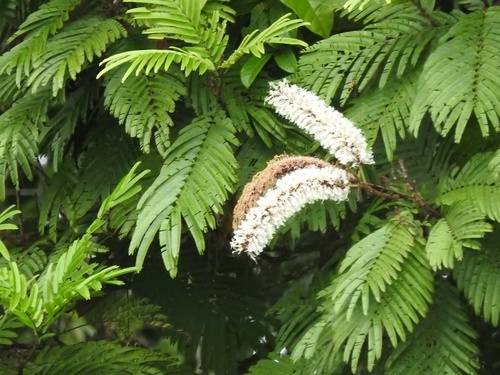
Pentaclethra macroloba (Willd.) Kuntze is a tree whose height and size vary based on its distribution. In Costa Rica, it reaches its largest dimensions, usually growing as a canopy tree that attains a trunk diameter of 130 centimetres (51 in) and a height of 30–40 metres (98–131 ft). In Brazil, its average height is approximately 14 metres (46 ft), while in the eastern Guianas it can grow up to 25 metres (82 ft). In both of these regions, it grows as a subcanopy tree. This size difference may be caused by infraspecific variation. The tree has a dense, broad crown or canopy. Its twigs are brownish-red; young twigs are covered in a fine puberulous indumentum, and twigs do not have spines. Its 0.7–0.8 cm stipules are deciduous, and shaped linear or hair-like. According to a 1983 source, this species occurs in three separate disjunct populations. The first population spans the lowlands of northeast Venezuela through the Guianas, and includes Trinidad and Tobago. The second population grows in western Colombia and Darien Province in eastern Panama. The third population is found in western Panama, Costa Rica, and Nicaragua. A different source states it is introduced to Trinidad and Tobago and the Windward Islands. In Costa Rica and Nicaragua, it primarily grows along the eastern coasts, and does not grow in western Nicaragua. Its populations in Costa Rica are not disjunct, as it grows through the central valleys and in specific patches on the western coast. In eastern Panama, it is the dominant tree in some moist, seasonal, swamp forests in Atlantic coastal areas. It has been collected in Bocas del Toro and Darién Province. In Colombia, it is only found along the Pacific coast. It is a common tree in northern Brazil, and occurs in the states of Acre, Amazonas, Amapá, Pará, and Roraima, and may also occur in the state of Mato Grosso. The 1993 work Catalogue of the Flowering Plants and Gymnosperms of Peru reported it growing in the Department of Loreto, but this record was based on a single voucher specimen; while the specimen was identified as P. macroloba in 1993, it was re-identified as Dimorphandra coccinea in 1997. In Costa Rica, this species grows in lowland forest from sea level to 600 metres above sea level, and is especially abundant in humid, temporarily inundated rainforests. It is restricted to lowlands in Panama, and occurs at an altitude of 0 to 290m in Colombia. In Brazil, it is found in seasonally flooded, closed tropical rainforests called várzea, growing in both igapó (inundated forest) habitat and terra firme forest. It is a hyperdominant lifeform in the Brazilian Amazon River estuary, and forms large continuous monospecific stands. Plants in the Amazon River estuary are exposed to daily tides. In the wooded floodplains of Mazagão, Brazil, the population density is 18 trees per hectare, with a basal area of 49 m2 per hectare. At La Selva Biological Station, P. macroloba makes up 40% of the total basal area and up to 18% of the stem density in some parts of the forest, where it forms monocultural stands. Separate trees of this species synchronize their flowering to occur in the dry season; in Costa Rica, flowering begins in March. Pollinators are attracted by the species' conspicuous white staminodes, rather than its tiny petals. The species is cross-pollinated, and the most common flower visitors are wasps, bees, and ants. Immature fruits develop during the dry season, and ripe fruits form during the rainy season. P. macroloba is evergreen, and does not show specific leaf changes throughout the year, even when flooded. The tree uses at least three different methods of seed dispersal. Seeds are mechanically dispersed when mature pods split open with a pop during rainfall, through a process of elastic dehiscence. This mechanism expels seeds up to ten meters away from the parent tree. This seed maturation and dispersal period falls when rivers overflow their banks and lowlands flood. In 2001, researchers published the discovery that submerged P. macroloba seeds develop air pockets that allow them to float. This was interpreted as evidence that the species has adaptations for water dispersal (hydrochory). Dispersal during daily river flooding and at the peak of river floods lets receding tide waters carry the seeds long distances. Population density of the species increases with distance from the normal edge of inundation. This pattern is thought to occur because floodwaters during high tide carry floating seeds that become trapped behind fallen branches, buttress roots, or other objects, often in large groups. Like many leguminous plants, P. macroloba is a nitrogen fixer that forms a symbiotic relationship with Rhizobium bacteria, which grow in specialized root nodules. While root nodules usually grow on buried roots, P. macroloba individuals growing in swampy areas produce nodules on their aerial roots.