About Hedysarum alpinum L.
Growth Form and Root System
Hedysarum alpinum L. is a perennial herb that grows several erect stems from its caudex, reaching up to 70 centimeters (28 inches) in height. It has a thick, woody taproot and rhizomes capable of producing new stems.
Leaf Characteristics
Its leaves are each divided into multiple leaflets, which grow up to 3.5 centimeters (1.4 inches) long.
Flowers and Pollination
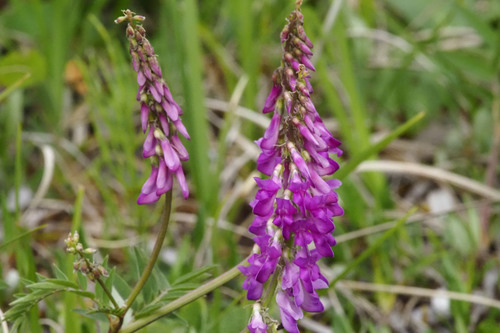
The inflorescence is a dense raceme of flowers that are pink or pale purple, and up to 1.5 centimeters (0.59 inches) long. These flowers are pollinated by insects including bumblebees and honeybees.
Fruit Traits
The fruit is a flat legume pod that narrows between its seeds, and can hold up to 9 seed segments.
Climate and Habitat Range
This species grows in boreal and northern temperate climates, found in tundra and taiga habitats, as well as floodplains, grasslands, and dry forests. It is well adapted to calcareous soils.
Community Status
It is not usually a dominant species, but it is considered dominant in several Alaskan river deltas and plains. It acts as a pioneer species on floodplains recently scoured by water and ice.
Associated Woody Vegetation
It grows alongside willows and birches along waterways, and in forests dominated by spruces.
Associated Grass Species
In grasslands it grows alongside grass species including little bluestem (Schizachyrium scoparium), Canada bluegrass (Poa compressa), and American dunegrass (Leymus mollis).
Large Mammal Food Source
Alpine sweetvetch is an important food source for many animals, including black bears, grizzly bears, American bison, moose, Dall's sheep, and caribou. Bears are skilled at digging up its nutritious roots, and patches of exposed dirt can often be found near growing populations of the plant.
Regional Herbivore Dependence
The roots are a primary food source for grizzly bears in some areas, such as Banff National Park. In parts of Alaska, the plant is a primary food for Dall's sheep, caribou, and muskoxen.
Small Wildlife Use
Many small mammals including voles and short-tailed weasels eat the plant, and a variety of bird species nest in alpine sweetvetch habitat.
Traditional Human Use
Alaska Natives have traditionally used and continue to use this plant as food, especially its fleshy roots. The roots are reported to have a flavor similar to young carrots.
Cultural Names and Uses
The Inupiat people call the plant wild potato and harvest its roots for dietary fiber. For the Dena'ina people, alpine sweetvetch is the most important food source after wild fruit species.
Harvesting Methods
Eskimo people train dogs to locate stores of these roots that have been cached by mice.
Preparation and Storage
The roots can be eaten raw or prepared in a number of ways including boiling, roasting, and frying in grease. They may be stored in lard or oil and eaten when other food supplies are exhausted.
Toxic Relative Distinction
The plant is sometimes confused with its close relative, the toxic Hedysarum mackenzii. Hedysarum alpinum can be distinguished by its longer floral stem, larger flowers, and dark veins on the back of its leaves; Hedysarum mackenzii has much smaller flowers and leaves covered in soft white fuzz.
Seed Toxicity
The seeds of Hedysarum alpinum should not be eaten raw or in large quantities, because they contain L-canavanine, a compound that is thought to have caused or contributed to the death of Christopher McCandless. Research into whether this theory is true is ongoing.