About Trifolium parryi A.Gray
Species Identity and General Habit
Trifolium parryi A.Gray is a short, herbaceous clover species that produces either very short stems or no stems at all, reaching a total height of 4 to 25 centimeters.
Stature Relative to Other Alpine Clovers
Despite its small stature, it is the tallest clover species that grows in alpine tundra, and it bears larger, showier flowers than other alpine clovers.
Growth Form and Rhizomes
This species grows into continuous spreading mats via thin, branching rhizomes.
Root and Caudex Structure
Its leaves and stems grow from a structure called a caudex, and mature plants develop a prominent taproot.
General Leaf Characteristics
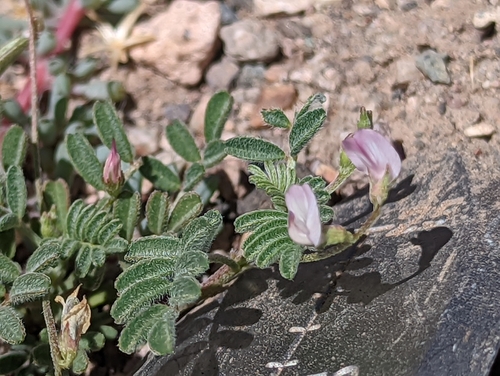
The leaves are compound, bearing the characteristic three leaflets of the Trifolium (clover) genus.
Petiole Characteristics
Leaves attach directly to the base of the plant through small leaf stems called petioles, which range in length from 8 millimeters to 19 centimeters.
Leaflet Characteristics
Each of the three leaflets is 5–43 millimeters long and 1.5–16 millimeters wide, is hairless, has toothed edges near its base, and may be widest at its base, midpoint, or tip.
Peduncle Characteristics
Flower heads rise above the leaf canopy on flower stems called peduncles, which measure 1.8–22 centimeters long and grow from existing stems when stems are present.
Flower Head Structure
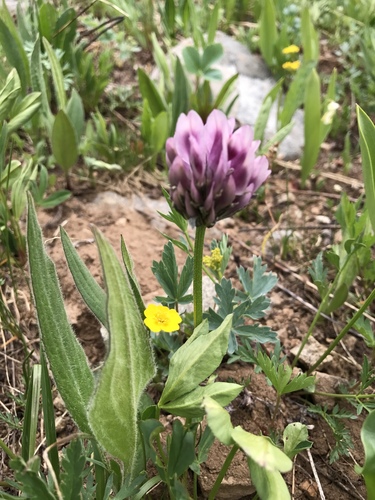
Each rounded flower head holds 5 to 30 very small individual flowers.
Individual Flower Characteristics
Individual flowers are 12–22 millimeters long, colored deep pink to rose, and are distinctly fragrant.
Flowering Period
In its native habitat, flowering occurs from June to September, during summer and early fall.
Fruit Structure
The fruit is a simple carpel commonly called a pod, which holds 1 to 4 seeds.
Fruit Development
As the pods develop and ripen, the flower petals wither, turn yellow-brown, and remain enclosing the pods.
Native Range Overview
Trifolium parryi is native to the Rocky Mountains in the Western United States.
Distribution in Montana
In Montana, it occurs in Madison, Gallatin, Park, and Carbon Counties, all counties surrounding Yellowstone National Park.
Distribution in Idaho
In Idaho, it has only been recorded in Fremont County, which borders Gallatin County, Montana.
Distribution in Wyoming
In Wyoming, it grows in two northern counties (Park and Hot Springs) and two southern counties (Carbon and Albany).
Distribution in Utah and Colorado
It is found across many eastern counties of Utah, and in most mountainous counties of Colorado.
Distribution in New Mexico
In New Mexico, it only grows in Taos County.
Alpine Tundra Habitat
In alpine tundra, Trifolium parryi is adapted to grow in areas covered by snowbanks, even though this snow cover limits its growing season to fewer than 80 days.
Subalpine Habitat
In the subalpine zone, it grows in meadows and along streams and creeks.
Soil and Substrate Preferences
Across all of its habitats, it prefers rocky soils, and will grow on rocky scree slopes formed by landslides and at the bases of cliffs.
Elevation Range
It grows at elevations between 3350 and 4025 meters.
Global Conservation Status
NatureServe evaluated Trifolium parryi as globally secure (G5) in 2001.
Regional Conservation Status
Within its range, it has been ranked as apparently secure (S4) in Montana and vulnerable (S3) in Wyoming, and has not been evaluated in the rest of its distribution.
Pollinator Association
Ecologically, Trifolium parryi relies on the golden-belted bumblebee for pollination.
Pollination and Seed Production
Plants produce more seed in areas with higher populations of this bumblebee species.