About Penstemon hallii A.Gray
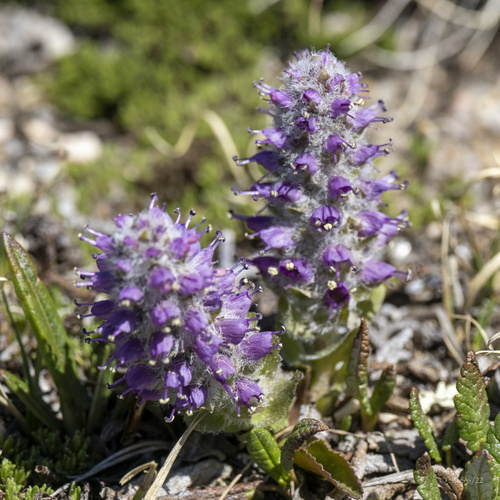
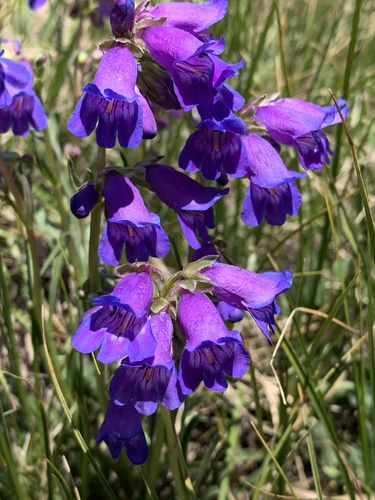
Penstemon hallii A.Gray, commonly called Hall's penstemon, is a moderately sized long-lived penstemon with somewhat woody stem bases. Its stems grow 7 to 25 centimeters (2.8 to 9.8 inches) tall, most often 9 to 16 cm (3.5 to 6.3 in). Stems may grow straight upward, or grow outward before curving upward; they may have glandular hairs near their tips, but are otherwise hairless and not glaucous. The plant sometimes grows into a mat. Basal leaves (growing directly from the plant's base) may be small, missing entirely, or noticeably larger than the leaves growing higher on the stems. Basal leaves and lower stem leaves measure 1.6 to 8.5 cm long and only 3 to 9 millimeters wide. They are shaped spatulate to lanceolate (like a spoon or a spearhead), with tapering bases. Leaf tips are variable: rounded, wide-pointed, or narrow-pointed, and leaf edges have no teeth. Each stem has two to four pairs of leaves attached on opposite sides. Upper leaves measure 2.4 to 5.5 cm long and 2 to 5 mm wide. All leaves are hairless except for their edges, which have antrorsely-scabrous rough hairs that point upward or forward. Hall's penstemon blooms in July and August. The inflorescence grows on the upper part of each stem, and is normally 2 to 7 cm long, though it can be as short as 1 cm. While many sources state all flowers face one direction, the Flora of North America reports that flowers can face all directions. Flowers are arranged in one to seven groups called verticillasters, with two paired attachment points. Each attachment point holds one to four flowers. Flower color is variable: reddish-purple, lilac, pinkish, or pale blue, with reddish-purple floral guide lines and sticky glandular hairs on the outside. Flowers are two-lipped and bell-shaped with abruptly inflated throats, and measure 1.4 to 2.5 cm long overall, with a flower mouth 6 to 7 mm in diameter. Fertile stamens do not extend out of the flower, but the sterile staminode often extends out of the mouth, and is 10 to 15 mm long. The staminode is moderately to densely covered in golden-yellow hairs. The fruit is a capsule 6 to 9 mm long and 4 to 7 mm wide. Hall's penstemon flowers resemble those of Penstemon teucrioides, grayleaf creeping penstemon, another Colorado mountain penstemon species. Unlike Hall's penstemon, which is nearly hairless, Penstemon teucrioides has hairy (but not glandular) leaves and stems, and generally grows above timberline. Hall's penstemon is endemic to the state of Colorado in the United States. It grows in the high mountains of central Colorado, ranging as far north as Jackson County and south almost to New Mexico, reaching Conejos and Archuleta counties. It grows at elevations of 2,800 to 4,000 meters (9,200 to 13,100 feet). The species is restricted to rocky or gravelly areas from just below timberline up into alpine tundra, and may also be found in meadows, on rocky slopes, and along ridges. Enthusiasts grow Hall's penstemon in rock gardens, alpine garden troughs, and specialized alpine houses. Other penstemons with similar growth habits, such as stiffleaf penstemon (Penstemon aridus) and grayleaf creeping penstemon, are also similarly grown in troughs. Alpine gardening specialists describe Hall's penstemon as "Quite showy and not difficult." Like other alpine species, it requires care to ensure its growing substrate drains freely and the plant stays cool. It is grown in Germany, where it is only recommended for gardeners willing to provide protection from cold and damp in winter, and a well-drained, sunny growing space. It can be grown from seed, or propagated by dividing plants in mid-spring (April in the northern hemisphere).