About Ourisia glandulosa Hook.fil.
Taxonomic Identity
Ourisia glandulosa Hook.fil. is a species of perennial herb.
Growth Habit
Its stems creep along the ground, and are densely covered in prostrate, opposite leaves that are often arranged in two distinct rows.
Leaf Petiole Dimensions
The leaf petioles measure 1.8–5.0 mm in length.
Leaf Blade Dimensions
Leaf blades are 4.7–10.6 mm long by 3.0–8.4 mm wide, with a length-to-width ratio of 1.2–1.5:1.
Leaf Blade Shape
Blades are usually narrowly to broadly obovate or spathulate, widest above the middle, with a rounded apex, an attenuate base, and either a smooth edge or occasionally a few irregular notches.
Leaf Surface Characteristics
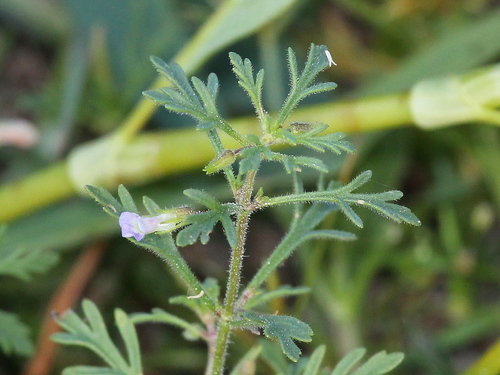
Leaves are sparsely to densely covered with non-glandular hairs near the tip on the upper surface, but are hairless (glabrous) on the lower surface, and are densely dotted with small punctures on both surfaces.
Inflorescence Structure
Inflorescences are erect, densely hairy racemes that grow up to 143 mm long, covered in a mixture of glandular and non-glandular hairs.
Raceme Flower Content
Each raceme holds 1–4 flowering nodes and up to 7 total flowers.
Flowering Node Bracts
Each flowering node bears 1–2 flowers and 2 sessile, clasping bracts that are usually narrowly to very broadly obovate.
Bract Size Variation
The lowest bracts are similar in size and shape to the plant's leaves, measuring 6.0–9.1 mm long and 3.6–8.0 mm wide, and bracts become smaller toward the apex of the raceme.
Flower Pedicel
Flowers grow from a densely hairy pedicel up to 22 mm long, which is covered in a mixture of glandular and non-glandular hairs.
Calyx Structure
The calyx is 6.2–8.6 mm long, irregularly shaped: 3 of its lobes are divided to roughly one-quarter of the calyx's total length, while 2 lobes are divided nearly to the base.
Calyx Indumentum
The calyx is densely hairy, with a mixture of glandular and non-glandular hairs.
Corolla Dimensions and Form
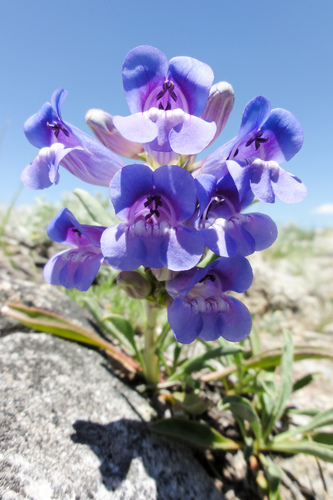
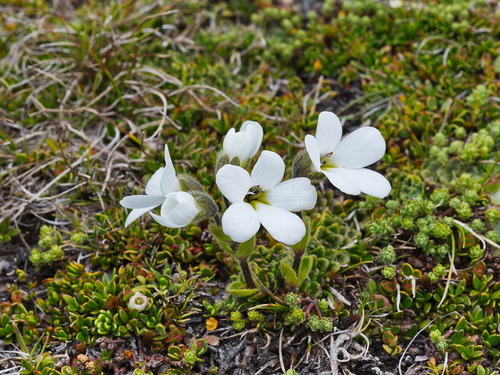
The corolla is 14.5–19.0 mm long including a 6.1–9.8 mm long corolla tube, and is bilabiate and tubular-funnelform.
Corolla Coloration and Surface
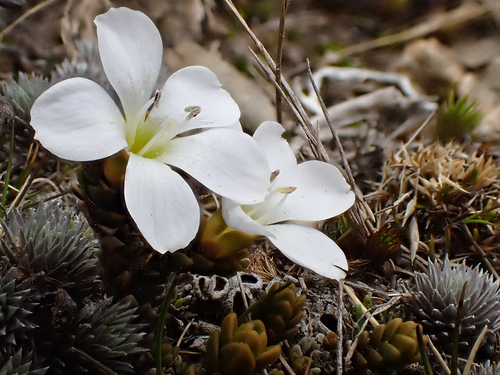
It is glabrous and white on the outside, sometimes with purple coloring near the base, and glabrous and yellow on the inside.
Corolla Lobes
The 5 corolla lobes are 5.0–10.3 mm long, spreading, and shaped obovate to obcordate.
Stamens
There are 4 didynamous stamens, up to 10.0 mm long: two longer stamens reach the opening of the corolla tube, while two shorter stamens remain enclosed inside the corolla.
Staminode
A short staminode up to 1.7 mm long is also present.
Style and Stigma
The style is 4.0–6.0 mm long, does not extend beyond the corolla, and has an emarginate stigma.
Ovary
The ovary is 2.9–4.8 mm long and glabrous.
Fruit Characteristics
Fruits are 5.5–6.0 mm long by 4.3–4.6 mm wide capsules, which open via loculicidal dehiscence, and are borne on pedicels up to 21.7 mm long.
Seed Characteristics
The total number of tiny seeds per capsule is unknown, but individual seeds measure 0.6–1.0 mm long by 0.4–0.6 mm wide, and are shaped rectangular, linear oblong or narrowly oblong, with a single-layered reticulate seed coat.
Phenology
Ourisia glandulosa flowers from December to March, and fruits from January to April.
Chromosome Number
Its chromosome number is 2n=48.
Common Name and Endemism
This species, commonly called New Zealand mountain foxglove, is endemic to the South Island of New Zealand.
Distribution Range
It is widespread and common across most high-elevation areas of Otago, especially around snowbanks, and can also occur in some high-elevation areas of nearby southern Canterbury and Southland.
Habitat and Elevation
It grows in damp, rocky, sheltered sites within herbfields, grasslands and scrub located above the bush line, at elevations ranging from 1,050 to 2,000 m (3,440 to 6,560 ft) above sea level.