About Chionophila jamesii Benth.
Scientific Classification and Growth Form
Rocky Mountain snowlover, scientifically Chionophila jamesii Benth., is a small perennial herb. It usually produces one or two flowering stems, occasionally three.
Stem Size
Stems typically grow 5 to 12 centimeters (2–4.5 inches) tall, and may range from as short as 3 cm (1 in) to as tall as 15 cm (6 in).
Root Structure
It has slightly tuberous roots and short rhizomes.
Stem Pubescence
Stems are usually puberulent, covered in thin, short, erect hairs or backward-pointing hairs, but are occasionally almost hairless.
Leaf Arrangement
Plants produce both basal leaves and smaller, few cauline (stem-attached) leaves.
Basal Leaf Morphology
Basal leaves measure 1.2–7.8 cm long by 0.2–1.8 cm wide, and are shaped like a spoon (spatulate) to a reversed spear head (oblanceolate), sometimes quite narrowly.
Cauline Leaf Morphology
There are only one to three pairs of stem leaves, which measure 8–28 millimeters long by 1–3 mm wide, and are shaped like grass blades (linear) to narrowly lanceolate.
Basal Leaf Autumn Coloration
In autumn, the basal leaves become very noticeable when they turn bright salmon red.
Basal Leaf Similarity to Western Bistort
Before flowering stems develop, the basal leaves of Rocky Mountain snowlover resemble those of western bistort (Bistorta bistortoides), but western bistort leaves are longer with more visible veins.
Inflorescence Structure
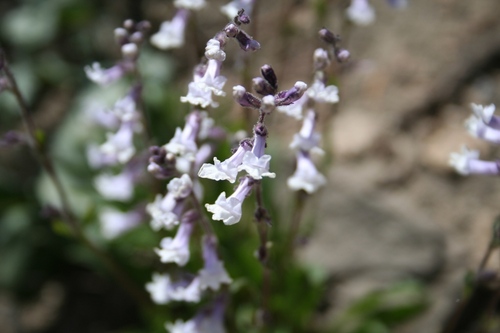
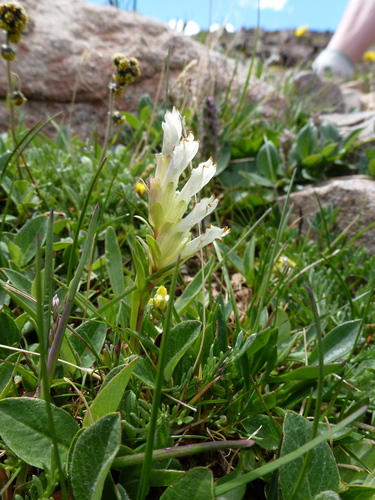
The inflorescence is a spike-like raceme, with all tightly packed flowers facing one direction.
Flower Coloration
Flowers are white, cream, or greenish-white.
Flower Discoloration
Flowers easily darken: even fresh flowers often have brown tips, and preserved specimens turn black.
Inflorescence Dimensions and Pubescence
The inflorescence is 1–5 cm long, holds 2 to 7 flower clusters, and is sparsely hairy, usually with glandular hairs.
Floral Bract Size
Flower-associated bracts are 0.8–1.9 cm long.
Calyx Morphology
Sepals are fused into a funnel-shaped pale green calyx 6–12 mm long, with five triangular lobes.
Corolla Lip Structure
Petals are united into a tube that ends in a mouth with an upper lip and a longer lower lip. The upper lip has two shallow lobes, while the longer, hairy lower lip has three lobes.
Corolla Dimensions and Surface
The full corolla is 1–1.5 cm long, with a hairless outer tube surface.
Staminode Characteristics
Unlike penstemons, the hairless staminode is shorter than the stamens, and measures 5–7 mm.
General Flowering Period
Flowering typically occurs from June to August, and rarely may extend as late as September.
Average Blooming Duration
In one location study, the average blooming period was 20 days, plus or minus nine days.
Fruit Characteristics
The fruit is a capsule 8–9.5 mm long and 4.5–6 mm wide, which splits along the partitions between its chambers, and contains many seeds.
Seed Morphology
Each seed is 1–2.2 mm long, dark brown with a metallic shine.
Overall Geographic Range
Rocky Mountain snowlover is endemic to the Southern Rocky Mountains, found in southern Wyoming, Colorado, and north-central New Mexico. Its range extends from the Medicine Bow Mountains in Wyoming south through Colorado to the Culebra Range in northernmost New Mexico.
Wyoming Distribution
In Wyoming, it grows in a single area spanning the border of Carbon County and Albany County, with the largest single population found on the western slopes of Medicine Bow Peak in Carbon County.
Colorado Distribution
The species is widespread in Colorado's mountains, with most specimens found near the Continental Divide, though some populations occur significantly east or west of the divide.
New Mexico Distribution
To the south, it is only known from Taos County, New Mexico.
Elevation Range
The lowest recorded elevation for the species is 3,300 meters (10,800 ft), and it grows as high as 4,300 meters (14,000 ft) per Ackerfield.
General Habitat Types
Its habitat is mostly moist, gravelly slopes in alpine tundra, though it also occurs in subalpine bogs. Above the timberline, it grows in meadows, scree fields at cliff bases, and clay slope soils.
Snowcover Requirement
It only grows in areas with winter snowcover. 1990s research on Niwot Ridge found the optimal snow depth for the species is 2 to 3 meters (6.5–10 ft), confirming its dependence on deep snowbanks.
Ecological Succession Association
In alpine tundra, Rocky Mountain snowlover is one of many species that colonize the cushions of moss campion (Silene acaulis) after moss campion pioneers newly open ground.
Niwot Ridge First Bloom Date
A 2018 Niwot Ridge study recorded an average first blooming date of 16 July, plus or minus eight days.
Cultivation Requirements
Rocky Mountain snowlover is rarely cultivated in rock gardens, where it is grown in moist but well-drained raised beds with gravelly soil. The only other species in its genus is not in cultivation.
Rarity and Visibility
Though it is the most common of Colorado's rare alpine plants, it is rarely seen by tourists due to the isolated nature of its habitat.
Public Viewing Locations
The easiest locations to view it in its native habitat are along Trail Ridge Road in Rocky Mountain National Park, and in alpine areas near the Mount Blue Sky Scenic Byway.