About Penstemon eatonii A.Gray
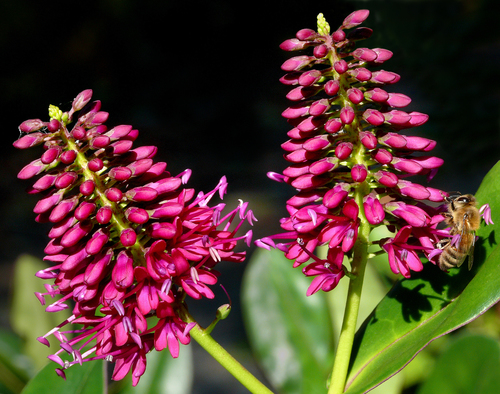
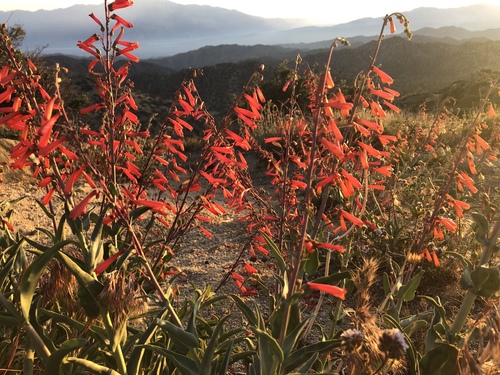
Penstemon eatonii A.Gray, commonly called firecracker penstemon, is a relatively short-lived herbaceous perennial. It produces a few to several medium-sized stems that reach 30 to 100 centimeters (1.0 to 3.3 ft) at maturity. Stems may grow straight upright, or grow outward before curving upward. Their surface is either hairless or covered in backward-facing stiff hairs, and is never waxy or glaucous. This species produces both basal leaves that grow directly from the plant base, and cauline leaves that grow attached to stems. Both types of leaves are a very deep glossy green. Basal leaves and the lowest stem leaves are normally 5 to 10 centimeters (2 to 4 in) long, and may occasionally reach 20 cm (8 in) in length. Their width ranges from 1.5 to 5 cm (0.6 to 2.0 in), and usually does not exceed 2.8 cm (1.1 in). Lower leaves are wider than leaves higher on the stem, and are attached via petioles. Three to five pairs of leaves are arranged oppositely along the stem. Lower leaves are obovate to elliptic (teardrop to ellipse shaped) with smooth edges. Upper leaves are ovate to lanceolate (egg to spear head shaped), attach directly to the stem, and sometimes have a clasping base with extended leaf shoulders that form a heart shape. The inflorescence occupies the upper 9 to 45 cm (3.5 to 17.5 in) of the stem. Each inflorescence holds four to twelve flower groups, with a pair of opposite bracts below each group's attachment point. Each group has two cymes (branched sections of the inflorescence) that usually hold one or two flowers, and occasionally as many as four. The bright flower color contrasts strikingly with the plant's darker foliage, making it a very noticeable wildflower. Flower color is most often described as cardinal red, scarlet, or orange-red. The fused petals of the flower are 24 to 33 millimeters (0.9 to 1.3 in) long. Flowers are nearly radially symmetrical, only weakly divided into two lips, with lobes that do not spread very widely. Penstemon eatonii is native to the southwestern United States, where its range largely covers the southern Great Basin and Colorado River Basin. At its eastern edge, it grows in the westernmost counties of Colorado, from Mesa County south to the Four Corners. It is only found occasionally in the far northwest corner of New Mexico. In Utah, it occurs from the Wasatch Mountains southward. Its range extends through almost all of Arizona, and it only grows in southern Nevada, with one isolated population in northern Humboldt County. In the far west, it reaches California, where it grows in the Mojave Desert, Sonoran Desert, and San Bernardino Mountains. Unconfirmed reports note it may also grow in Wyoming and Idaho, with no specific locations recorded. It grows in a wide variety of habitats including sagebrush steppes, pinyon–juniper woodlands, mountain mahogany scrublands, and Ponderosa pine forests. It has no strong preference for either sloped or flat growing areas. Unlike bee-pollinated penstemons, firecracker penstemon has a much longer, narrower floral tube, and lacks wide lobes at the flower mouth that insects use as landing platforms. Instead, it is pollinated by visiting hummingbirds. Caterpillars of the anicia checkerspot (Euphydryas anicia morandi) feed on firecracker penstemon. A Shoshone person from Nevada interviewed by Beatty Train in the 1930s reported that red-flowered penstemons including Penstemon eatonii could be used to help heal burns. The whole plant is boiled, then used as a wash to support skin healing and reduce pain.