About Plantago raoulii Decne.
Growth Form
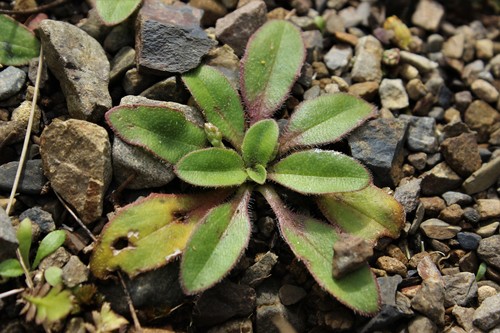
Plantago raoulii Decne. grows as small rosettes with a primary root up to 17 mm thick.
Leaf Count and Shape
Each basal rosette produces up to 21 leaves, which are most commonly narrowly angular-obovate, but may also be angular-obovate, linear, or narrowly rhombic.
Leaf Axil Hairs
Visible, short (less than 11 mm long) rust-coloured hairs are present in the leaf axils of the basal rosette.
Leaf Veins and Dimensions
Leaves have 1 to 3 veins, occasionally 5, are 21 to 270 mm long including the petiole, and up to 27 mm wide.
Leaf Surface Hairiness
They are not punctate, usually sparsely hairy on the upper surface, and usually sparsely or densely hairy on the lower surface.
Leaf Apex and Margins
Leaves typically have an acute apex; their edges are smooth, wavy, or bear up to 14 minute to medium-sized teeth, and are usually sparsely hairy near the teeth.
Petiole Characteristics
The petiole is usually distinguishable from the leaf blade, and grows up to 167 mm long.
Inflorescence Count and Size
Each rosette produces up to 20 erect inflorescences, which can reach 386 mm in length.
Scape Characteristics
The scapes are smooth and range from sparsely to densely hairy.
Spike Characteristics
Spikes are usually linear-ovoid, holding 5 to 32 densely crowded flowers.
Flower Bract Features
Each flower has one small bract that is ovate, broadly ovate, or very broadly ovate; the bract is glabrous except for isolated hairs near the apex, and sometimes on the midrib.
Calyx Measurements and Hairiness
The calyx measures 1.5–2.4 mm long and 1.1–2.7 mm wide, with isolated hairs at the apex and is otherwise glabrous.
Corolla, Stamen and Style Dimensions
The corolla tube is 1.3–2.2 mm long, corolla lobes are 0.6–1.2 mm long, stamen filaments 0.7–2.5 mm long, anthers 0.5–1.0 mm long, and the style 1.1–3.6 mm long and densely hairy.
Ovary Characteristics
The ovary is 0.8–2.0 mm long, containing 4 to 6 ovules.
Capsule Shape and Size
The fruit is a dry, dehiscent capsule with circumscissile dehiscence; it may be ellipsoid, broadly ellipsoid, rhomboid, broadly rhomboid, ovoid, or angular-ovoid, and is widest at or below its middle, measuring 1.8–4.3 mm long and 1.1–2.7 mm wide.
Seed Count and Dimensions
Each capsule holds 4 to 6 rust, brown, or dark brown seeds that are 0.6–2.2 mm long and 0.4–1.0 mm wide.
Seed Shape Variation
Seeds occur in two or three size classes: 2 to 4 seeds are ellipsoid or broadly ellipsoid and rounded, while the top seed and sometimes 2 others are rhomboid, angular-ovoid, or broadly angular-ovoid and angular.
Flowering and Fruiting Periods
Plantago raoulii flowers from November to March and fruits from approximately September to May.
Chromosome Number
Its chromosome number is 2n=48.
Endemic Range
This plantain is endemic to the North and South Islands of New Zealand, where it is widespread and can be locally common.
North Island Distribution
In the North Island, it occurs in the Northland, Auckland (including Inner and Outer Gulf Islands), Volcanic Plateau, Gisborne, Taranaki, and Southern North Island regions.
South Island Distribution
In the South Island, it occurs in the Western Nelson, Sounds Nelson, Marlborough, Westland, Canterbury, Fiordland, Otago, and Southland regions.
Offshore Island Distribution
It also grows on several other islands of the New Zealand archipelago: Manawatāwhi Three Kings Islands, Rakiura Stewart Island, and the Rēkohu Chatham Islands (including Rēkohu Chatham Island, Rangiaotea Pitt Island, and Hokorereoro South East Island).
Habitat and Elevation
Plantago raoulii grows in herbfields, turf, grasslands, and forest in rocky, coastal, dry, or wet areas, across a range of substrates including limestone, mudstone, clay, sand, gravel, and silt, at elevations from 0 to 1,280 m (0 to 4,199 ft) above sea level.