About Ourisia sessilifolia Hook.fil.
Taxonomic Identity
Ourisia sessilifolia Hook.fil. are perennial herbaceous plants.
Growth Form and Stem Structure
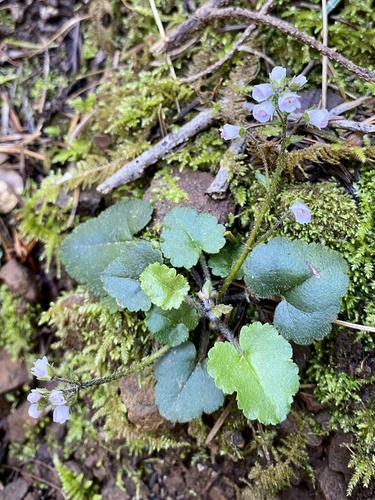
They have creeping stems, with opposite leaves that are tightly packed into rosettes or subrosettes.
Leaf Petiole Dimensions
Leaf petioles measure 3.9–29.8 mm in length.
Leaf Blade Dimensions
Leaf blades are 12.2–59.1 mm long by 9.7–44.5 mm wide, with a length-to-width ratio of 1.1–1.5:1.
Leaf Shape and Margins
Leaves are usually ovate to very broadly ovate, widest below the middle, with a rounded apex, cuneate base, and regularly crenate edges.
Leaf Indumentum
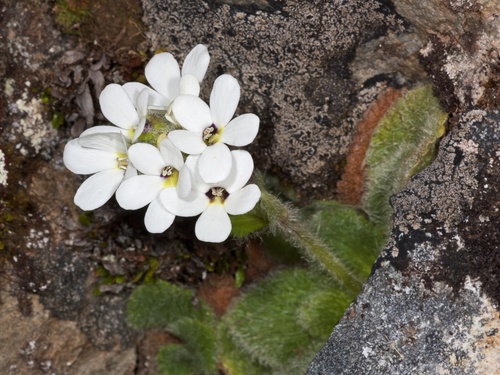
Both leaf surfaces are densely covered in a mix of short glandular hairs and longer non-glandular hairs; this hairiness is particularly prominent on the visible veins of the lower leaf surface.
Inflorescence Structure and Size
Inflorescences are erect, hairy (sometimes densely hairy) racemes that reach up to 202 mm in length, and also carry a mixture of glandular and non-glandular hairs.
Raceme Flower and Node Count
Each raceme holds 2–5 flowering nodes and up to a total of 10 flowers.
Flowering Node Bracts and Flower Count
Each flowering node produces 1–4 flowers and 2 sessile, sometimes clasping bracts that are shaped oblanceolate to narrowly obovate or narrowly elliptic.
Bract Size Gradation
The lowest bracts are similar in appearance to the plant’s leaves, measuring 11.6–18.6 mm long and 4.4–12.2 mm wide, and bracts become smaller toward the apex of the raceme.
Flower Pedicel Characteristics
Flowers are borne on a densely hairy pedicel up to 19.5 mm long, which usually also carries a mix of non-glandular and glandular hairs.
Calyx Structure and Size
The calyx measures 6.3–10.4 mm long, is regular in shape, and usually has all lobes equally divided all the way to the base.
Calyx Indumentum
It is often densely hairy, with a mixture of glandular and non-glandular hairs.
Corolla Overall Dimensions and Form
The corolla is 13.8–21.4 mm long, including a 4.3–9.3 mm long corolla tube.
Corolla Outer Surface Characteristics
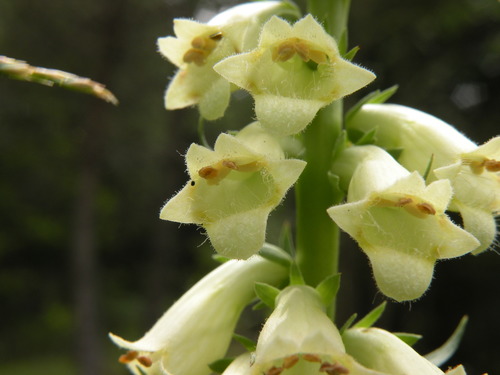
It is bilabiate and tubular-funnelform, glabrous, and white to purplish on its outer surface.
Corolla Inner Surface Markings
The inside of the corolla is purple, with one or three lines of white hairs.
Corolla Lobe Characteristics
Corolla lobes are 4.9–13.9 mm long, spreading, and obovate in shape.
Stamen Structure and Placement
There are 4 didynamous stamens, reaching up to 9.6 mm long: two long stamens extend to the opening of the corolla tube or slightly out of it, while two short stamens remain contained inside the corolla.
Staminode Characteristics
A short staminode 0.8–1.3 mm long is also usually present.
Style and Stigma Characteristics
The style measures 4.3–7.1 mm long, is exserted, and has an emarginate stigma.
Ovary Characteristics
The ovary is 1.7–3.4 mm long and glabrous.
Fruit Characteristics and Dehiscence
Fruits are capsules 4.4–7.6 mm long and approximately 4.1–5.9 mm wide, that open via loculicidal dehiscence; fruit pedicels reach up to 34.0 mm long.
Seed Count per Capsule
Each capsule holds approximately 240 seeds.
Seed Characteristics
Seeds are 0.6–1.1 mm long by 0.4–0.6 mm wide, and have a two-layered, reticulate seed coat.
Flowering and Fruiting Periods
Ourisia sessilifolia flowers from December to April, and fruits from December to March.
Chromosome Number
Its chromosome number is 2n=48.
Common Name and Endemic Range
This species, commonly known as New Zealand mountain foxglove, is endemic to the South Island and Stewart Island of New Zealand.
Distribution by Region
It is found across the South Island in Western Nelson, Canterbury, Westland, Southland and Fiordland, as well as across Stewart Island.
Habitat and Elevation Range
It grows in high-elevation herbfields, meadows, and grasslands located in damp, shaded habitats near rocks, cliffs, and slopes, at elevations between 800 and 2,100 m (2,600 to 6,900 ft) above sea level.