About Penstemon deustus Douglas
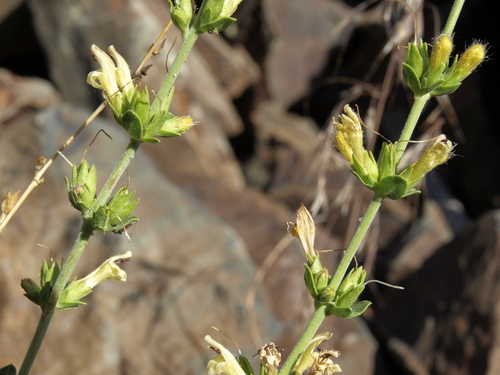
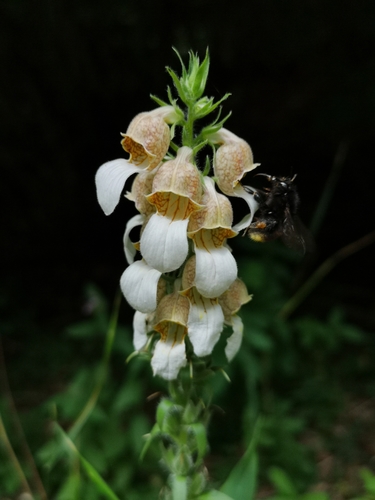
Penstemon deustus Douglas is a subshrub that is mostly herbaceous in growth, but develops woody tissue at its base. Its stems grow from a many-branched woody caudex, whose branches can be up to 1 centimeter thick. The species also produces leafy shoots that do not flower. Stems measure between 6 and 60 cm in length, and are usually taller than 15 cm. While stems can be nearly hairless, they are more often covered in small, stiff, backwards-facing hairs, and they are never waxy. Stems can grow in one of three habits: lying along the ground, growing outward a short distance before curving upward, or growing straight upward. Leaves can be hairless or covered in glandular hairs, and have edges ranging from shallowly to deeply toothed. All leaves are cauline, meaning they attach to stems rather than the base of the plant, and they are not leathery. Like stems, leaves may be hairless or covered in backwards-facing hairs, and can be arranged opposite each other on stems, nearly opposite, or in whorls. Stems typically hold five to nine pairs of leaves, which attach via petioles or directly to the stem. The inflorescence forms at the top of a stem, measuring 6 to 30 centimeters long, and holds five to eleven clusters of flowers. Each cluster has a pair of bracts and two cymes, each holding one to six flowers. The flowers are tubular, two-lipped, and five-lobed. The glandular flowers are cream-colored with dark internal lining, and reach 1.5 cm in length. The range of Penstemon deustus covers parts or most of eight western US states. It grows across much of eastern Washington, and in all of Oregon except the state's northwest corner. In California, it occurs north of San Francisco Bay in the North Coast Ranges, extending into the Klamath Range and Cascades, and may also be found in the northern and central Sierra Nevada. It is extremely widespread across Nevada, recorded in every county except Lincoln County. It is also found across most of Idaho. In contrast, it is only known from two southwestern counties in Montana, three western counties in Wyoming, and only Box Elder County in northwest Utah. This species grows in dry rocky locations, and it is very commonly found growing on basalt rock, though it sometimes grows on limestone. It is used for wilderness revegetation and landscaping projects within its native region. It is valued for its low water requirements and abundant flowers, which attract pollinators including honey bees, bumblebees, sweat bees, and leafcutter bees.