About Digitalis lanata Ehrh.
Growth Form and Rootstock
Digitalis lanata Ehrh. is either a biennial or perennial plant that grows from a woody, horizontal rootstock.
Basal Rosette
Before it sends up its flowering spike, it forms an orderly basal rosette that is neatly arranged around stems that have a purple tinge.
Stem Development
The species usually produces a single upright stem that is more or less evenly covered in leaves, and which is partially ascending at its base; this stem and its flowers usually develop in the plant's second year of growth.
Stem Height
Stems reach 0.3 to 0.6 meters (13 to 26 inches) in height.
General Leaf Traits
Leaves are a moderate green shade, woolly, veined, and covered in white hairs on their underside, and they have a very bitter taste.
Lower and Upper Stem Leaves
Lower stem leaves are 6 to 12 cm long, sometimes growing up to 20 cm, and 1.5 to 3.5 cm wide; upper stem leaves are 4 to 10 cm long, lanceolate in shape, usually with smooth entire margins, and have a distinctive midrib.
Leaf Arrangement and Senescence
Leaves along the stem are arranged alternately, and lower stem leaves wither by the time the plant begins to flower.
Pubescence of Flowers and Stems
Both flowers and stems are also woolly and covered in hairs.
Inflorescence Structure
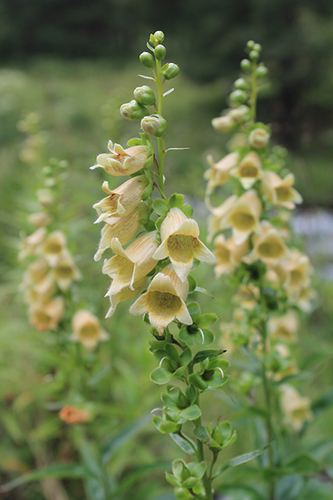
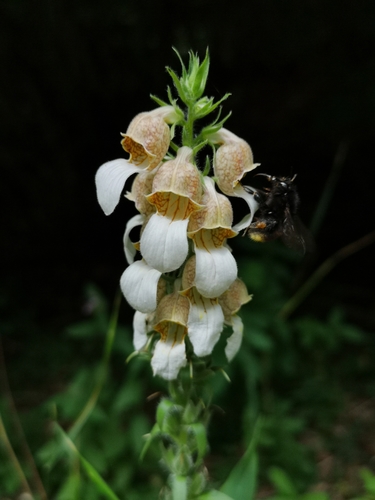
The inflorescence axis is densely covered in tightly matted woolly tomentose hairs, and flowers are densely packed into a pyramidal-shaped raceme.
Flower Appearance
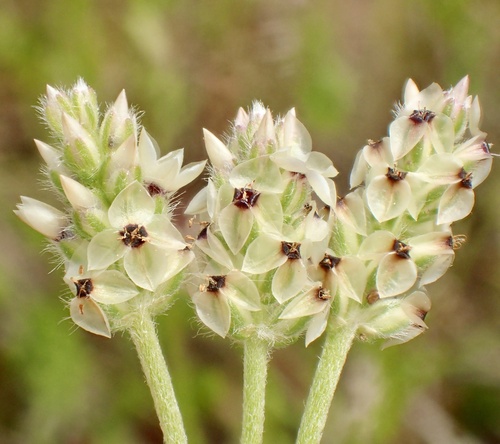
Flowers are tubular and bell-shaped, ranging in color from pale yellow to whitish, marked with brown or violet ferruginous reticulated lines.
Flower Lower Lobe Size
The center lobe of the flower's lower lip measures 8 to 13 mm long.
Fruit Characteristics
The fruit is a conical capsule with a blunt end topped by a short beak.
Seed Morphology
Seeds produced inside the capsule are quadrangular or prismatic in shape, roughly 0.6 mm broad and 1.1 to 1.3 mm long.
Native Range
This species is native to Anatolia and the Balkans, where it occurs in Albania, Bulgaria, Croatia, Greece, Thrace (European Turkey), Hungary, Serbia, Kosovo and Romania, ranging eastward to northern Moldova.
Introduced Range in Europe
It has been introduced to Ukrainian Galicia, Austria, the Czech Republic, Estonia and Germany; its presence in Slovakia is unconfirmed.
Invasive Status in the U.S.
It has become naturalized in a number of northeastern U.S. states. While it has only spread to a small number of counties per state, it is considered potentially invasive or a noxious weed.
U.S. State Regulatory Status
Minnesota lists it as a noxious weed; it is an invasive species of grasslands and woodlands in Wisconsin and Kansas, and has been banned from import into Kansas as of 2001.
U.S. Naturalized States
The U.S. states where it has naturalized include Connecticut, Indiana, Maine, Maryland, Massachusetts, Michigan, Minnesota, Nebraska, New Hampshire, New Jersey, New York, Ohio, Pennsylvania, Vermont and West Virginia.
Canadian Naturalized Range
In Canada, it has naturalized in southern Ontario and Quebec.
Other Potential Naturalized Ranges
It may also be naturalized in Vietnam and the western Himalayas.
Minnesota Phenology
In Minnesota, Digitalis lanata spends its first growing year as a basal rosette. In subsequent years, it flowers in June and July, and its seeds ripen in early to mid September.
Reproductive Traits
Its flowers are perfect, bearing both male and female organs, and are pollinated by bees.
Ukrainian and Moldovan Phenology
In Ukraine and Moldova, it flowers in July and August.
Habitat and Soil Preferences
It is adapted to sunny, warm sites, and prefers partial shade and humus-rich soil, but can also grow in sandy, stony loamy, and clay soils under either dry or moist conditions.
First Year Growth Pattern
During its first growing season, the plant only develops a leaf rosette, with flowering occurring in the second growing season. This gives it particularly high drought resistance during its first year.
Drought Adaptation Mechanisms
Its leaves remain somewhat turgid even at very low leaf water potential, thanks to osmotic adaptation from the synthesis of non-ionic substances within the leaves.
Drought Effects on Photosynthesis
The reduction in photosynthesis caused by drought is reversible a few hours after the plant is watered, though drought stress does reduce the quantum yield of photosystem 2.
Cardiac Glycoside Defense Compounds
More than 70 bitter cardiac glycosides, with five distinct aglycones (digitoxigenin, gitoxigenin, digoxigenin, diginatigenin and gitaloxigenin) are present in the leaves to act as a defense against herbivores.
Greenhouse Cultivation Effects
Greenhouse cultivation increases the yield and concentration of these cardiac glycosides via increased temperature and elevated carbon dioxide concentration.
Medicinal Cardiac Glycoside Content
Digitalis lanata contains powerful cardiac glycosides that may be used to treat heart conditions.
Digoxin Medical Uses
The drug digoxin (also called digitalin) is extracted from this species, and is used to treat heart conditions including atrial fibrillation and cardiac arrhythmias.
Digoxin Cardiotonic Mechanism
Its cardiotonic effect slows atrioventricular conduction, which slows the heartbeat and slightly increases contraction power, a positive inotropic effect.
Congestive Heart Failure Treatment Effects
For congestive heart failure caused by rapid atrial fibrillation, improved circulation helps kidney function, which stimulates urine output, reduces total blood volume, and lowers the workload of the heart.
Veterinary Use Controversy
The use of Digitalis glycosides in veterinary medicine has been controversial, due to its relatively low therapeutic-to-toxicity ratio, divergent physiological responses, variable side effects, and difficulty demonstrating positive therapeutic effects.
Cardiac Glycoside Toxicity Mechanisms
Cardiac glycosides from D. lanata and other natural sources are toxic, producing ventricular automaticity and vagal effects that lead to AV nodal blocking.
Acute Toxicity Symptoms
Acute toxicity causes symptoms including nausea, vomiting, lethargy, confusion, and weakness.
Early Digitalis Medical Research
William Withering was the first to clinically investigate Digitalis species as a treatment for dropsy, publishing a book in 1785 about the potential medical uses of D. purpurea extracts after completing human trials.
Digitalin Discovery
Digitalin was first discovered in the mid-19th century by French scientists Homolle Ouevenne and Theodore Ouevenne.
Digoxin Identification and Isolation
Oscar Schmiedberg identified digoxin in the plant in 1875, and digoxin was first isolated in the 1930s in Britain by Sydney Smith.
Modern Digoxin Production
Digoxin is still extracted from D. lanata today, because industrial synthesis of the compound is too expensive and difficult.
Declining Use of Digitalis Extracts
However, D. lanata extracts are used less frequently now due to their narrow therapeutic margin and high risk of severe side effects.
Replacement Medications
Digoxin is increasingly replaced by newer medications including beta blockers, angiotensin-converting enzyme inhibitors, and calcium channel blockers, and use of digitalis preparations is expected to continue declining as new pharmaceutical treatments become available.
Historical Asylum Use
Throughout the 19th century, asylums used digitalis extracts as sedatives, alongside hyoscine and opiates.
Commercial Digoxin Production Process
Commercial production of digoxin from D. lanata follows this process: plants are grown from seed for two years, harvested, dried in a silo, then the leaves are crushed into a powder, after which digoxin is extracted and purified through chemical processes.