About Paradoxurus hermaphroditus musanga (Raffles, 1821)
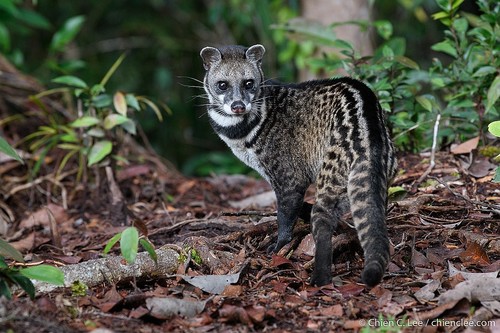
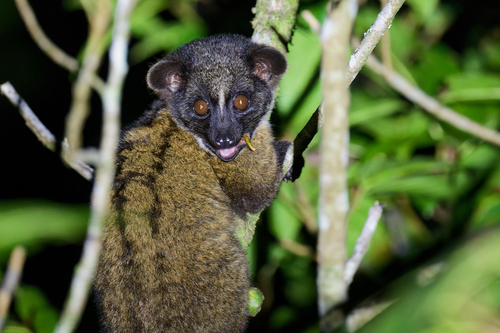
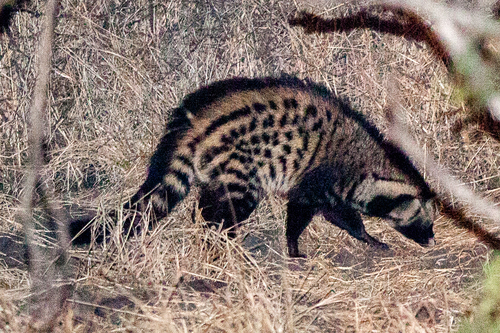
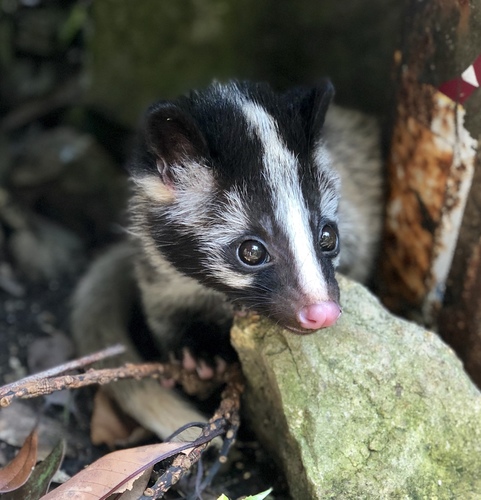
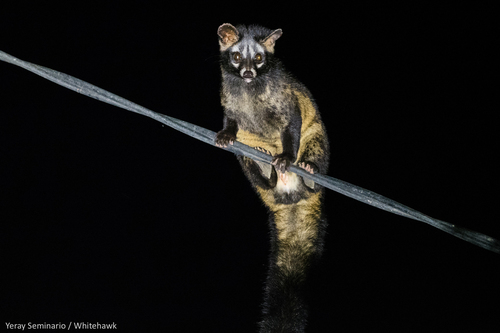
Paradoxurus hermaphroditus musanga, more commonly known as the Asian palm civet, has a long, stocky body covered in coarse, shaggy fur that is typically greyish in colour. It has distinct white markings: a mask across the forehead, a small white patch under each eye, a white spot on each side of the nostrils, and a narrow dark line running between the eyes. The muzzle, ears, lower legs, and distal half of the tail are black, and three rows of black markings cover its body. It reaches around 53 cm (21 in) in head-to-body length, with an unringed tail that is 48 cm (19 in) long. Adults weigh between 2 and 5 kg (4.4 to 11.0 lb). When threatened or upset, it uses its anal scent glands to release a nauseating secretion as a chemical defense.
The Asian palm civet has a wide distribution across South and Southeast Asia, with its range extending from India, Nepal, Bangladesh, Bhutan, and Sri Lanka east to Myanmar, Thailand, Peninsular Malaysia, Singapore, Laos, Cambodia, Vietnam, China, the Philippines, Borneo, and the Indonesian islands of Sumatra, Java, Bawean, and Siberut. It most commonly inhabits primary forests, but also lives at lower population densities in secondary forests and selectively logged forests. This species has been introduced to Irian Jaya, the Lesser Sunda Islands, Maluku, and Sulawesi, and its presence in Papua New Guinea remains uncertain.
Asian palm civets are believed to be solitary animals, only gathering briefly during the mating season. They are both terrestrial and arboreal, with a strictly nocturnal activity pattern that peaks between late evening and after midnight. They are generally active from dawn until 4:00 in the morning, and are less active on nights with a bright full moon. Scent marking behavior and olfactory responses to different excretions, including urine, feces, and perineal gland secretion, differ between males and females. Dragging the perineal gland to leave secretion on surfaces is the most common scent marking method observed in both sexes. The length of an olfactory response varies based on both the individual's sex and the type of excretion being examined. Asian palm civets can distinguish between different animal species, different sexes, and familiar versus unfamiliar individuals by the odor of perineal gland secretion.
Because of the species' solitary, nocturnal habits, very little is known about its reproductive processes and behavior. The only recorded direct observation of mating occurred in March 2010, when a pair of Asian palm civets was seen attempting to mate on a tree branch. The pair copulated for approximately five minutes total, during which the male mounted the female 4 to 5 times. After each mounting, the pair separated for a few moments before repeating the process. After finishing mating, the pair frolicked together for some time, moving between branches in the tree. The two individuals separated after roughly six minutes, moving to separate branches to rest.