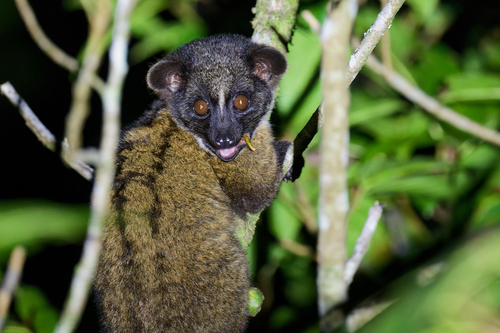
About Arctogalidia trivirgata (Gray, 1832)
Common and Scientific Names
The small-toothed palm civet, scientifically named Arctogalidia trivirgata, is also commonly called the three-striped palm civet.
Native Habitat Range
It is a viverrid native to dense forests across Southeast Asia and the easternmost part of South Asia, specifically Northeast India.
Geographic Distribution
Its range extends from the Indian state of Assam through Indochina, the Malay Peninsula, and Singapore, and also includes Sumatra, Bangka, Java, Borneo, and many small nearby Indonesian islands.
Taxonomic History
John Edward Gray published the first formal scientific description of this species in 1832, based on a zoological specimen from the Maluku Islands held in the collection of the Rijksmuseum van Natuurlijke Historie in Leiden, Netherlands.
Genus Classification
This species is the only member of the monotypic genus Arctogalidia.
Genus Name Etymology
The genus name Arctogalidia translates to 'bear-weasel', derived from the ancient Greek roots arkto- meaning 'bear' and galidia meaning 'little weasel'.
Specific Epithet Etymology
The specific epithet trivirgata means 'three-striped' in Latin.
Body Size
By the standards of its family, the small-toothed palm civet is mid-sized.
Body Measurements
It typically weighs 2.4 kg (5.3 lb), with a body length of 53 cm (21 in) plus a 58 cm (23 in) tail.
Fur and Base Coloration
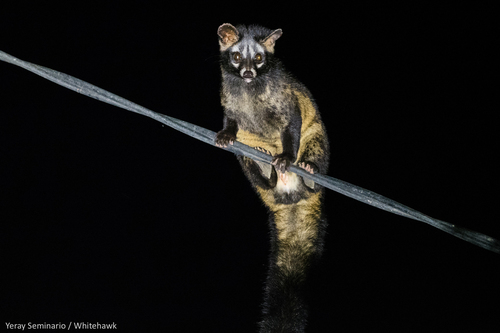
It has short fur that is generally blackish grey, tawny, or buff; the head is a darker greyish tawny.
Distinctive Body Markings
It has black paws and three black longitudinal stripes running along its back.
Facial Markings
Its muzzle is brown, with a white streak that stretches from the nose up to the forehead.
Scent Gland Characteristics
Only females possess a perineal scent gland, which is located near the vulva.
Diet
The small-toothed palm civet is an omnivore with a varied diet, which generally includes insects, small mammals, nesting birds, fruits, frogs, and lizards.
Behavioral Traits
Like other palm civets, this species is solitary, arboreal, and nocturnal.
Reproductive Cycle Basics
Its gestation period lasts 45 days, and the average litter size is 3.
Offspring Birth Details
Offspring are born in dens built in trees.
Offspring Development Milestones
Young civets open their eyes at 11 days old and are weaned at two months of age.
Breeding Frequency
This species can produce two litters per year, and has no fixed mating season.
Lifespan
It can live up to 11 years.
Primary Threats
Like many forest-dwelling animals native to Southeast Asia, the small-toothed palm civet is primarily threatened by deforestation.