About Civettictis civetta (Schreber, 1776)
Coat and Markings
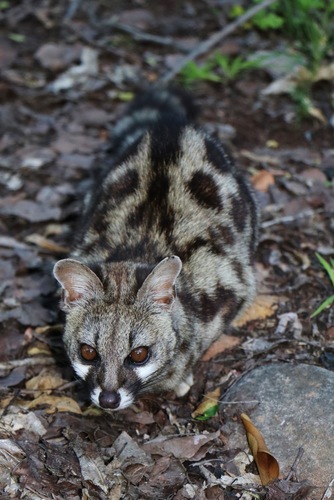
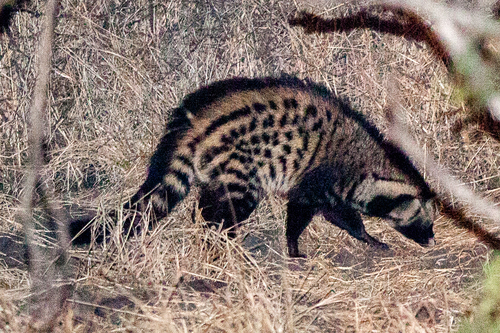
The African civet, scientifically named Civettictis civetta (Schreber, 1776), has a coarse, wiry pelage that ranges in color from white to creamy yellow to reddish across the back. Its distinct stripes, spots, and blotches are deep brown to black. Prominent horizontal lines mark the hind limbs; spots are usually present on the midsection, and these fade into vertical stripes above the forelimbs.
Head and Crest
It has a pointed muzzle, small rounded ears, a black band across its small eyes, and two black bands encircling its short, broad neck. An erectile dorsal crest runs along the spine from the neck to the base of the tail, and the hairs of this crest are longer than the rest of the animal’s fur.
Skull and Bite
Its skull has a well-developed sagittal crest that provides a large attachment area for the temporal muscle, while the robust zygomatic arch offers a large attachment area for the masseter muscle. This musculature paired with a strong mandible gives the African civet a powerful bite. Its dental formula is 3.1.4.2 / 3.1.4.2.
Paws and Claws
It has compact black paws with hairless soles, five digits on each forepaw, where the first toe sits slightly set back from the others. Its long, curved claws are semi-retractile.
Size and Weight
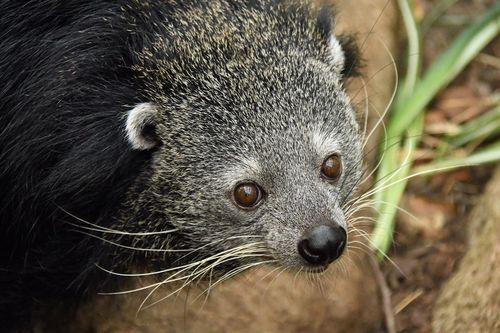
Head-and-body length ranges from 67 to 84 cm (26 to 33 in), with a tail measuring 34 to 47 cm (13 to 19 in) long. Average weight falls between 11 and 15 kg (24 to 33 lb), with a total weight range of 7 to 20 kg (15 to 44 lb). It is the largest viverrid found in Africa; among all living viverrids, only the binturong is likely heavier.
Shoulder Height
Average shoulder height is 40 cm (16 in).
Perineal Glands
Both males and females have perineal and anal glands, which are larger in males. In males, perineal glands are located between the scrotum and penis; in females, they are located between the anus and vulva.
Habitat
African civets are native to central and southern Africa, where they typically sleep during the day in tall grasses near water sources. They most often inhabit savannahs, forests, and sometimes areas near rivers, since tall grasses and thickets provide the cover they need during daytime.
Protected Areas
They have been recorded in multiple protected areas across the region: in Guinea’s National Park of Upper Niger during 1996 to 1997 surveys; in Gabon’s Moukalaba-Doudou National Park, photographed near forested areas during a 2012 survey; in Batéké Plateau National Park, recorded in gallery forest along the Mpassa River during surveys from June 2014 to May 2015; in the Republic of Congo’s Odzala-Kokoua National Park within the Western Congolian forest–savanna mosaic during 2007 surveys; and in the transboundary Dinder–Alatash protected area complex spanning Sudan and Ethiopia during surveys from 2015 to 2018. They are also frequently spotted in Ethiopia’s northern Degua Tembien massif.
Civetries
African civets defecate in large communal piles called latrines, or specifically civetries. Civetries contain fruit, seeds, insect exoskeletons, millipede rings, and occasionally clumps of grass. The role of these latrines in seed dispersal and forest regeneration remains under active research.
Scent Marking
Like felids, male African civets scent mark by spraying urine backwards. They are typically solitary animals, and use secretion from their perineal glands to mark territories around their civetries. 96.72% of these markings lie along common routes and paths within 100 meters of civetries.
Defensive Behavior
When threatened, an African civet raises its dorsal crest to appear larger, making it more formidable and less appealing to attack; this is a defensive behavior against predators.
Breeding
Captive female African civets are polyestrous. Mating sessions last 40 to 70 seconds. In Southern Africa, African civets likely mate between October and November, and females give birth during the rainy season between January and February. The average lifespan of a captive African civet is 15 to 20 years.
Nesting
Females build nests, usually in dense vegetation and often in a hole dug by another animal. Females typically give birth to one to four young.
Young Development
The young are born at a more advanced developmental stage than the young of most carnivores: they are covered in short dark fur and can crawl immediately after birth. The young leave the nest after 18 days, but remain dependent on their mother for milk and protection for an additional two months.