About Parablennius marmoreus (Poey, 1876)
Common Name & Body Shape
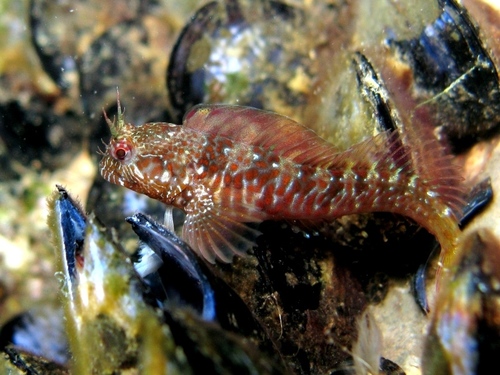
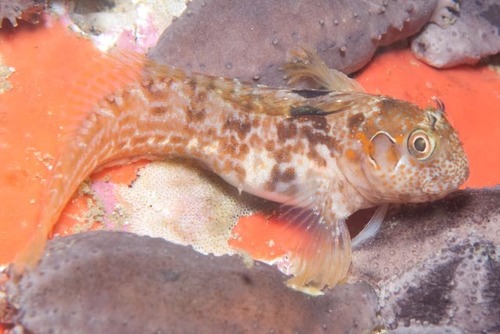
Parablennius marmoreus, commonly called the seaweed blenny, has a blunt head, a beak-like snout, and a long, slender body.
Maximum Size
It reaches a maximum total length of around 8.5 centimetres, or 3.3 inches.
Mouth & Cephalic Structures
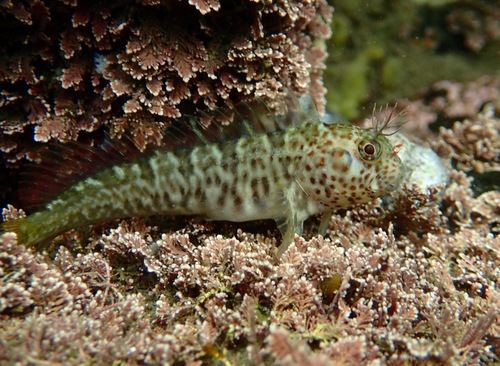
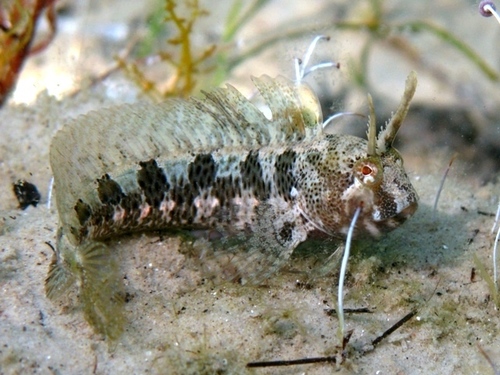
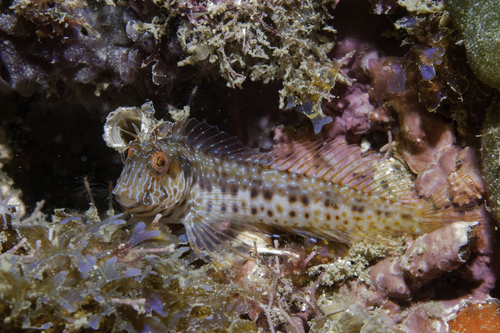
Its mouth holds approximately forty comb-shaped incisors, and tufts of branched, slender fleshy structures called cirri sit above its eyes.
Gill Slit Structure
The fish’s gill slits form a continuous opening across its throat.
Fin Structure
Its dorsal fin has twelve spines and eighteen soft rays, its anal fin has two spines and nineteen or twenty soft rays, and its tail fin is rounded.
Base Body Coloration
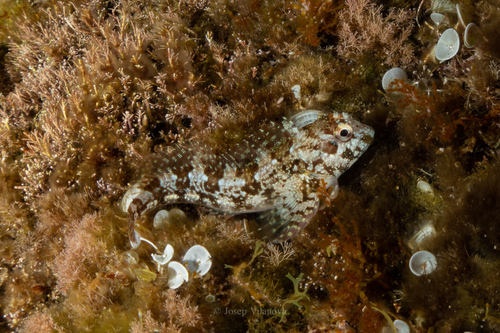
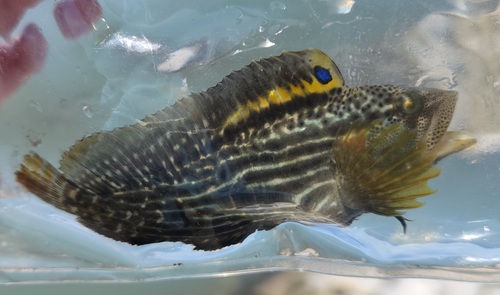
Body coloration is variable, ranging in shades of gold, green, tan, or rust, with regularly spaced dark brown mottled blotches.
Head & Lateral Stripe Markings
The top of the head is bronze, and a dark stripe originates above the eye, widens above the pectoral fin, and fades gradually as it approaches the caudal peduncle.
Dorsal Fin Spot
Some individuals have a blue spot near the front of the dorsal fin.
Camouflage Ability
This species can adjust its coloration to match its surroundings for camouflage.
Ventral & Anal Fin Coloration
The border of the anal fins and the underside of the fish are whitish.
Native Range
The seaweed blenny is native to shallow waters of the western Atlantic Ocean.
Distribution & Depth Range
Its distribution ranges from New York south to Brazil, and includes the Caribbean Sea, Gulf of Mexico, Bermuda, and Bahamas, where it occurs at depths up to around 10 metres, or 33 feet.
Rock-associated Habitat
Its typical habitat is among limestone boulders, and in rock scoops and basins where the rock surface is covered by algal mats, sea fans, and other invertebrates.
Other Habitat Types
It can also be found on reefs, in seagrass meadows, in oyster beds, around human-made structures including pilings, jetties, seawalls, oil rigs, and buoys, and among the roots of mangroves.