About Pantholops hodgsonii (Abel, 1826)
Common Name and Sexual Dimorphism
Pantholops hodgsonii, commonly known as the Tibetan antelope, is a medium-sized antelope with marked sexual dimorphism.
Size Measurements
Males reach a shoulder height of around 83 cm (32+1⁄2 in) and weigh approximately 39 kg (86 lb), while females are smaller, averaging 74 cm (29 in) at the shoulder and 26 kg (57 lb) in weight.
Sex Identification Traits
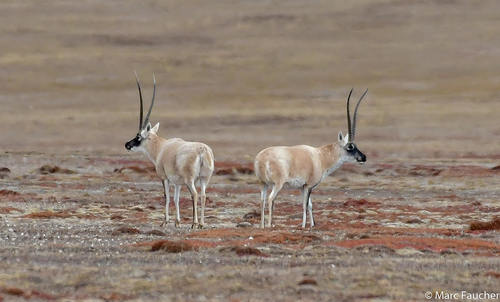
Males can be easily told apart from females by their horns and black leg stripes, both of which females lack.
General Coat Coloration
The species has a thick, woolly coat that ranges in color from pale fawn to reddish-brown, with a whitish belly.
Male Facial Features
Males have almost black faces with prominent, paler-colored nasal swellings.
Rut Season Male Coloration
During the annual breeding rut, male coloration becomes more intense: the coat lightens to almost white, creating a strong contrast with the darker patterns on the face and legs.
Male Horn Length
Male Tibetan antelopes have long, backward-curved horns that typically measure 54 to 60 cm (21 to 24 in) in length.
Horn Structural Features
The horns are slender, with ring-like ridges on their lower sections and smooth, pointed tips.
Horn Shape Variation
While horn length is fairly consistent across individuals, the exact shape of the horns varies, so the distance between the two tips ranges widely from 19 to 46 cm (7+1⁄2 to 18 in).
Horn Growth Pattern
Unlike the horns of caprines, Tibetan antelope horns do not grow throughout the animal's life.
Other External Morphology
The species also has short, pointed ears and a relatively short tail that is around 13 cm (5 in) long.
Fur Composition
The fur of the Tibetan antelope is distinctive, made up of long guard hairs and a silky, shorter-fibered undercoat.
Guard Hair Characteristics
Individual guard hairs are thicker than those of other goats, have unusually thin walls, and bear a unique pattern of cuticular scales described as resembling the shape of a benzene ring.
Endemic Range and Habitat Elevation
The Tibetan antelope is endemic to the Tibetan Plateau, where it inhabits open alpine and cold steppe habitats at elevations between 3,250 and 5,500 m (10,660 and 18,040 ft).
Habitat Preference
It prefers flat, open terrain with sparse vegetation cover.
Current Geographic Distribution
Almost the entire wild population lives in China, where it occurs in Tibet, southern Xinjiang, and western Qinghai; a small number of individuals are also found across the border in Ladakh, India.
Westernmost Population Location
The westernmost known population lives on the Depsang Plains, at altitudes up to 5500 m.
Core Protected Habitat
Today, most Tibetan antelopes live within the Chang Tang Nature Reserve of northern Tibet.
Historical Distribution Note
The first specimens of the species, described in 1826, were collected from Nepal, but the species has since been extirpated from that area.
Taxonomic Subspecies Status
No subspecies of the Tibetan antelope are recognized.
Calving Ground Location
Zhuonai Lake in Hoh Xil is a well-known calving ground for the species.
High-Altitude Hemoglobin Adaptation
A key adaptation to the species' high-altitude habitat is that adult Tibetan antelopes retain the fetal form of hemoglobin, which has a higher oxygen affinity.
Adaptation Uniqueness
This adaptation has been documented in no other mammal species besides the Tibetan antelope.
Rutting Season Timing
The rutting season for the Tibetan antelope runs from November to December.
Male Harem Structure
Males form harems of up to 12 females, though harems of one to four females are more common.
Male-Male Competition Behavior
Males drive off competing males primarily through displays or chasing with their head lowered, rather than fighting directly with their horns.
Courtship and Mating Behavior
Courtship and mating are both brief, and lack most of the typical breeding behaviors seen in other antelope species, though males commonly kick the thighs of females with their fore legs.
Gestation and Birth Timing
After a gestation period of approximately six months, mothers give birth to a single calf in June or July.
Calf Developmental Traits
Calves are precocial, able to stand within 15 minutes of birth.
Maturation Timeline
They reach full size within 15 months, and become sexually mature at two or three years of age.
Juvenile Dispersal Patterns
Females may stay with their mothers until they give birth to their own young, while males leave their mother within 12 months, by which time their horns have started to grow.
Male Social Status Determinant
Male social status is determined by horn length, and maximum horn length is reached at around three and a half years of age.
Estimated Lifespan
Since very few Tibetan antelopes have been kept in captivity, their exact lifespan is not known with certainty, but it is thought to be around 10 years.