About Panthera onca (Linnaeus, 1758)
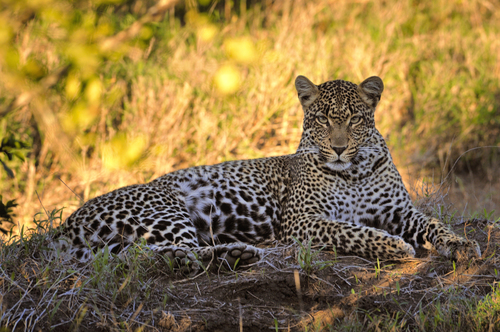
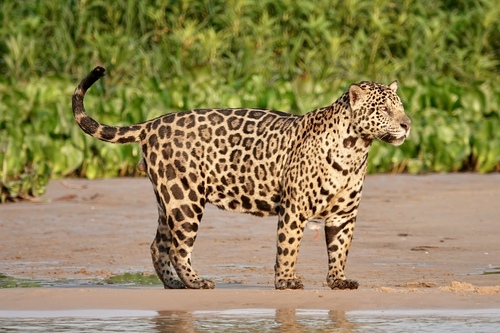
The jaguar, whose scientific name is Panthera onca (Linnaeus, 1758), is a compact, muscular big cat. It is the largest cat native to the Americas, and the third largest cat in the world — only tigers and lions grow larger than jaguars. Jaguars measure 57 to 81 cm (22.4 to 31.9 in) tall at the shoulders. Their size and weight vary significantly based on sex and region: most jaguars typically weigh between 56–96 kg (123–212 lb). Exceptionally large males have been recorded weighing up to 158 kg (348 lb), while the smallest females from Middle America weigh around 36 kg (79 lb). The species is sexually dimorphic, with females usually 10–20% smaller than males. The length from the nose to the base of the jaguar's tail ranges from 1.12 to 1.85 m (3.7 to 6.1 ft). The jaguar's tail is 45 to 75 cm (17.7 to 29.5 in) long, the shortest tail of any big cat. Its muscular legs are shorter than the legs of other Panthera species that have similar body weights. Jaguar size generally increases from north to south: jaguars in the Chamela-Cuixmala Biosphere Reserve on the Pacific coast of central Mexico weighed around 50 kg (110 lb), while jaguars in Venezuela and Brazil are much larger, with average weights of around 95 kg (209 lb) for males and 56–78 kg (123–172 lb) for females. The jaguar's coat ranges in color from pale yellow to tan or reddish-yellow, with a whitish underside, and is covered in black spots. The shapes of the spots vary: on the jaguar's sides, the spots become rosettes that may include one or multiple small dots. Spots on the head and neck are generally solid, and this is also true for spots on the tail; spots on the tail often merge to form bands near the end, creating a black tip. On the middle of the back, the spots are elongated, and often connect to form a central median stripe, while they are blotchy on the belly. These spot patterns work as camouflage in areas with dense vegetation and patchy shadows. Forest-dwelling jaguars are often darker and considerably smaller than jaguars that live in open areas, which may be caused by the smaller population of large herbivorous prey in forest regions. Jaguars closely resemble leopards, but are generally more robust, with stockier limbs and a squarer head. The rosettes on a jaguar's coat are larger, darker, fewer in number, and have thicker lines than a leopard's, with a small spot in the middle of each rosette. Jaguars have powerful jaws, with the third-highest bite force of all felids, behind only the tiger and the lion. They have an average bite force at the canine tip of 887.0 Newtons, and a bite force quotient at the canine tip of 118.6. A 100 kg (220 lb) jaguar can bite with a force of 4.939 kN (1,110 lbf) with its canine teeth, and 6.922 kN (1,556 lbf) at the carnassial notch. In terms of distribution and habitat, a 1999 estimate found that the jaguar's historic range at the turn of the 20th century covered 19,000,000 km² (7,300,000 sq mi), stretching from the southern United States through Central America to southern Argentina. By the turn of the 21st century, the species' global range had shrunk to around 8,750,000 km² (3,380,000 sq mi), with the largest range losses occurring in the southern United States, northern Mexico, northern Brazil, and southern Argentina. The jaguar's current range extends from the United States and Mexico, through Central America, into South America, and includes Belize, Guatemala, Honduras, Nicaragua, Costa Rica (particularly the Osa Peninsula), Panama, Colombia, Venezuela, Guyana, Suriname, French Guiana, Ecuador, Peru, Bolivia, Brazil, Paraguay and Argentina. Jaguars are considered locally extinct in El Salvador and Uruguay. Jaguars have been occasionally sighted in Arizona, New Mexico and Texas, with 62 sighting accounts reported during the 20th century. Between 2012 and 2015, a vagrant male jaguar was recorded at 23 different locations in the Santa Rita Mountains. Eight jaguars were photographed in the southwestern United States between 1996 and 2024. The jaguar prefers dense forest, and typically lives in dry deciduous forests, tropical and subtropical moist broadleaf forests, rainforests and cloud forests in Central and South America, as well as open, seasonally flooded wetlands, dry grassland, and historically also oak forests in the United States. It has been recorded at elevations up to 3,800 m (12,500 ft), but avoids montane forests. It favors riverine habitats and swamps with dense vegetation cover. In the Mayan forests of Mexico and Guatemala, 11 GPS-collared jaguars preferred undisturbed dense habitat far from roads; females avoided even areas with low levels of human activity, while males appeared less affected by human population density. A young male jaguar was also recorded at a waterhole in the semi-arid Sierra de San Carlos. In its former range, during the 19th century jaguars were still sighted at the North Platte River 48–80 km (30–50 miles) north of Longs Peak in Colorado, in coastal Louisiana, and in northern Arizona and New Mexico. Multiple verified zoological records confirm jaguars once lived in California, with two records as far north as Monterey in 1814 and 1826. The only recorded active jaguar den with breeding adults and kittens in the United States was in the Tehachapi Mountains of California before 1860, and jaguars persisted in California until around 1860. The last confirmed jaguar in Texas was shot in 1948, 4.8 km (3 miles) southeast of Kingsville, Texas. In Arizona, a female jaguar was shot in the White Mountains in 1963. By the late 1960s, jaguars were considered extirpated from the United States. Arizona outlawed jaguar hunting in 1969, but by that time no female jaguars remained in the state, and only two males were sighted and killed over the next 25 years. In 1996, a rancher and hunting guide from Douglas, Arizona encountered a jaguar in the Peloncillo Mountains, and later became a jaguar researcher placing trail cameras, which recorded four more jaguars. Historical records show jaguars lived in the Brazilian state of Santa Catarina until at least 1984. In behavior and ecology, the jaguar is mostly active at night and during twilight. However, jaguars living in densely forested regions of the Amazon rainforest and the Pantanal are largely active during the day, while jaguars in the Atlantic Forest are primarily active at night. The jaguar's activity pattern matches the activity of its main prey species. Jaguars are strong swimmers, and play and hunt in the water, possibly more often than tigers. They have been recorded moving between islands and the shore, swimming distances of at least 1.3 km. Jaguars are also capable climbers, but climb trees less often than cougars. In terms of reproduction and life cycle, captive female jaguars reach sexual maturity at around 2.5 years of age. Estrus lasts 7–15 days, with an estrus cycle of 41.8 to 52.6 days. During estrus, females show increased restlessness, along with rolling and prolonged vocalizations. Female jaguars are induced ovulators, but can also ovulate spontaneously. Gestation lasts 91 to 111 days. Male jaguars reach sexual maturity at three to four years of age. The mean ejaculate volume for males is 8.6±1.3 ml. The jaguar's generation length is 9.8 years. In the Pantanal, breeding jaguar pairs have been observed staying together for up to five days. Females give birth to one to two cubs. Jaguar cubs are born with closed eyes, and open their eyes after two weeks. Cubs are weaned at three months old, but remain in the birth den for six months before leaving to accompany their mother on hunts. Jaguars stay with their mothers for up to two years. Wild jaguars rarely live beyond 11 years, but captive jaguars may live up to 22 years. In 2001, a male jaguar killed and partially consumed two cubs in Emas National Park. DNA paternity testing of blood samples confirmed the male was the cubs' father. Two more cases of infanticide were documented in the northern Pantanal in 2013. To defend against infanticide, female jaguars hide their cubs and distract males with courtship behavior.