About Panthera leo (Linnaeus, 1758)
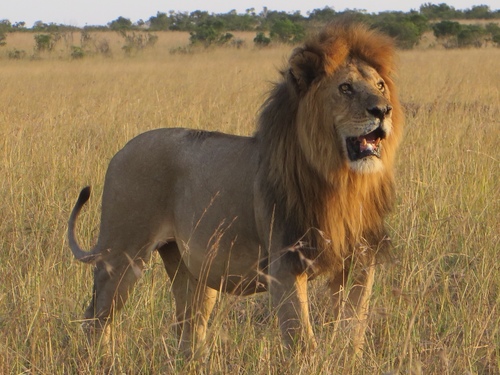
The lion is a muscular, broad-chested cat with a short, rounded head, a reduced neck, and round ears; male lions have broader heads. Fur color ranges from light buff to silvery grey, yellowish red, and dark brown, with underparts generally lighter in color. Newborn lions have dark spots that fade as the cub reaches adulthood, though faint spots often remain visible on the legs and underparts. All lions have a dark, hairy tuft at the end of their tail. In some lions, this tuft hides an approximately 5 mm (0.20 in) long hard "spine" or "spur" made of dermal papillae, and the function of this spur is currently unknown. The tail tuft is not present at birth; it develops around five and a half months of age and is easily identifiable by seven months of age. A lion's skull is very similar to that of a tiger, though the frontal region is usually more depressed and flattened, with a slightly shorter postorbital region and broader nasal openings than a tiger's skull. Due to high amounts of skull variation in both species, only the structure of the lower jaw can reliably be used to tell the two species apart. Skeletal muscles make up 58.8% of a lion's body weight, which is the highest muscle percentage among all mammals. Lions have a high concentration of fast twitch muscle fibres, which lets them produce quick bursts of speed but leaves them with lower stamina. African lions live in scattered populations across sub-Saharan Africa. Lions prefer grassy plains, savannahs, river-bordering scrub, and open woodlands with bushes, and they rarely enter closed forests. Lions have been recorded up to an elevation of 3,600 m (11,800 ft) on Mount Elgon, and close to the snow line on Mount Kenya. The majority of African lion habitat is savannahs with an annual rainfall of 300 to 1,500 mm (12 to 59 in), estimated to be at most 3,390,821 km2 (1,309,203 sq mi). Remnant lion populations also exist in tropical moist forests of West Africa and montane forests of East Africa. The Asiatic lion now only survives in and around Gir National Park in Gujarat, western India, where its habitat is a mix of dry savannah forest and very dry, deciduous scrub forest. Historically, the lion's range in Africa covered most of the central African rainforest zone and the Sahara desert. Lions became extinct in North Africa by the 1960s, except in the southern part of Sudan. During the mid-Holocene, around 8,000 to 6,000 years ago, lions expanded their range into Southeastern and Eastern Europe, partially reoccupying the range of the now extinct cave lion. Modern lions were present in Hungary from about 4,500 to 3,200 years Before Present, and in Ukraine from about 6,400 to 2,000 years Before Present. In Greece, lions were common as reported by Herodotus in 480 BC, considered rare by 300 BC, and extirpated by AD 100. In Asia, lions once ranged across regions where climate conditions supported abundant prey. Lions were present in the Caucasus until the 10th century, lived in the Levant until the Middle Ages, and in Southwest Asia until the late 19th century. By the late 19th century, lions had been extirpated from most of Turkey. The last confirmed sighting of a live lion in Iran was in 1942, around 65 km (40 mi) northwest of Dezful, though a lioness corpse was found on the banks of the Karun river in Khuzestan province in 1944. Historically, Asian lions ranged from Sind and Punjab in Pakistan to Bengal and the Narmada River in central India. Lions spend much of their time resting, and are inactive for around twenty hours per day. Though lions can be active at any time, their activity generally peaks after dusk, with a period of socialising, grooming, and defecating. Intermittent activity continues until dawn, when hunting most often occurs. On average, lions spend two hours a day walking and fifty minutes eating. Most lionesses reach reproductive maturity by four years of age. Lions do not mate at a specific time of year, and females are polyestrous. Like other cats, male lions have penile spines that rake the vaginal walls during copulation, which may trigger ovulation. A lioness may mate with more than one male while she is in heat. Lions of both sexes may participate in group homosexual and courtship activities; males will also head-rub and roll with each other before mounting. A lion's generation length is around seven years. The average gestation period is around 110 days. Females give birth to litters of between one and four cubs in a secluded, sheltered den such as a thicket, reed-bed, or cave, usually located away from the pride. While cubs are still helpless, the mother often hunts alone and stays relatively close to the den. Lion cubs are born blind, with their eyes opening around seven days after birth. They weigh 1.2–2.1 kg (2.6–4.6 lb) at birth and are almost helpless; they begin crawling one to two days after birth, and start walking around three weeks of age. To avoid building up scent that would attract predators, the lioness moves her cubs to a new den site several times a month, carrying each cub individually by the nape of the neck. Reproductive-age lionesses within a pride usually have similar numbers of surviving cubs, which they initially keep hidden. Lionesses without offspring do not help care for the communal litter. Usually, a mother does not rejoin the pride with her cubs until the cubs are six to eight weeks old. Sometimes this introduction to pride life happens earlier, particularly when other lionesses have given birth around the same time. When first introduced to the rest of the pride, lion cubs are unconfident around adult lions other than their mother. They soon begin integrating into pride life, playing among themselves or trying to initiate play with adults. Lionesses that have cubs of their own are more likely to tolerate another lioness's cubs than lionesses without cubs. Male tolerance of cubs varies: one male may patiently let cubs play with his tail or mane, while another may snarl and bat cubs away. Pride lionesses often synchronize their reproductive cycles, and practice communal rearing and suckling of young. Cubs nurse indiscriminately from any or all nursing females in the pride. Birth synchronization is advantageous because it leaves cubs growing to roughly the same size with an equal chance of survival, preventing older cubs from dominating sucklings. Weaning occurs after six or seven months. Male lions reach maturity at around three years of age, and by four to five years old they are capable of challenging and displacing adult males leading another pride. They begin to age and weaken between 10 and 15 years of age at the latest. When one or more new males oust the previous males associated with a pride, the victorious new males often kill any existing young cubs. This may happen because females do not become fertile and receptive until their cubs mature or die. Females often fiercely defend their cubs from a usurping male, but are rarely successful unless three or four mothers within the pride join forces against the intruder. Cubs also die from starvation, abandonment, and predation by leopards, hyenas and wild dogs. Male cubs are pushed out of their maternal pride when they reach maturity around two or three years of age, while some females may leave the pride when they reach two years of age. When a new male lion takes over a pride, adolescent lions of both sexes may be evicted.