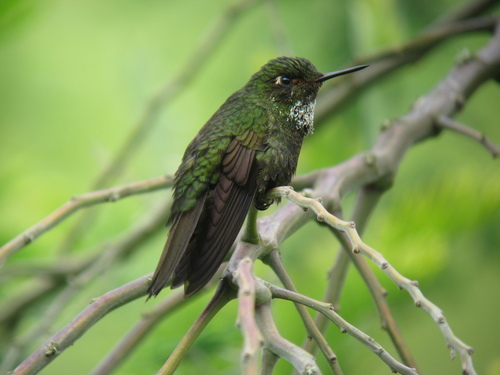
About Ramphodon naevius (Dumont, 1818)
Taxonomy and Size
The saw-billed hermit, scientifically named Ramphodon naevius (Dumont, 1818), is 14 to 16 cm (5.5 to 6.3 in) long and weighs 5.3 to 9 g (0.19 to 0.32 oz). It is one of the three heaviest hermit hummingbirds, and males are heavier than females.
Bill Structure
Both sexes have saw-like serrations on the mandible; males additionally have a hooked tip to their bill. Only one other hummingbird, the unrelated tooth-billed hummingbird (Androdon aequatorialis), also has a serrated bill.
Plumage: Body and Head
Both sexes have scaly brown upperparts and underparts patterned with dark and pale stripes. They have a reddish ochre throat, a dark patch running through the eye, and a white supercilium.
Tail Coloration
The upper surface of the tail is purplish black, while the underside of the outer tail feathers has progressively more buff coloring at their tips.
Distribution Range
The saw-billed hermit occurs in a narrow band in southeastern Brazil, ranging from the states of Minas Gerais and Espírito Santo south to eastern Santa Catarina and the northernmost part of Rio Grande do Sul.
Habitat and Elevation
It lives in the understory of humid coastal Atlantic Forest, at elevations up to 500 m (1,600 ft).