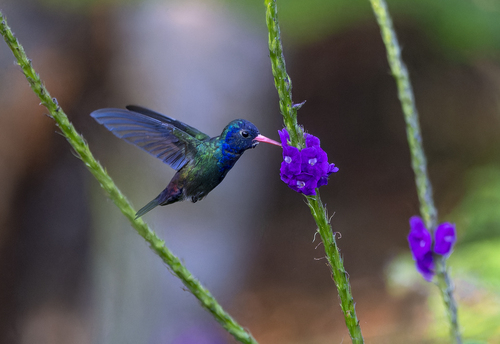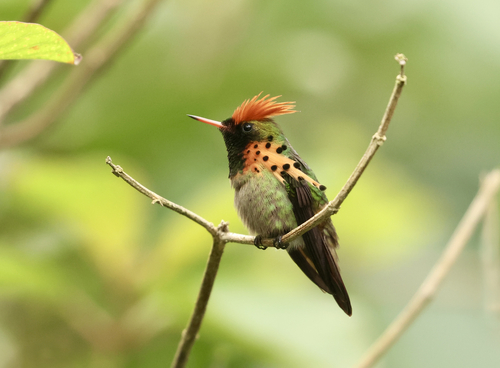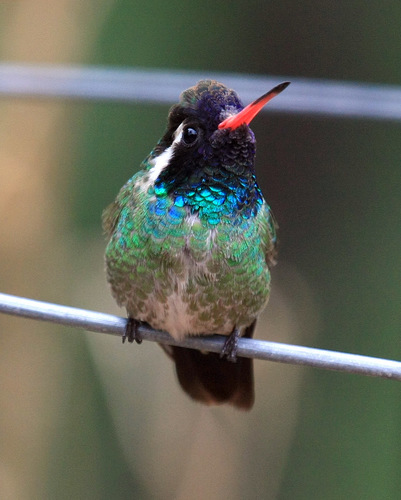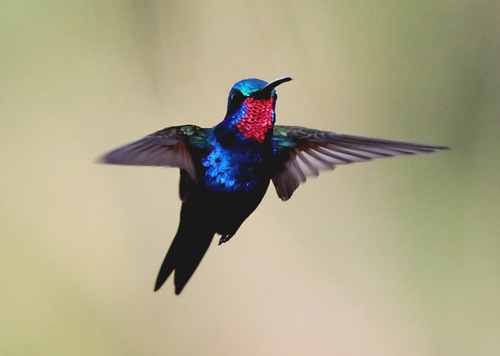
About Colibri cyanotus (Bourcier, 1843)
Size Classification
This species, the lesser violetear, is roughly medium-sized by hummingbird standards. It averages 9.7 to 12 cm (3.8 to 4.7 in) in total length.
Bill Characteristics
Its bill is black, mostly straight with only a slight downward curve, and measures 1.8 to 2.5 cm (0.71 to 0.98 in). Body mass ranges from 4.8 to 5.6 g (0.17 to 0.20 oz).
Morphometric Measurements
Among standard measurements, the wing chord is 5.8 to 6.8 cm (2.3 to 2.7 in) and the tail is 3.5 to 4.3 cm (1.4 to 1.7 in).
Upperparts Coloration
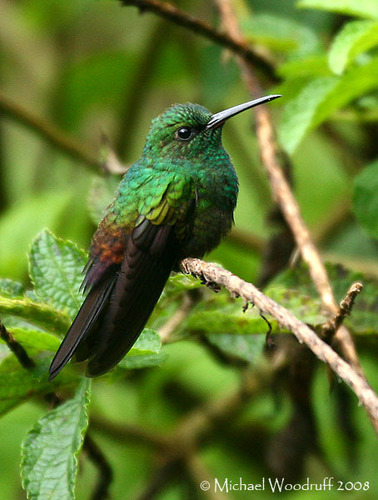
The upperparts are shining green, with a glittering violet ear-patch on the sides of the neck.
Underparts Coloration
Its throat and chest are a more glittering green, and it has a shining green belly.
Tail Appearance
The tail is metallic blue-green with more bronzy central feathers and a prominent black subterminal band.
Breeding Range
The lesser violetear breeds in the highlands of Costa Rica and western Panama, the mountains of northern Venezuela, and the Andes from western Venezuela to western Bolivia.
Habitat Types
Common habitats for the lesser violetear include the canopy and borders of subtropical and lower temperate forest, secondary woodland and scrub, and clearings and gardens in the subtropical zone on both slopes of the Andes.
Altitudinal Range
It is mostly recorded at altitudes between 1,500 to 3,300 m (4,900 to 10,800 ft), although it is sometimes found as low as 900 m (3,000 ft).
Niche Differentiation
Compared to the similar sparkling violetear, the lesser violetear generally prefers more humid, high-altitude areas such as cloud forests, and it is completely absent from the central valley where the sparkling violetear is most common. However, the two species may sometimes be found together feeding at flowering Inga trees.