About Ozotoceros bezoarticus (Linnaeus, 1758)
Fur Coloration
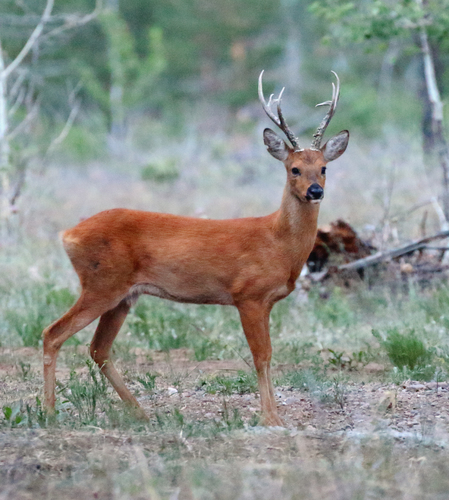
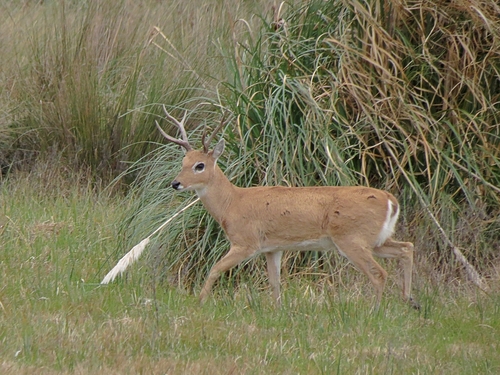
Pampas deer (Ozotoceros bezoarticus) have tan fur that is lighter on their undersides and the insides of their legs. Their coat color does not change with the seasons. They have white spots above their lips and white patches on their throats.
Shoulder Height
Shoulder height ranges from 60–65 cm (24–26 in) for females and 65–70 cm (26–28 in) for males.
Tail Characteristics
Their tails are short and bushy, measuring 10–15 cm (3.9–5.9 in) long; when they run, they lift their tail to reveal a white patch, just like white-tailed deer.
Adult Weight
Adult males typically weigh 24–34 kg (53–75 lb), though individuals have been documented reaching up to 40 kg (88 lb), while females typically weigh 22–29 kg (49–64 lb). This is a small deer species with relatively little sexual dimorphism.
Male Antlers
Males have small, lightweight 3-pronged antlers that are shed annually in August or September, with a full new set grown by December. The lower front main prong of the antler is not divided, while the upper prong is divided.
Female Head Markings
Females have hair whorls that resemble tiny antler stubs.
Urination Stance
Males and females have different urination stances.
Hoof Scent Secretion
Males secrete a strong scent from glands in their back hooves that can be detected up to 1.5 km away.
Male Reproductive Anatomy
Compared to other small ruminants, male Pampas deer have small testicles relative to their body size.
Birthing Period
Fawns can be born at any time of year, but there is a birth peak between September and November.
Parturition Behavior
Females separate from their group to give birth, and keep their fawn hidden after birth. Immediately after giving birth, females enter heat and usually mate within the following 48 hours.
Newborn Fawn Appearance
Newborn fawns are small and covered in spots, which they lose at around two months old.
Litter Size and Gestation
Most births produce only one fawn, which weighs about 2.2 kg (4.9 lb) at birth, after a gestation period that lasts more than seven months.
Fawn Development
Fawns can eat solid food and begin following their mother by six weeks old. They stay with their mother for at least one year, and reach sexual maturity at around one year old.