About Capreolus pygargus (Pallas, 1771)
Scientific Classification and General Morphology
The Siberian roe deer, scientifically named Capreolus pygargus, is a medium-sized metacarpalian deer with a long neck and large ears.
Size Measurements
Adults typically reach a maximum body length of 146 cm (4.8 ft) and a maximum weight of 59 kg (130 lb), and it is larger than the European roe deer (Capreolus capreolus).
Population Distribution by Region
On average, the largest populations are found in the Ural and Northern Kazakhstan, followed by populations from the Transbaikal, Amur, and Primolskil regions.
Antler Comparison to European Roe Deer
Its antlers are larger and have more branches than the antlers of European roe deer.
Lifespan
Siberian roe deer generally have a lifespan of 8 to 12 years, with a maximum recorded lifespan of around 18 years.
Winter Coloration
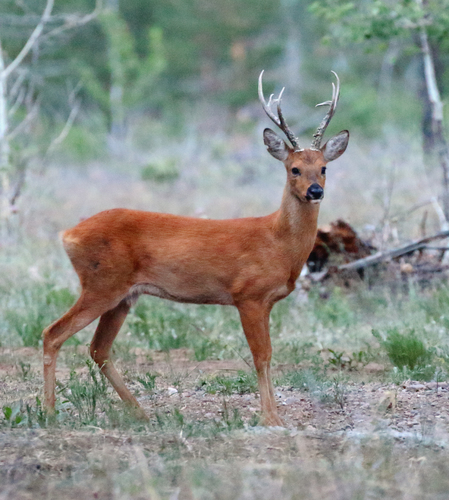
In winter, northern populations have light gray coloring, while southern populations are grayish brown and ochraceous. Their belly is creamy, and they have a white caudal patch.
Summer Coloration
In summer, their coloring is reddish.
Juvenile Coat Pattern
Young Siberian roe deer have spotted coats.
Male Sexual Dimorphism
Males are larger than females, and have three-tined antlers that are widely spaced and slant upward.
Antler Growth Cycle
These antlers are shed in autumn or early winter, and begin regrowing shortly after shedding.
Current Geographic Range
Siberian roe deer are currently found across the temperate zone of Eastern Europe, Central Asia, and East Asia.
Historical Range
Fossil records show their historical range once extended to the northern Caucasus Mountains and eastern Ukraine.
19th-20th Century Range Reduction
In the late 19th and early 20th centuries, overhunting reduced their range across Eastern Europe, northern Kazakhstan, western Siberia, and the northern regions of eastern Siberia.
Subspecies Formation
The division of their original range led to the formation of two morphologically distinct subspecies: the Tian Shan roe deer and the Siberian roe deer.
Sympatric Range with European Roe Deer
Siberian roe deer and European roe deer meet at the Caucasus Mountains, with Siberian roe deer occupying the northern flank of the range, and European roe deer occupying the southern flank, Asia Minor, and parts of northwestern Iran.
Body Adaptations for Locomotion
Siberian roe deer have a light, slender build that is adapted for moving through tall, dense grass.
Habitat Preferences
They inhabit forest and steppe habitats, and reach high population densities in tall-grass meadows and floodplains.
Weather Adaptation
They are well adapted to handle severe weather extremes.
Introduced Population in England
A population of escaped individuals from Woburn may have become temporarily naturalized in England in the early 20th century, but this population was extirpated by 1945.