About Oxylebius pictus Gill, 1862
Common Name and Body Shape
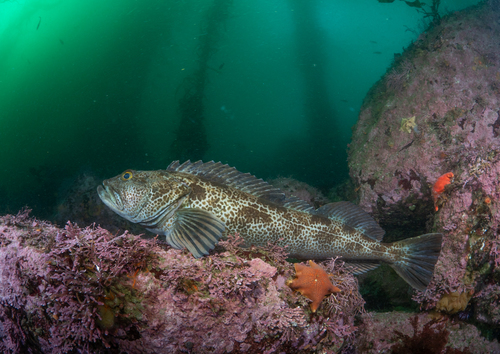
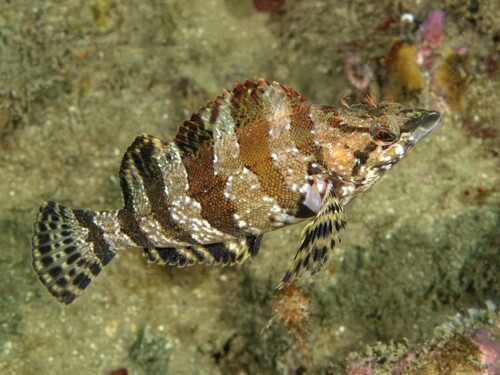
Oxylebius pictus, commonly called the painted greenling, has an elongated, compressed body and a long head with a pointed snout.
Dorsal and Anal Fin Structure
Its dorsal fin contains 16 spines and 14 to 16 soft rays, while its anal fin contains 3 or 4 spines and 12 or 13 soft rays. The soft-rayed portion of the dorsal fin is taller than the spiny portion.
Additional Fin Morphology
The caudal fin is slightly rounded, there is a notch in the anal fin between its spines and soft rays, and the pelvic fin is moderately long, not extending as far as the anus.
Head Scales and Cirri
The head is scaled; there is one single cirrus above each eye, and a pair of cirri at the back of the head.
Base Body Color and Flank Markings
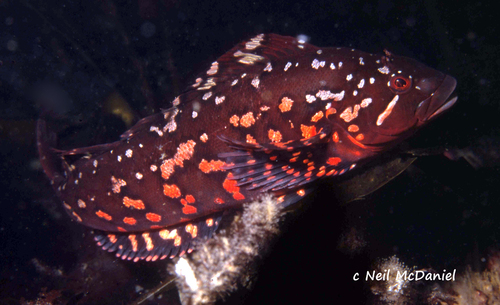
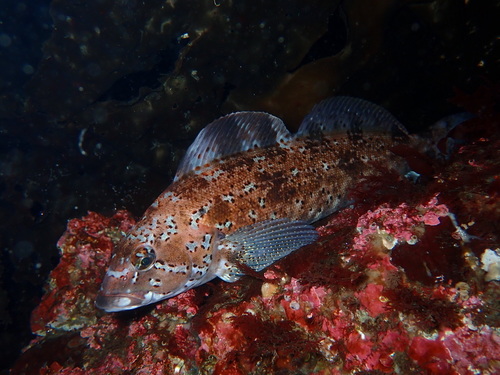
The base body color is grayish brown, broken by five to seven broad, distinct red or reddish brown bars along the flanks that extend onto the fins. Breeding males lose these bars.
Color Morphs
A small number of individuals are entirely dark with white spots.
Head and Fin Dark Markings
Three dark bars radiate out from the eyes: one toward the snout, and two back toward the nape. There are dark spots on the throat, as well as on the caudal, pectoral, and pelvic fins.
Distribution Range
This species is distributed in the eastern Pacific Ocean, ranging from Kodiak Island, Alaska to central Baja California.
Habitat and Depth
It lives in rocky habitats shallower than 50 meters (160 feet).