About Hexagrammos decagrammus (Pallas, 1810)
Taxonomic History
Hexagrammos decagrammus, commonly known as the kelp greenling, was first formally described in 1810 by German naturalist Peter Simon Pallas under the original name Labrax decagrammus, with its type locality recorded as Cape St. Elias, Alaska.
Etymology
The species specific name decagrammus means "ten lines", which refers to the five lateral line canals on each flank, for a total of 10 canals across the body.
Dorsal Fin Structure
The first dorsal fin of the kelp greenling has 21 or 22 spines, while the second dorsal fin has 24 soft rays.
Anal Fin Structure
The anal fin contains one single spine and 23 or 24 soft rays.
Male Coloration
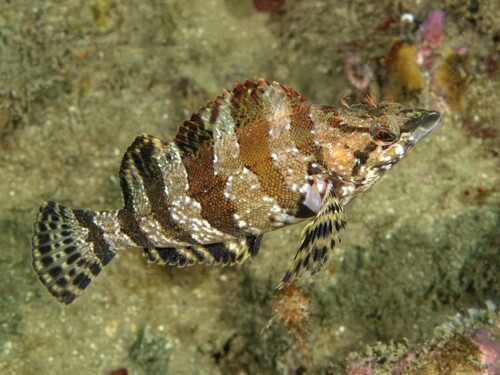
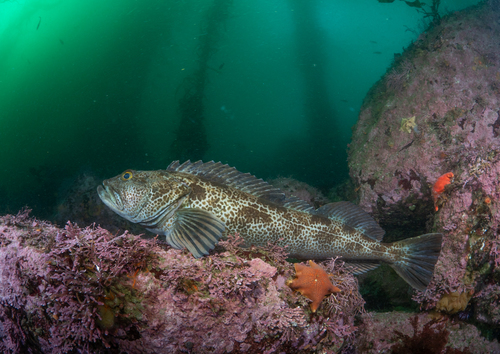
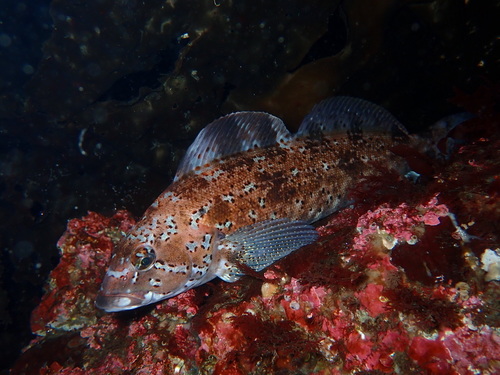
Male kelp greenlings are gray to brownish olive in color, covered in irregular blue spots across the anterior half to two-thirds of their body.
Each blue spot is surrounded by a ring of small rusty spots.
Female Coloration
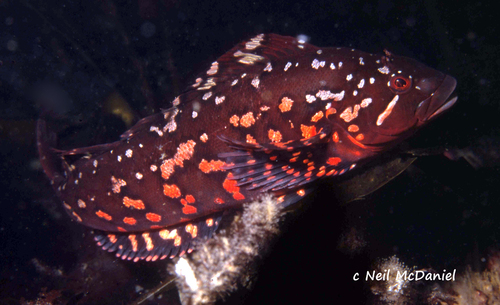
Female kelp greenlings are also gray to brownish in color, but they are covered entirely in rust-colored or golden spots, with yellowish orange fins.
Shared Coloration Features
In both males and females, the inside of the mouth is yellowish, and there is frequently an eye-like ocellus spot at the rear of the second dorsal fin.
Lateral Line Characteristics
This species has five lateral lines on each flank.
Cirrhi Morphology
It also has fleshy cirrhi: one located over the eye, and another halfway between the eye and the origin of the dorsal fin.
Size and Weight
The maximum published total length of this species is 61 cm (24 in), and the maximum published weight is 2.1 kg (4.6 lb).
Geographic Range
The kelp greenling is native to the eastern Pacific Ocean, with a range that stretches from the Aleutian Islands of Alaska to La Jolla in southern California.
Habitat
It lives in rocky nearshore areas, is common in kelp beds, and can also be found on sand bottoms.