About Aepyceros melampus (Lichtenstein, 1812)
Common Name and Build
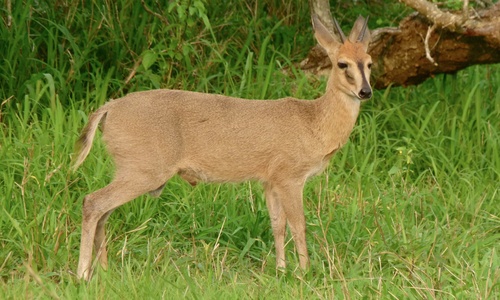
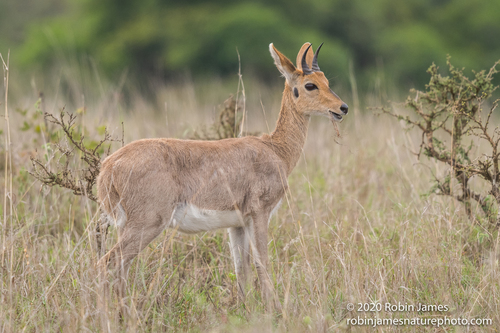
Aepyceros melampus, commonly known as impala, is a medium-sized, slender-bodied antelope with a build and size similar to kob, puku, and Grant's gazelle. Its head-and-body length measures around 130 centimetres (51 in).
Shoulder Height
Males stand approximately 75–92 cm (30–36 in) tall at the shoulder, while females reach 70–85 cm (28–33 in).
Weight
Males typically weigh 53–76 kilograms (117–168 lb), and females weigh 40–53 kg (88–117 lb).
Sexual Dimorphism
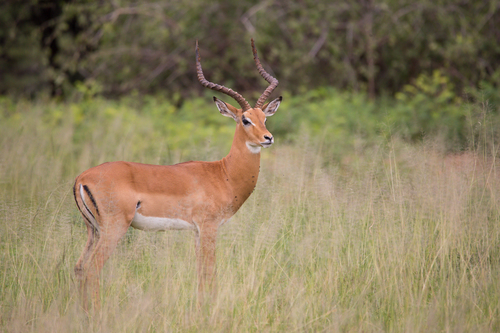
The species is sexually dimorphic: females are hornless and smaller than males. Males grow slender, lyre-shaped horns 45–92 cm (18–36 in) long.
Horn Structure
These horns are strongly ridged, divergent, circular in cross-section, and hollow at the base. Their arch-like shape allows horns to interlock, which helps males throw off opponents during fights, and also protects the skull from damage.
Coat Coloration
Impala have a glossy two-toned coat: reddish brown on the back, tan on the flanks, and both contrast sharply with the white underbelly.
Facial Features
Facial features include white rings around the eyes, and a light chin and snout. The 17 cm (6.7 in) long ears are tipped with black.
Pelage Markings
Black streaks run from the buttocks to the upper hindlegs. The bushy white tail is 30 cm (12 in) long, with a solid black stripe along its midline.
Similar Species Comparison
Impala colouration closely resembles that of the gerenuk, but the gerenuk has shorter horns and lacks impala's black thigh stripes.
Hindleg Scent Glands
Impala have scent glands on their hindlegs covered by a black tuft of hair; 2-Methylbutanoic Acid and 2-Nonanone have been identified from these glands.
Sebaceous Glands
Dominant males have concentrated sebaceous glands on the forehead and dispersed glands on the torso that are most active during the mating season; female sebaceous glands are only partially developed and do not change with the seasons.
Nipple Count
Impala have four nipples.
Black-faced Impala Size and Coloration
Among the recognized subspecies, the black-faced impala is significantly larger and darker than the common impala; melanism causes the dark colouration.
Black-faced Impala Facial Markings
Black-faced impala are distinguished by a dark stripe on each side of the nose that runs upward toward the eyes and thins as it reaches the forehead.
Black-faced Impala Other Differences
Other differences between the subspecies include a larger black ear tip, and a bushier, nearly 30% longer tail in the black-faced impala.
Dental Adaptation
Impala have a special dental arrangement on the front lower jaw similar to the toothcomb found in strepsirrhine primates, which is used during allogrooming to comb fur on the head and neck and remove ectoparasites.
General Habitat Type
Impala inhabit woodlands, as they prefer shade, and can also be found in the ecotone between woodlands and savannahs. They prefer areas close to water sources.
Southern African Habitat Associations
In southern Africa, populations are typically associated with Colophospermum mopane and Acacia woodlands.
Seasonal Habitat Selection
Habitat selection changes with the seasons: Acacia senegal woodlands are preferred in the wet season, and Acacia drepanolobium savannahs are preferred in the dry season.
Predator-related Habitat Choice
Vulnerability to predators also affects habitat choice: impala avoid areas with tall grasses that can conceal predators.
Elephant Impact on Habitat
One study found that the reduction of woodland cover and creation of shrublands by African bush elephants has benefited impala populations by increasing the availability of dry season browse. Previously, Baikiaea woodland, which has declined due to elephants, provided very little browse for impala.
Shrubland Habitat Benefit
The newly formed Capparis shrubland, by contrast, can act as a key browsing habitat.
Altitudinal Range
Impala are generally not found in montane habitats, but in KwaZulu-Natal they have been recorded at altitudes up to 1,400 metres (4,600 ft) above sea level.
Historical Range
The historical range of impala spans across southern and eastern Africa, and it has remained largely intact, though the species has disappeared from a few locations such as Burundi.
Current General Range
The current range extends from central and southern Kenya and northeastern Uganda in the east to northern KwaZulu-Natal in the south, and westward as far as Namibia and southern Angola.
Black-faced Impala Distribution
The black-faced impala subspecies is restricted to southwestern Angola and Kaokoland in northwestern Namibia; the status of this subspecies has not been monitored since the 2000s.
Common Impala Distribution
The common impala has a wider distribution, and has been introduced to protected areas in Gabon and across southern Africa.
Activity Pattern
Impala are diurnal, meaning they are mainly active during the day, though activity stops during the hot midday hours; they also feed and rest at night.
Social Group Types
Three distinct social groups are seen in impala: territorial males, bachelor herds, and female herds.
Territorial Male Behaviour
Territorial males hold territories where they may form harems of females; territories are marked with urine and faeces and defended against juvenile or male intruders.
Bachelor Herd Structure
Bachelor herds tend to be small, with fewer than 30 members. Individuals maintain a distance of 2.5–3 m (8.2–9.8 ft) from one another; while young and old males may interact, middle-aged males generally avoid each other except to spar.
Female Herd Structure
Female herds range in size from 6 to 100 individuals, and occupy home ranges of 80–180 ha (200–440 acres; 0.31–0.69 sq mi). The bond between a mother and her calf is weak, and breaks soon after weaning; juveniles leave their mother's herd to join other herds. Female herds tend to be loosely organized with no clear leadership.
Allogrooming Behaviour
Allogrooming is an important form of social interaction in bachelor and female herds; in fact, impala appear to be the only ungulate that practices both self-grooming and allogrooming. During allogrooming, females typically groom related impalas, while males groom unrelated individuals. Each partner grooms the other between six and twelve times.
Territoriality Variation
Social behaviour varies with climate and geography: impala are territorial at certain times of year and gregarious at others, and the length of these periods varies widely between populations. For example, southern African populations only show territorial behaviour during the few months of the rut, while eastern African populations have relatively little territoriality even with a longer mating season. Additionally, territorial males often tolerate bachelors, and may even alternate between being bachelors and being territorial at different times of the year. A study of impala in Serengeti National Park found that 94% of males displayed territorial behaviour for less than four months.
Predator Species
Impala are an important prey species for large African carnivores, including cheetahs, leopards, wild dogs, lions, hyenas, crocodiles, and pythons.
Anti-predator Leaping Behaviours
The antelope has two characteristic leaping behaviours: it can jump up to 3 m (9.8 ft) over vegetation and even other impala, covering distances up to 10 m (33 ft); the other leap type is a series of jumps where the animal lands on its forelegs, kicks with its hindlegs mid-air, lands on all four feet in a movement called stotting, then rebounds. It leaps in these ways in multiple directions, likely to confuse predators. Sometimes, impala will also hide in vegetation to avoid being seen by predators.
Vocalization Characteristics
The most notable vocalization is a loud roar, produced by one to three loud snorts with the mouth closed, followed by two to ten deep grunts with the mouth open and the chin and tail raised; a typical roar can be heard up to 2 km (1.2 mi) away.
Scent Gland Signalling
Secretions from scent glands identify territorial males.
Sedentary Behaviour
Impala are sedentary, especially adult and middle-aged males, who may hold their territories for years.
Male Sexual Maturity
Males reach sexual maturity by one year old, though successful mating generally only occurs after they are four years old. Mature males begin establishing territories and attempt to gain access to females.
Female Reproductive Cycle
Females can conceive after they are one and a half years old; oestrus lasts 24 to 48 hours, and occurs every 12–29 days in non-pregnant females.
Rut Timing
The annual three-week-long rut, or breeding season, starts near the end of the wet season, typically in May.
Pre-rut Male Physiological Changes
Gonadal growth and hormone production in males begins a few months before the breeding season, leading to greater aggressiveness and territoriality. During the rut, bulbourethral glands are heavier, testosterone levels are nearly twice as high in territorial males as in bachelors, and territorial males typically have thicker necks than bachelors.
Mating Timing
Mating tends to occur between full moons.
Rutting Male Aggression
Rutting males fight over dominance, often making loud roars and chasing one another; they walk stiffly and display their neck and horns.
Male Rut Behaviour
Males stop feeding and allogrooming during the rut, likely to devote more time to gathering oestrus females; males check female urine to confirm the female is in oestrus.
Courtship Behaviour
When a male finds a receptive female, he begins courtship by pursuing her, keeping a distance of 3–5 metres (9.8–16.4 ft) from her. The male flicks his tongue and may nod vigorously; the female allows him to lick her vulva, and holds her tail to one side.
Copulation Behaviour
The male attempts to mount the female, holding his head high and clasping her sides with his forelegs. Mounting attempts may be repeated every few seconds to every minute or two. The male loses interest in the female after the first copulation, though she is still receptive and can mate with other males.
Gestation Period
Gestation lasts six to seven months.
Birth Behaviour
Births usually happen at midday; when labour begins, the female isolates herself from the herd. The idea that females can delay birth for an extra month if conditions are harsh is not supported as realistic.
Calf Rearing
A single calf is born, and is immediately hidden in cover for the first few weeks of life. The fawn then joins a nursery group within its mother's herd. Calves are suckled for four to six months; young males are forced out of the group and join bachelor herds, while females may stay with the mother's herd.