About Orites revolutus R.Br.
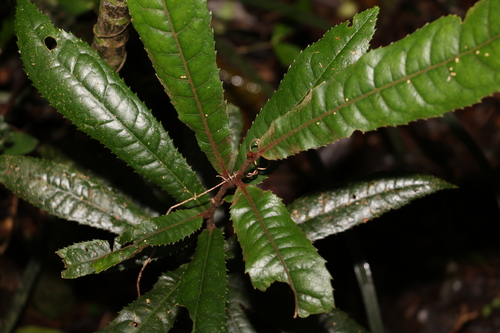
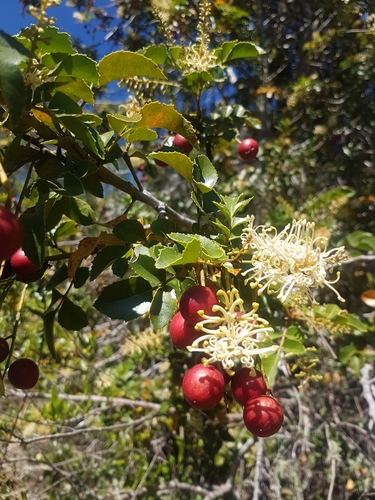
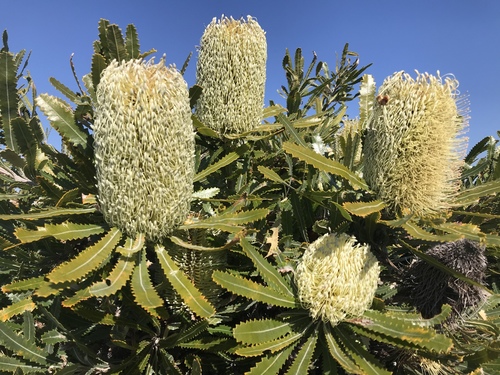
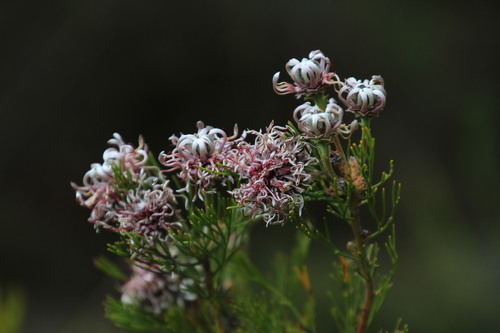
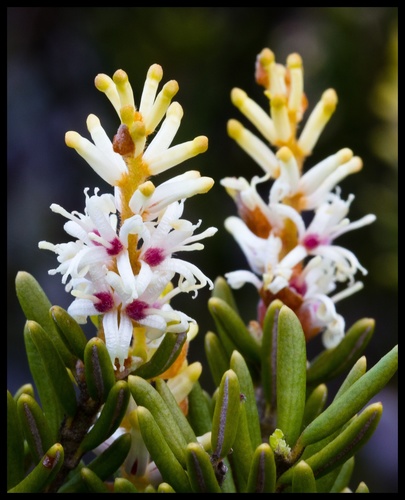
Orites revolutus R.Br. grows as a spreading bush or an erect, woody shrub, typically reaching 0.5 to 1.5 meters (1 foot 8 inches to 4 feet 11 inches) in height. It has dense branching, with alternate leaves arranged along its stems. Leaves are narrow, fairly blunt at the apex, 7 to 20 mm long and 1 to 1.5 mm wide, with tightly rolled (revolute) margins and a hairy surface on the underside. Flowering takes place in early to mid-summer. Sour-scented, white flowers grow on terminal spikes up to twice the length of the leaves. Each flower is 5 mm long, actinomorphic, and bisexual, with 4 adnate stamens and a superior ovary. The corolla is valvate, forming a tube when in bud and splitting once it matures. The fruit is a hairy follicle up to 15 mm long that holds winged seeds. In the field, this species is often confused with Olearia ledifolia, but this unrelated species does not produce woody follicles. Orites revolutus is endemic to Tasmania, where it is widespread across mountain plateaus at altitudes between 700 and 1,300 meters (2,300 to 4,300 feet). It grows in rocky, well-drained areas within alpine and subalpine heaths and woodlands, and can grow on both dolerite and sedimentary substrates. In its native range, the mean annual temperature is around 8 °C (46 °F), and annual rainfall can reach as high as 1700 to 2000 mm (67 to 78 inches). It can be found in many Tasmanian localities, including Hartz Mountains, Mount Field, Cradle Mountain-Lake St Clair, and Ben Lomond National Parks, as well as Wellington Park near Hobart, Tasmania's capital. Orites revolutus is a prominent shrub in alpine and subalpine sclerophyll heath and woodland, and commonly grows alongside Epacris serpyllifolia, Baeckea gunniana, Richea sprengelioides, Eucalyptus coccifera, Empodisma minus, Leptospermum rupestre, and Orites acicularis. The two Orites species have roughly similar distribution and vegetation dominance. Its sour-smelling white flowers appear on terminal spikes in early to mid-summer, which correspond to December and January in its native range. Surveys of insect visitors to Orites species in mainland Australia and New Zealand suggest pollination by small to medium insects, including bees in the genera Lasioglossum and Hylaeus, and many types of flies from the families Syrphidae, Calliphoridae, Muscidae, Empididae, and Tachinidae, all of which are present in Tasmania. This finding aligns with the common trait of many Orites species having purple 'bee lines' on their white to cream tepals. Over the following months after flowering, numerous seeds develop inside hairy follicles. Orites revolutus may be heavily infested by the seed parasite Symphygas nephaula, a tortricid moth borer. This parasite lays its eggs in developing flower buds before seed pods form; after hatching, the larvae feed on maturing seeds. O. revolutus is a preferred host for this moth compared to O. acicularis, which has a heavily overlapping range, and plants growing at lower altitudes are more likely to become infested. This parasite is thought to be the most important agent of predispersal seed loss for the species. Once mature, follicles dry and split open to release seeds into the surrounding environment. Seeds remain dormant in the soil until sufficient disturbance such as wildfire stimulates germination, or until they are no longer viable. Studies of alpine and subalpine heath show the average minimum fire-free period is over 250 years, and it is unlikely that many seeds remain viable for this length of time. During long periods between disturbances, O. revolutus mostly maintains itself through vegetative propagation, with the vast majority of young plants growing from underground stems. This means the high levels of seed parasitism observed in O. revolutus likely have negligible impact on recruitment. Additionally, O. revolutus is one of the few species in its community that can resprout after fire, a trait that O. acicularis lacks. Many species of arthropods have been observed living on O. revolutus, including members of the families Sminthuridae, Entomobryidae, Membracidae, Curculionidae, and Miridae, and species from the genera Diaea, Rhyzobius, and Nannochorista. Orites revolutus supports a higher diversity of arthropods than the often co-dominant O. acicularis, possibly because it has a more complex growth shape that creates a greater mosaic of ecological niches, though this higher diversity is only seen in fully grown plants. This higher diversity corresponds to a reduction in ecological dominance by just a small number of taxa. The species' characteristic revolute (tightly rolled) leaf margins are very likely an adaptation to the harsh growing conditions of its native range. The structure is thought to add structural integrity to leaves exposed to frost, sleet, driving wind, and very high UV levels. Rolled margins also reduce air movement across leaf stomata, which protects the plant from desiccation. This hypothesis is supported by observations of plants growing in shady subalpine pockets: in these locations, where the need for sunlight can outweigh the benefits of a tough leaf exterior, plants tend to have flatter or broader leaves with recurved rather than fully revolute margins. Little is known about pathogenic microbial interactions with Orites revolutus, but there is clear evidence of dieback in Tasmania's Central Highlands that may be caused by a Phytophthora species.