About Grevillea buxifolia (Sm.) R.Br.
Species Naming and Growth Form
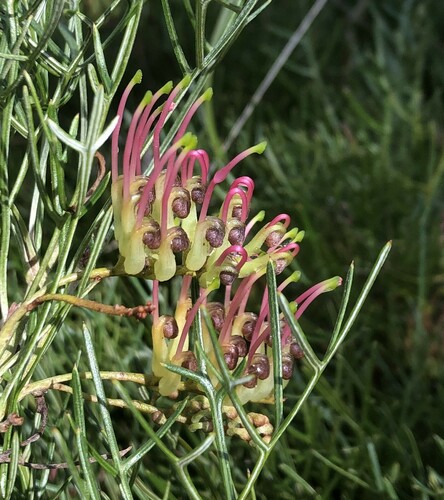
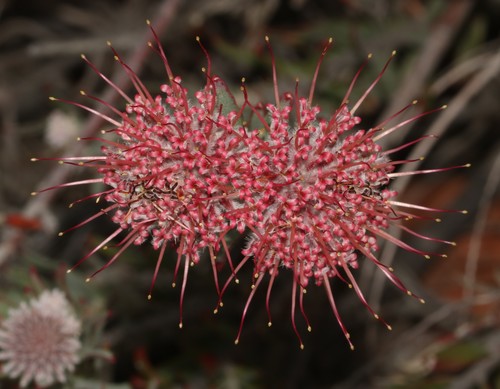
Grevillea buxifolia, commonly known as grey spider flower, is an erect to spreading shrub that typically reaches 0.5 to 2 metres (1 foot 8 inches to 6 feet 7 inches) in height.
Leaf Characteristics
Its leaves are egg-shaped, ranging from narrowly oblong to elliptic, measuring 7 to 35 millimetres (0.28 to 1.38 inches) long and 2.0 to 8.5 millimetres (0.079 to 0.335 inches) wide, with edges that are curved downward or rolled under.
Flower Structure
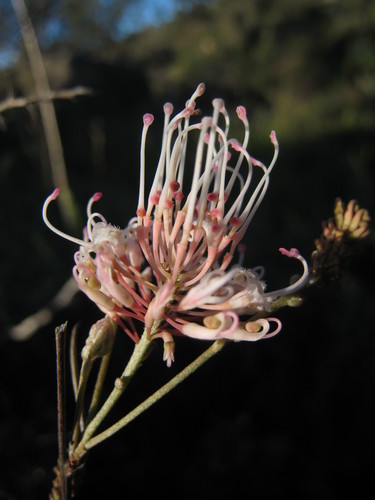
The flowers grow in clusters at the ends of branchlets, and are covered in woolly rust-coloured to fawn and whitish hairs; the pistil is 11 to 21 millimetres (0.43 to 0.83 inches) long.
Flowering Period and Fruit
Flowering occurs mainly from spring to autumn, and the fruit is an usually hairy oval follicle that is 18 to 22 millimetres (0.71 to 0.87 inches) long.
General Habitat and Distribution
This species grows in woodland or heath in New South Wales, where it occurs on the South Coast, Central Coast, and extends inland to near Pigeon House Mountain west of Ulladulla.
Subspecies Distribution
The subspecies Grevillea buxifolia subsp. ecorniculata is restricted to the area between Putty, Gospers Mountain and Wollombi, north-west of Sydney.