About Oreotragus oreotragus (Zimmermann, 1783)
Taxonomy and Physical Overview
The klipspringer (Oreotragus oreotragus) is a small, sturdy antelope.
Body Size Measurements
It stands 43–60 cm (17–23+1⁄2 in) tall at the shoulder, has a typical head-and-body length of 75 to 115 cm (30 to 45 in), weighs 8 to 18 kg (18 to 40 lb), and has a 6.5–10.5 cm (2+1⁄2–4+1⁄4 in) long tail. This species is sexually dimorphic: females are slightly larger and heavier than males.
Facial Features
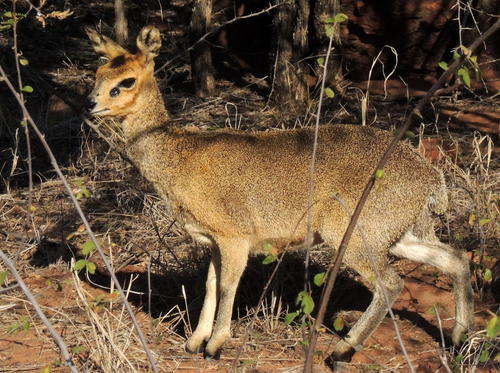
Key facial features include a brown forehead, short black-marked ears, prominent preorbital glands near the eyes, and white lips and chin.
Horn Characteristics
Short, spiky horns are only present on males, typically measuring 7.5–9 cm (3–3+1⁄2 in); the maximum recorded horn length is 15.9 cm (6+1⁄4 in).
Coat Coloration
The klipspringer's coat ranges from yellowish gray to reddish brown, which works as effective camouflage in its rocky habitat, and its underbelly is white.
Coat Structure and Adaptations
Unlike most other antelopes, the klipspringer has a thick, coarse coat made of hollow, brittle hairs. Grooming can even damage the incisors from these hairs, but the coat is an important adaptation that protects the animal during steep falls and provides effective insulation in the extreme climates of its mountain habitat.
Tick Distribution on Body
Research has found that ticks occur in larger numbers on the underbelly, where the hair is less coarse.
Hair Erection Behavior
The hair often stands erect, particularly when the animal is ill or its body temperature increases.
Gait and Hoof Adaptations
Another unique feature of the klipspringer is its gait: it walks on the tips of its cylindrical, blunt hooves. This improves grip on the ground, allowing the animal to climb and jump nimbly over rocky surfaces.
Subspecific Coat Variation
Subspecies differ in coat color: Cape klipspringer, Ethiopian klipspringer, golden klipspringer and Transvaal klipspringer have golden yellow coats, while Maasai klipspringer, Stevenson's klipspringer and Zambian klipspringer have ochre or rufous coats.
Subspecific Size Differences
Cape klipspringer populations tend to have the largest males, while Maasai klipspringer have the largest females.
Habitat Preferences
The klipspringer lives in areas with rocky terrain and sparse vegetation. It migrates to lowlands when food is scarce, and can be found at altitudes as high as 4,500 m (15,000 ft) on Mount Kilimanjaro.
High Population Density
In large, favourable habitats, klipspringer can reach high population densities: 10 to 14 individuals per square kilometre in Simien Mountains National Park, Ethiopia.
Typical Population Density
However, because its habitat is typically extensive rocky terrain with discontinuous grassy areas, typical population density is between 0.01 and 0.1 individual per square kilometre.
Geographic Range
This antelope is found in significant numbers across eastern and southern Africa; its range extends from northeastern Sudan, Eritrea, northern Somalia and Ethiopia in the east to South Africa in the south, and along coastal Angola and Namibia. Smaller populations live in the northern and western highlands of the Central African Republic, southeastern Democratic Republic of Congo, on the Jos Plateau, and east of Gashaka Gumti National Park in Nigeria. It is thought to be extinct in Burundi.
Activity Patterns
Klipspringer are typically nocturnal, active mainly at night. They rest during midday and late night, and tend to be more active on moonlit nights. They bask in morning sunlight to warm up.
Mating System
Klipspringer are gregarious, and like dik-diks and oribi, they are far more monogamous than most other antelopes. Opposite-sex individuals form pairs that usually last until one partner dies.
Pair Behavior
Mates generally stay within 5 m (16 ft) of each other most of the time: they take turns standing guard for predators while the other feeds, and face danger together. When threatened, klipspringer will hop a few metres away from danger.
Social Group Structure
Other social arrangements include small family herds of eight or more members, or solitary individuals.
Social Greeting Behavior
Klipspringer greet each other by rubbing cheeks during social encounters.
Territory Size
Males establish territories 7.5–49 hectares (18+1⁄2–121 acres) in size (territory size depends on rainfall patterns), where they live with their partner and offspring. Males are generally more vigilant than females.
Dung Heap Territory Marking
Klipspringer build large dung heaps, nearly 1 m (3 ft 3 in) across and 10 cm (4 in) deep, at territory borders.
Preorbital Gland Marking
They also mark territories by secreting a thick, black substance 5 mm (1⁄4 in) across from their preorbital glands onto vegetation and rocks within the territory. One study found that the tick Ixodes neitzi detects and aggregates on twigs marked by klipspringer, and another study showed that plants near territory borders next to neighbouring territories are particularly preferred for marking.
Vocalisation
The klipspringer's main vocalisation is a shrill whistle, performed as a duet by the mated pair, used for communication or as an anti-predator response.
Predators
Common predators of klipspringer include baboon, black-backed jackal, caracal, crowned eagle, leopard, martial eagle, serval, spotted hyena and Verreaux's eagle.
Ectoparasite Cleaning Symbiosis
Birds including familiar chats, pale-winged starlings, red-winged starlings and yellow-bellied bulbuls have been observed feeding on klipspringer ectoparasites.
Breeding Seasonality
Klipspringer are seasonal breeders, and the timing of mating varies geographically. Females reach sexual maturity by one year old; males take slightly longer to mature. Mating behaviour has not been widely studied.
Gestation and Birth
Gestation lasts around six months, after which a single calf weighing slightly more than 1 kg (2 lb) is born. Births peak from spring to early summer, and take place in dense vegetation.
Calf Rearing
Newborn calves are carefully hidden for up to three months to avoid predator detection; the mother suckles it three to four times a day, and these visits gradually get longer as the calf grows. Males protect their offspring, watching for other males and predators.
Juvenile Development and Lifespan
The calf is weaned at four to five months old, and leaves its mother when it reaches one year old. Klipspringer live around 15 years on average.