About Oncorhynchus mykiss (Walbaum, 1792)
Adult Weight
Description: Adult resident freshwater rainbow trout average between 0.5 and 2.5 kg (1 and 5 lb) in river environments, while lake-dwelling and anadromous forms may reach 9 kg (20 lb).
General Color Variation
Coloration varies widely across regions and subspecies.
Adult Freshwater Coloration
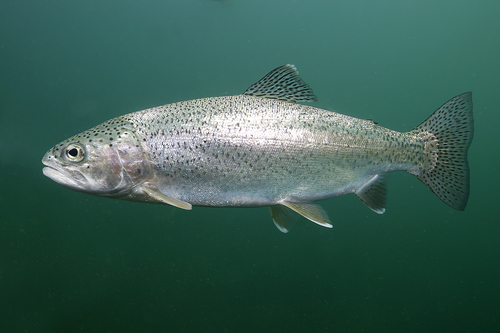
Adult freshwater forms are generally blue-green or olive green with heavy black spotting covering the full length of the body. Adult fish have a broad reddish stripe along the lateral line, running from the gills to the tail, which is most prominent in breeding males.
Caudal Fin Structure
The caudal fin is squarish and only mildly forked.
Lake/Anadromous Adult Coloration
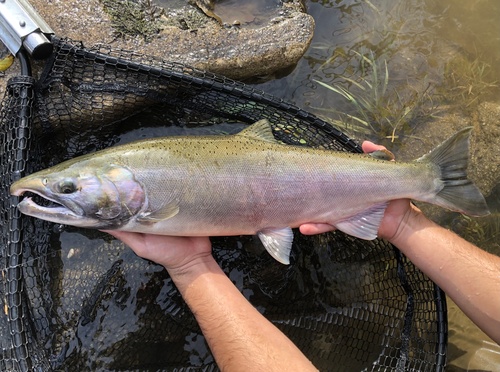
Lake-dwelling and anadromous forms are usually more silvery in color, with the reddish stripe almost completely absent.
Juvenile Parr Marks
Juvenile rainbow trout have parr marks (dark vertical bars), a trait typical of most juvenile salmonids. In some redband and golden trout forms, these parr marks are typically retained into adulthood.
Throat Markings
Some populations of coastal rainbow trout (O. m. irideus) and Columbia River redband trout (O. m. gairdneri), as well as cutbow hybrids, may also have reddish or pink throat markings similar to cutthroat trout.
Hatchery Trout Identification
In many regions, hatchery-bred trout can be distinguished from native trout by fin clips. Clipping the adipose fin is a common management tool used to identify hatchery-reared fish.
Native Pacific Range
Range: The native range of Oncorhynchus mykiss covers the coastal waters and tributary streams of the Pacific basin, from the Kamchatka Peninsula in Russia, east along the Aleutian Islands, through southwest Alaska, the Pacific coast of British Columbia and southeast Alaska, and south along the U.S. west coast to northern Mexico.
Southern Range Comparison
It has been claimed that the Mexican forms of Oncorhynchus mykiss represent the southernmost native range of any trout or salmon (Salmonidae), though the Formosan landlocked salmon (O. masou formosanus) in Asia lives at a similar latitude.
Subspecies Range Extensions
The range of coastal rainbow trout (O. m. irideus) extends north from the Pacific basin into tributaries of the Bering Sea in northwest Alaska, while forms of the Columbia River redband trout (O. m. gairdneri) extend east into the upper Mackenzie River and Peace River watersheds in British Columbia and Alberta, Canada, which eventually drain into the Beaufort Sea, part of the Arctic Ocean.
Introduced Global Range
Since 1875, rainbow trout have been widely introduced to suitable lake and river environments throughout the United States and around the world, and many of these introductions have established wild, self-sustaining populations.
Cutbow Hybrid Formation
Hybridization and habitat loss: When introduced into waters that hold cutthroat trout, rainbow trout (primarily hatchery-raised coastal rainbow trout subspecies O. m. irideus) will breed with cutthroats to produce fertile hybrids called cutbows.
Westslope Cutthroat Threat
For the westslope cutthroat trout (O. clarki lewisi), hybridization with introduced rainbow trout and Yellowstone cutthroat trout (O. clarki bouvieri) threatens the subspecies with genomic extinction.
Redband Trout Range Reduction
Such introductions into the ranges of redband trout (O. m. gairdneri, newberrii, and stonei) have severely reduced the range of pure stocks of these subspecies, making them "species of concern" in their respective ranges.
Kern River Trout Genetic Dilution
Within the range of the Kern River golden trout of Southern California, hatchery-bred rainbows introduced into the Kern River have diluted the genetic purity of Kern River rainbow trout (O. m. gilberti) and golden trout (O. m. aguabonita) through intraspecific breeding.
Beardslee Trout Threats
The Beardslee trout (O. m. irideus var. beardsleei), a genetically unique lake-dwelling variety of coastal rainbow trout isolated in Lake Crescent, Washington, is threatened by the loss of its only spawning grounds in the Lyre River to siltation and other types of habitat degradation.
Spawning Timing
Life cycle: Rainbow trout, including steelhead forms, generally spawn from early to late spring — January to June in the Northern Hemisphere, and September to November in the Southern Hemisphere — when water temperatures reach at least 6 to 7 °C (42 to 44 °F).
Maximum Lifespan
The maximum recorded lifespan for a rainbow trout is 11 years.
Resident River Habitat
Freshwater life cycle: Freshwater resident rainbow trout usually live and spawn in small to moderately large, well-oxygenated, shallow rivers with gravel bottoms.
Introduced River Habitat
They are native to the alluvial or freestone streams that are typical tributaries of the Pacific basin, but introduced rainbow trout have established wild, self-sustaining populations in other river types such as bedrock and spring creeks.
Lake Resident Habitat
Lake-resident rainbow trout are usually found in moderately deep, cool lakes with adequate shallows and vegetation to support sufficient food production.
Lake Population Spawning Requirement
Lake populations generally require access to gravelly-bottomed streams to be self-sustaining.
Spawning Site Characteristics
Spawning sites are usually a bed of fine gravel in a riffle above a pool.
Redd Construction
A female trout clears a redd (nest) in the gravel by turning on her side and beating her tail up and down.
Egg Production
Female rainbow trout usually produce 2000 to 3000 4-to-5-millimetre (5⁄32–3⁄16 in) eggs per kilogram of body weight.
Egg Fertilization Process
During spawning, the eggs fall into gaps between the gravel, and the female immediately begins digging at the upstream edge of the nest, covering the eggs with displaced gravel. As the female releases eggs, a male moves alongside and deposits milt (sperm) over the eggs to fertilize them.
Egg Hatching Timeline
The eggs usually hatch in about four to seven weeks, though hatching time varies greatly by region and habitat.
Alevin Stage
Newly hatched trout are called sac fry or alevin.
Fry Feeding Stage
After approximately two weeks, the yolk sac is completely consumed, and fry start feeding mainly on zooplankton.
Growth Rate Factors
The growth rate of rainbow trout varies with area, habitat, life history, and the quality and quantity of available food.
Parr Stage Development
As fry grow, they develop parr marks: dark vertical bars on their sides. In this juvenile stage, immature trout are often called "parr" because of these marks.
Fingerling Terminology
These small juvenile trout are sometimes called fingerlings because they are roughly the size of a human finger.
Stocked Trout Carryover
In streams where rainbow trout are stocked for sport fishing but no natural reproduction occurs, some stocked trout may survive, grow, and "carryover" for several seasons before being caught or dying.
Steelhead Regional Naming
Steelhead life cycle: The ocean-going (anadromous) form, including those returning to spawn, is known as steelhead in Canada and the U.S. In Tasmania, this anadromous form is commercially propagated in sea cages and called ocean trout, though it is the same species.
Spawning Return Trait
Like salmon, steelhead return to their original hatching grounds to spawn.
Iteroparity Trait
Similar to Atlantic salmon, but unlike their Pacific Oncorhynchus salmonid relatives, steelhead are iteroparous — able to spawn several times, with each event separated by months — and make multiple spawning trips between fresh and salt water, though fewer than 10 percent of native spawning adults survive from one spawning to the next. The survival rate for introduced populations in the Great Lakes is as high as 70 percent.
Smoltification Process
As young steelhead transition from freshwater to saltwater, a process called smoltification occurs: the trout undergoes physiological changes to allow it to survive in seawater.
Smoltification Genetic Basis
There are genetic differences between freshwater and steelhead populations that may explain why steelhead undergo smoltification.
Juvenile Freshwater Residency
Juvenile steelhead may stay in the river for one to three years before smolting and migrating to sea.
Steelhead Run Types
Individual steelhead populations leave the ocean and migrate into their freshwater spawning tributaries at different times of the year, and two general forms exist: "summer-run steelhead" and "winter-run steelhead".
Summer-Run Steelhead Traits
Summer-run fish leave the ocean between May and October before their reproductive organs are fully mature. They mature in freshwater while traveling to spawning grounds, where they spawn in the spring. Summer-run fish generally spawn in longer, more inland rivers such as the Columbia River.
Winter-Run Steelhead Traits
Winter-run fish are ready to spawn when they leave the ocean, typically between November and April, and spawn shortly after returning to fresh water. Winter-run fish generally spawn in shorter, coastal rivers typically found along the Olympic Peninsula and British Columbia coastline, though summer-run fish can also be found in some shorter, coastal streams.
Steelhead Spawning Behavior
Once steelhead enter river systems and reach suitable spawning grounds, they spawn just like resident freshwater rainbow trout.
Culinary Popularity
As food: Rainbow trout is popular in Western cuisine; both wild-caught and farmed fish are consumed. It has tender flesh and a mild, somewhat nutty flavor.
Wild vs Farmed Flavor
Wild-caught fish has a stronger, gamier taste than farmed fish. While the taste of wild-caught trout is often promoted as superior, rainbow trout and "steelhead" sold in American restaurants are typically farmed.
Farmed Trout Consumption Benefits
Farmed rainbow trout are considered one of the safest fish to eat, are noted for high levels of B vitamins, and have a generally appealing flavor.
Seafood Watch Ranking
Seafood Watch ranks farmed rainbow trout as a "Best Choice" fish for human consumption.
Montana Wild Trout Sale Rule
In Montana, it is illegal to sell or market wild-caught rainbow trout, which are legally classified as game fish.
Flesh Color Flavor Factors
The color and flavor of the flesh depend on the trout's diet and freshness.
Astaxanthin Flesh Color Link
Farmed trout and some wild trout populations, especially anadromous steelhead, have reddish or orange flesh due to high astaxanthin levels in their diets. Astaxanthin is a powerful antioxidant that may come from a natural source or a synthetic trout feed.
US Steelhead Labeling Practice
Rainbow trout raised to have pinker flesh from a diet high in astaxanthin are sometimes sold in the U.S. labeled as "steelhead". As wild steelhead are declining in parts of their range, farmed rainbow trout are viewed as a preferred alternative.
International Steelhead Labeling
In Chile and Norway, rainbow trout farmed in saltwater sea cages are sold labeled as steelhead.
Trout Cooking Preparation
Trout can be cooked as soon as they are cleaned, without scaling, skinning, or filleting. If cooked with the skin on, the meat tends to hold together better.
Regional Commercial Preparation Differences
While trout sold commercially in Europe is often prepared and served this way, most trout sold commercially in the United States have their heads removed and are fully or partially deboned and filleted.
Wine Pairing Recommendations
Medium to heavy-bodied white wines, such as chardonnay, sauvignon blanc, or pinot gris, are typical wine pairings for trout.
China Salmon Labeling Rule
In Mainland China, an industrial association ruled in 2018 that rainbow trout can be labeled and sold as salmon.