About Olneya tesota A.Gray
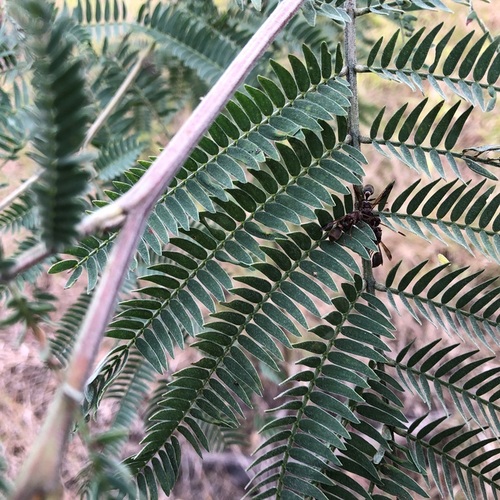
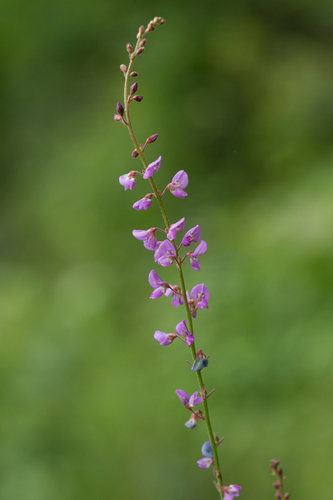
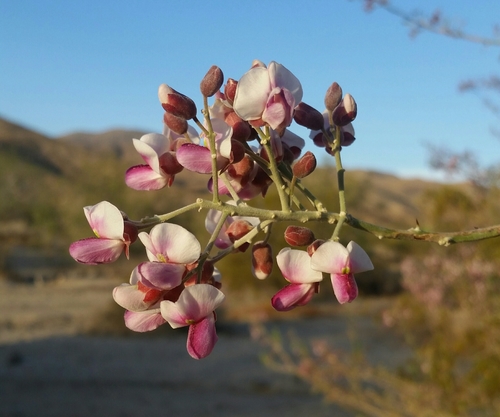
Desert ironwood (Olneya tesota A.Gray) grows as either a bush or a tree. It typically reaches about 10 meters (33 feet) in height, with an average trunk diameter of around 60 centimeters (24 inches). Exceptionally large specimens growing in larger protected washes can reach greater heights and develop much more massive trunks. Younger trees have gray, shiny, smooth bark, while older trees have broken, cracked bark. This species is an evergreen, but it will shed its leaves if temperatures drop below 2 °C (36 °F), or if it is exposed to extended drought conditions. Its leaves are bluish-green and pinnately compound, arranged on a 15 cm (6 in) long petiole. Each leaf holds 6 to 9 leaflets, and occasionally up to 15 leaflets, arranged as seven opposite pairs and one terminal leaflet; individual leaflets measure between 0.7 and 2.5 cm (1⁄4 to 1 in) long. Two thorns, each approximately 1 cm (3⁄8 in) long, grow at the base of each pinnate leaf petiole. It blooms from late April or May through June. Its flowers have five unequal petals, and come in shades of medium purple, magenta-red, or white to pale pink. Mature seedpods measure 5–8 cm (2–3 in) long, and turn light reddish-brown when ripe. Two other species, Parkinsonia florida (blue palo verde) and Acacia constricta (catclaw acacia), produce similar light red to brownish seedpods; the seedpods of catclaw acacia are shorter and J-shaped. Olneya tesota is native to the Southwestern United States and extreme northwestern Mexico, found across the Baja California Peninsula and within the Sonoran Desert. In Mexico, its range covers the states of Baja California and Baja California Sur, on the Gulf of California side east of the local cordillera ranges, and Sonora state west of the Sierra Madre Occidental cordillera, extending south close to the northern border of Sinaloa state. In the Southwestern United States, it occurs in the Colorado Desert (a subregion of the Sonoran Desert) in southeastern Southern California, and in western and southern Arizona. It does not grow in the higher-elevation, colder southeastern portion of Arizona’s Sonoran Desert, nor in the sky islands of the Madrean Sky Islands region. Bees and hummingbirds consume this tree’s pleasant-tasting sap. Phainopeplas (silky-flycatchers) can harm the tree: when they eat mistletoe berries and excrete the seeds into bark cracks on Olneya tesota, the mistletoe grows and parasitizes the tree. The seeds of Olneya tesota can be eaten after roasting. The ironwood from this species is extremely hard and heavy, with a density higher than water, so it sinks rather than floats downstream in washes, and can only be moved by the force of moving current. The considerable hardness of the wood makes processing difficult, and high density also makes finishing the wood with solution treatments challenging. Because mass processing of this wood is difficult, most commercial uses are artisanal, including creating durable wooden sculptures and knife handles.