About Orbexilum pedunculatum (Mill.) Rydb.
Growth Form and Height
Orbexilum pedunculatum is a herbaceous perennial plant with a long taproot that reaches 12 to 30 inches (30 to 76 cm) in height. Its slender stem branches occasionally, and can be either hairless or slightly downy.
Leaf Arrangement
The stem bears alternate, trifoliate leaves. Each leaf has a petiole that grows up to 2 inches (5 cm) long, with a pair of small lanceolate stipules at its base.
Leaflet Morphology
Leaflets can be up to 3 inches (8 cm) long and 0.75 inches (2 cm) wide, with an ellipsoid or oblong shape, entire margins, and acute tips. Lateral leaflets have no stalks, while the terminal leaflet has a short stalk.
Leaf Surface
The upper surface of the leaves is medium green and hairless.
Inflorescence Structure
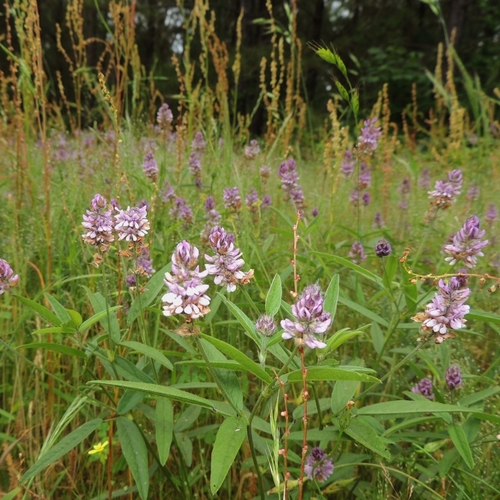
Inflorescences form dense racemes that grow from the axils of some leaves. They are held above the foliage on long, bare peduncles, and can reach up to 4 inches (10 cm) long.
Flower Characteristics
Each individual flower is 0.25 inches (1 cm) long, with five petals arranged in the typical pea family pattern. Flowers are blue-violet when in bud, and fade to pale violet or white once open.
Seedpod Features
After flowering, the plant produces nearly circular, flat seedpods with crinkled edges; each pod holds a single seed.
Native Range
Orbexilum pedunculatum is native to the southern and southeastern United States, and has been recorded in Alabama, Arkansas, Florida, Georgia, Illinois, Indiana, Kansas, Kentucky, Louisiana, Maryland, Michigan, Missouri, Mississippi, North Carolina, Ohio, Oklahoma, South Carolina, Tennessee, Texas, and Virginia.
Habitat
It typically grows on prairies, savannas, and in well-drained sandy soils within woodland areas.
Traditional Medicinal Uses
This plant has traditional uses in Cherokee Native American herbal medicine. Roots are made into a topically applied salve to help knit broken bones, and to treat wounds, ulcers, and boils.
Additional Medicinal Uses
Other parts of the plant are used as a tonic, to relieve indigestion, to induce sweating, and to stimulate blood flow during menstruation.
Similar Species Distinction
This plant should not be confused with other plants commonly called snakeroot: these include Aristolochia serpentaria (Virginia snakeroot, which contains toxic aristolochic acids), Ageratina altissima (white snakeroot, which contains toxic tremetol), Actaea racemosa (black snakeroot, also called black cohosh), and Sanicula canadensis (Canadian blacksnakeroot).