About Acacia glaucocarpa Maiden & Blakely
Scientific Name
Acacia glaucocarpa Maiden & Blakely
Description
Growth Form
Acacia glaucocarpa (common name hickory wattle) is a shrub or tree that typically grows to a height of 2.5–10 m (8 ft 2 in – 32 ft 10 in). It has slightly fissured grey or grey-brown bark, and terete, faintly ridged branchlets that bear woolly hairs near their tips.
Leaf Structure
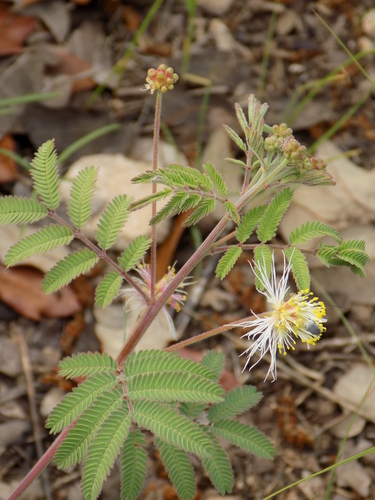
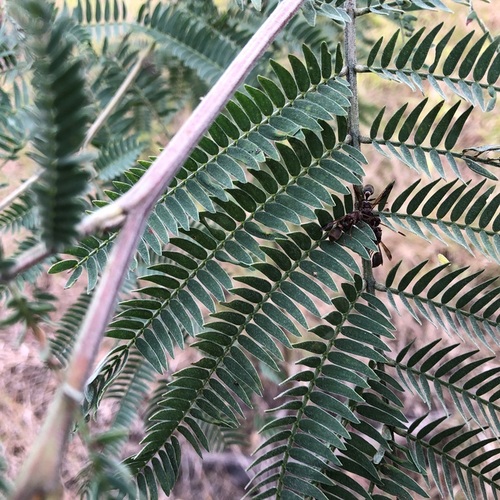
Its leaves are bipinnate and bluish green, with 3 to 8 pairs of pinnae that are 35–110 mm (1.4–4.3 in) long. The leaf rachis measures 30–100 mm (1.2–3.9 in) long, and the petiole is 10–30 mm (0.39–1.18 in) long.
Pinnule Features
Each pinna holds 12 to 33 pairs of pinnules, which are knife-like, narrowly oblong, narrowly elliptic, or lance-shaped, 5–14 mm (0.20–0.55 in) long and 2–4 mm (0.079–0.157 in) wide.
Flower Arrangement
Flowers are arranged in spherical heads grouped into panicles at branch ends or in leaf axils; each head contains 15 to 30 pale yellow or cream-coloured flowers. Flowering occurs from February to July.
Seed Pod Characteristics
The seed pods are roughly straight-sided, 50–130 mm (2.0–5.1 in) long and 6.5–10 mm (0.26–0.39 in) wide, slightly leathery, blue-green to blue-black, and more or less pruinose.
Distribution and habitat
Geographic Range
Hickory wattle has a wide distribution in open forest and woodland habitats in southeastern Queensland, Australia. Its range extends from approximately 82 km (51 mi) west of Emerald, Queensland, south to near the New South Wales border, and it is common in areas near Kingaroy and Ipswich.
Habitat Conditions
This species is recorded within protected areas and occurs across many localities. It typically grows on sandstone or sedimentary bedrock, most often in deep soil.