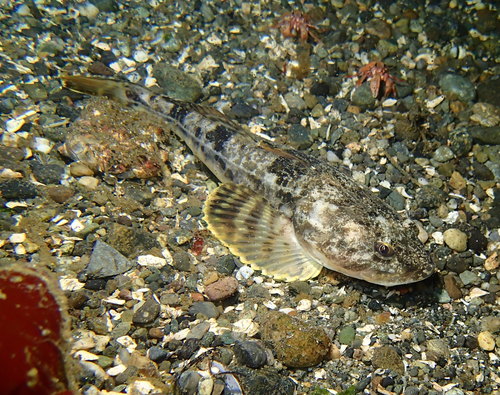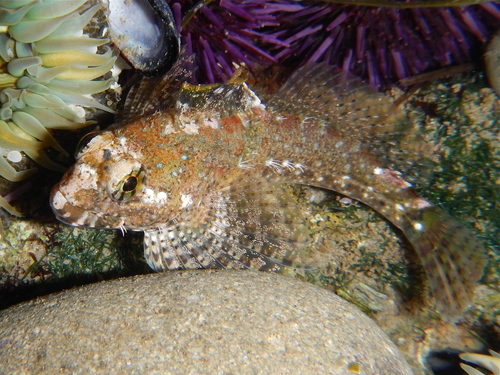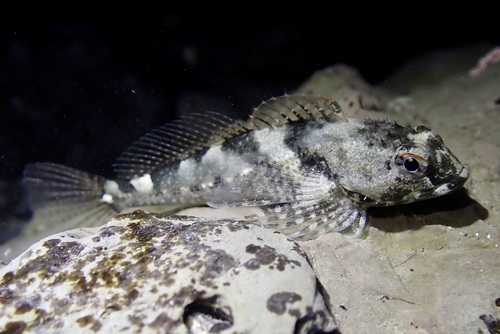
About Oligocottus maculosus Girard, 1856
Common Name and Size
Oligocottus maculosus Girard, 1856, commonly called the tidepool sculpin, grows to around 8 cm (3 in) in length.
Body and Fin Structure
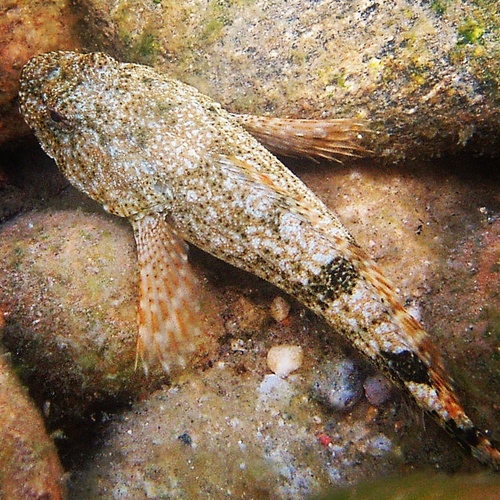
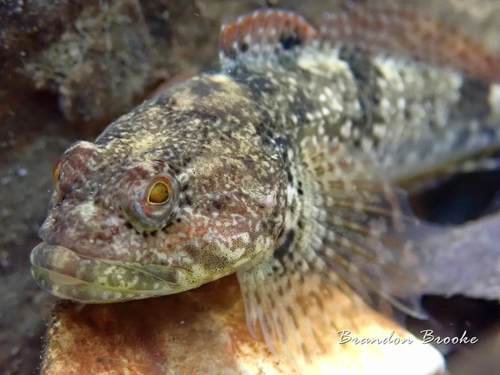
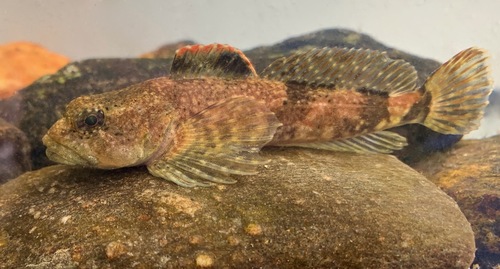
It has a large head, a tapering body, and spiny fins. It features a single pre-opercular spine and tufts of cirri on the top of its head, but unlike the closely related fluffy sculpin (Oligocottus snyderi), it does not have cirri on its body below the dorsal fin.
Coloration and Camouflage
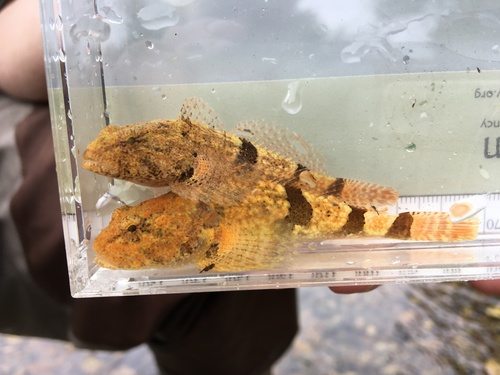
Its coloration varies widely; it is often marbled in shades of grey, brown, and white, but may also be reddish or greenish, and it can change color rapidly for camouflage.
Geographical Range
The tidepool sculpin is native to the northeastern Pacific Ocean, where its range extends from the Bering Sea to southern California.
Depth and Salinity Tolerance
It occurs at depths from the intertidal zone down to about 100 m (330 ft), and can tolerate both brackish water and full-strength seawater. Compared to other sculpin species like the fluffy sculpin, it is found higher up the shore and has a higher tolerance for warmer water.
Habitat and Movement
The tidepool sculpin is a common small fish that inhabits intertidal rock pools on rocky coasts, and it often moves quickly between hiding places.
Homing Ability
It has a remarkable homing ability, returning to its resident pool each time the tide recedes. Studies have shown that it can return to its home pool from a distance of 102 m (335 ft) even after being displaced for six months.
Diet
It is a predator that feeds on small invertebrates including isopods, amphipods, gastropod molluscs, polychaete worms, and barnacles, as well as insects that fall into the water. Small amounts of algae are also part of its diet.
Predators
When the tide is high, tidepool sculpins are preyed on by diving birds and predatory fishes.
Rough Water Behavior
They move higher up the shore during rough sea conditions.
Air Breathing Ability
This species can leave the water to breathe air, exchanging both oxygen and carbon dioxide, while hiding in a damp location. It evades predators by flapping or wriggling to reach a safer spot.
Sexual Maturity Size
Tidepool sculpins reach sexual maturity when they are around 35 mm (1.4 in) long.
Reproductive Anatomy
Males have modified anal fin rays; these are either used as claspers for internal fertilization, or the male clasps the female and fertilizes eggs as they are laid.
Egg Laying
Small clusters of eggs are laid in late winter, usually in crevices or empty barnacle shells.
Larval Development
The larvae are planktonic in the open ocean, and sometimes school near the seabed in embayments. After 30 to 60 days, the larvae move back into rock pools and develop into juvenile fish.
Growth Factors
Overcrowding in a pool affects their growth rate.