About Leptocottus armatus Girard, 1854
Scientific Name and Common Name
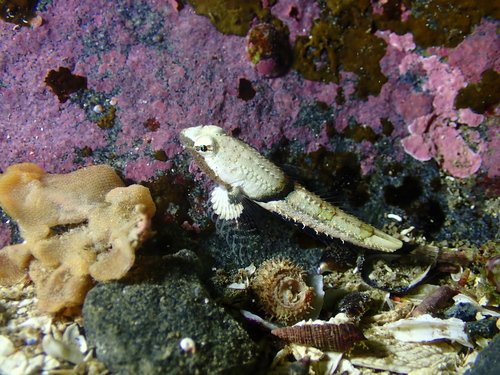
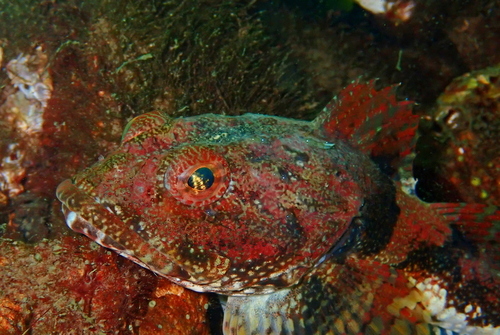
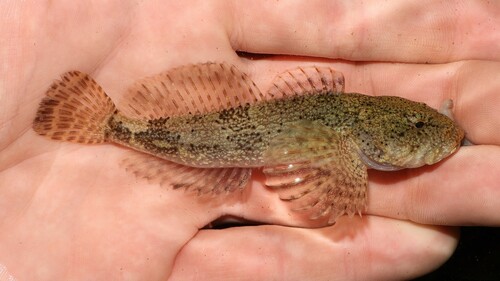
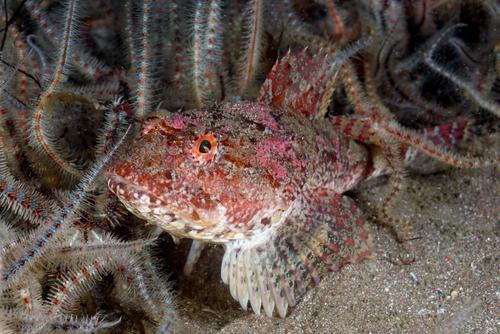
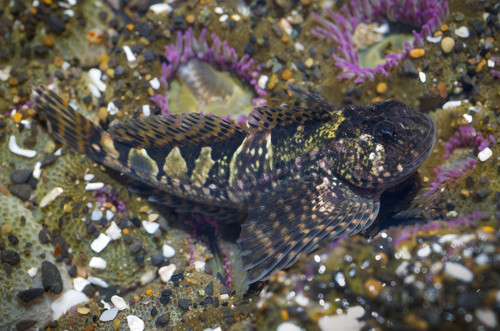
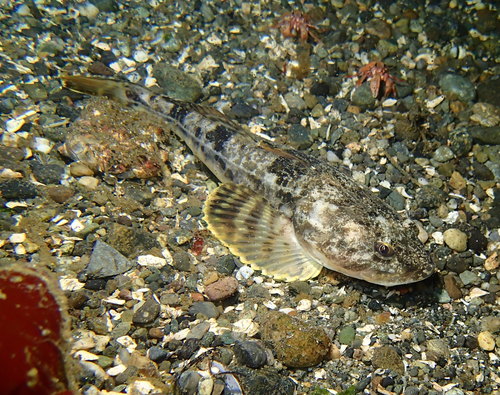
Leptocottus armatus Girard, 1854, commonly known as the Pacific staghorn sculpin, is a slender fish with a wide, large, highly flattened head that tapers toward the tail.
Body Coloration
Its upper body is overall grayish-olive with faint yellow tints, fading to creamy yellow on the underside. This species is reported to be able to change its color for camouflage.
Anal, Pelvic and Caudal Fin Coloration
The anal and pelvic fins are lighter in color, while the caudal fin is dusky with 1 or 2 light-colored bars.
Dorsal Fin Coloration
The dorsal fins are continuous; the first dorsal fin is marked with black spots close to the tips of its rearmost 3 spines and has a white band along its base, while the second dorsal fin is dusky with a number of diagonal white to yellowish bands.
Pectoral Fin Coloration
The pectoral fins are yellow and marked with 5 or 6 dark green bars.
Head and Preoperculum Features
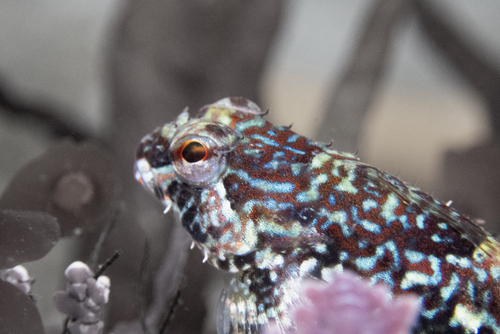
This fish has large eyes placed on the top of the head, a large wide mouth filled with many small teeth, and a preoperculum with a large spine that ends in three or four sharp, recurved spinules.
Fin Ray Counts
The dorsal fins are supported by between 6 and 8 spines and between 15 and 20 soft rays, while the anal fin has 14 to 20 rays.
External Body Features
The caudal fin is rounded, the species has no scales, and its lateral line is straight.
Size
Pacific staghorn sculpins reach a maximum total length of 46 cm (18 in), with 35 cm (14 in) being more typical.
Distribution Range
This species is distributed in the eastern Pacific Ocean along the western coast of North America, ranging from Izembek Lagoon on the southeastern Bering Sea coast of Alaska south to San Quintín, Baja California.
Habitat and Substrate Preference
Pacific staghorn sculpins are commonly found near shore, particularly in bays and estuaries, most often on sandy substrates.
Life Stage Habitat Differences
Adults of the species live in sheltered marine estuaries, while juveniles inhabit freshwater streams and upper estuarine environments.