About Odorrana hosii (Boulenger, 1891)
Nomenclature
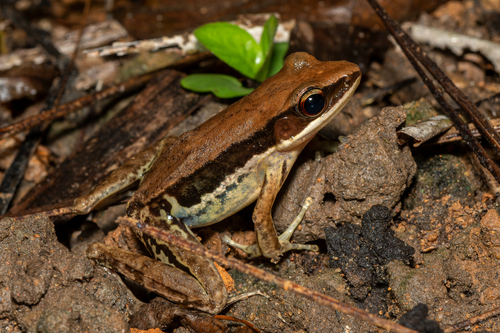
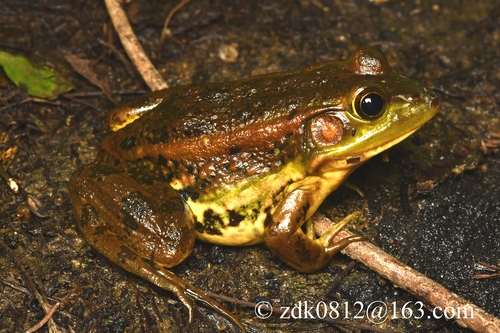
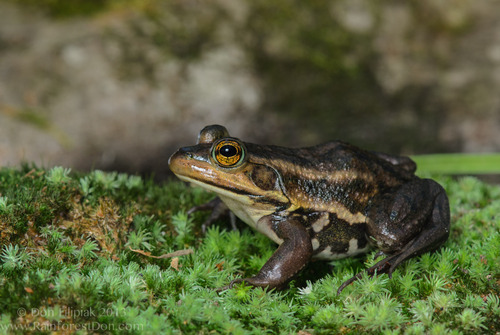
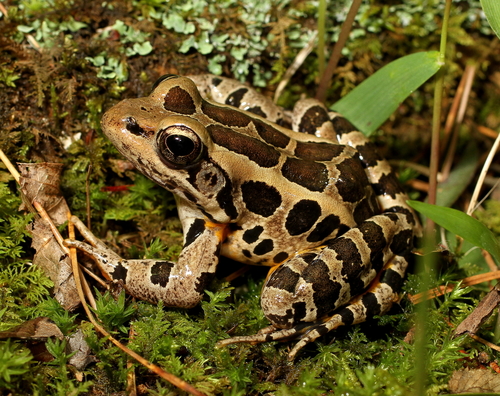
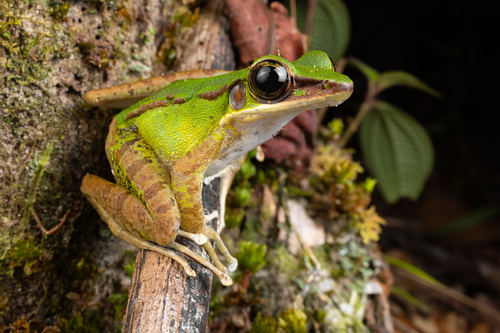
This species, Odorrana hosii (Boulenger, 1891), commonly known as Hose's frog, has a robust body with long, slender legs.
Adult Size
Males measure 50–60 mm in length, while females measure 85–100 mm.
Coloration
The dorsal surface is dark green with brown sides, the ventral surface is pale, and the limbs are marked with dark crossbars.
Limb Morphology
Its finger and toe tips bear grooved discs.
Dorsal Color Variation
There are many variations in this frog's dorsal colouration, including solid green, solid brown, green with brown dots, and brown with green dots.
Vocalization
Its call resembles the "cit" sound made by rats.
Tadpole Morphology
Its tadpoles apparently lack suctorial discs.
Geographic Range
Hose's frog has been recorded from the Malay Peninsula south of the Kra Isthmus, as well as Phuket, Tioman, Borneo, the Batu Islands, Sumatra, Simeulue, Bangka Island, Belitung, and Java.
Habitat and Elevation
It inhabits clear, swift streams and rivers, and the surrounding rainforest, occurring at elevations up to 1,700 meters above sea level.
Population Trend and Threats
While its population has declined in recent times due to deforestation, it remains widely distributed and abundant.
Habitat Tolerance
There is evidence that it is more tolerant of pollution and more willing to occupy secondary forest than many other frog species in the region.
Conservation Status
For these reasons, the IUCN lists this species as a Species of Least Concern.
Oviposition Habit
Eggs are probably deposited in water in a manner broadly similar to other true frogs.
Egg Morphology and Oviposition Site
However, the eggs within their gelatinous outer layer are cream-coloured and lack a dark hemisphere, which suggests the species uses a specialized oviposition site.