About Ocyceros birostris (Scopoli, 1786)
Common Name and Size
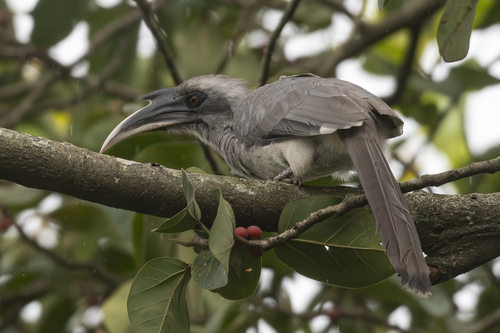
Ocyceros birostris, commonly known as the Indian grey hornbill, is a medium-sized hornbill that reaches approximately 61 cm (24 in) in length.
Upperpart Plumage
Its upperparts are greyish brown, with a faint pale supercilium, and darker ear coverts. Its wing flight feathers are dark brown with whitish tips.
Tail Features
Its tail has a white tip and a dark subterminal band.
Head and Bill Features
Individuals have red irises, eyelashes on their eyelids, and a short, pointed casque on the bill.
Male Morphology
Males have a larger casque on a dark bill, with yellowish culmen and lower mandible, and dark bare skin around the eye.
Female Morphology
Females usually have pale reddish bare skin around the eye, and a more yellowish bill with black coloring on the basal half of the bill and the casque.
Juvenile Morphology
Juveniles do not have a casque, and have dull orange bare skin around the eye.
Core Distribution Range
This species is mainly found on plains up to around 610 m (2,000 ft), ranging south from the Himalayan foothills, bounded to the west by the Indus system and to the east by the Ganges Delta.
Local Movement and Habitat
It may make local movements in the drier western region, and can even be found in cities with old avenue trees.
High Elevation Sighting
It has been observed, usually in pairs, in Dharamsala town, Himachal Pradesh at approximately 1500 to 1600 meters above sea level during summer and the rainy season from May to September 2017.
Range Overlap
It does not overlap much in range with the Malabar grey hornbill of the Western Ghats.
Vocalization
The Indian grey hornbill's call is a squeal similar to that of a black kite.
Flight Pattern
Its flight is heavy, consisting of bouts of flapping interspersed with glides.
Social Grouping
It occurs in pairs or small groups.
Nesting Season
Its nesting season runs from April to June.
Clutch Characteristics
Clutch size ranges from one to five very symmetrical white eggs.
Nest Site Selection
Indian grey hornbills typically nest in tree hollows in tall trees; they may further excavate an existing hollow to suit their needs.
Nest Entrance Sealing
The female enters the nest hollow and seals the nest entrance, leaving only a small vertical slit that the male uses to feed her. The female seals the nest entrance using her own excreta and mud pellets supplied by the male.
Nesting Female Behavior
While inside the nest, the female moults her flight feathers and incubates the eggs.
Male Nest Maintenance
The male brings a steady supply of bark pieces to the nest to absorb waste and maintain the cavity's micro-climate.
Nest Exit Timing
The regrowth of the female's flight feathers aligns with the maturity of the chicks, at which point the nest is opened.
Key Fruit Diet
A study of a nest near Mumbai found that the key fruiting trees this hornbill feeds on are Streblus asper, Cansjera rheedii, Carissa carandas, Grewia tiliaefolia, Lannea coromandelica, Ficus spp., Sterculia urens and Securinega leucopyrus.
Faunal Diet
Indian grey hornbills also eat molluscs, scorpions, insects, small birds (they have been recorded removing and possibly preying on rose-ringed parakeet chicks), and reptiles.
Toxic Fruit Consumption
They are known to feed on the fruits of Thevetia peruviana, which are toxic to many vertebrates.
Ground Behavior
They are almost completely arboreal, only very rarely descending to the ground to pick up fallen fruits, take dust baths, or collect mud pellets for sealing the nest cavity during the nesting period.
Social Activities
They engage in various social activities, including bill-grappling and aerial jousting.