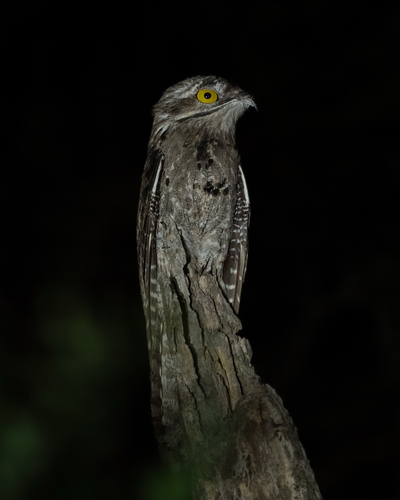
About Nyctibius griseus (J.F.Gmelin, 1789)
Size
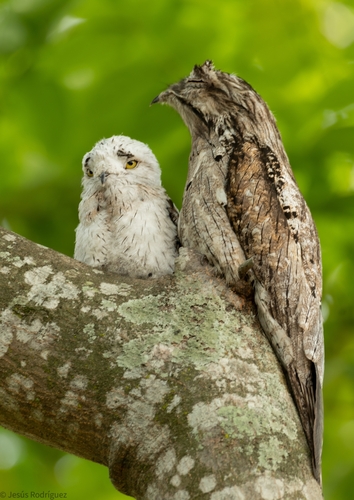
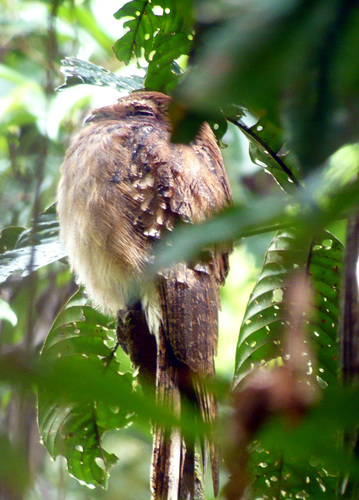
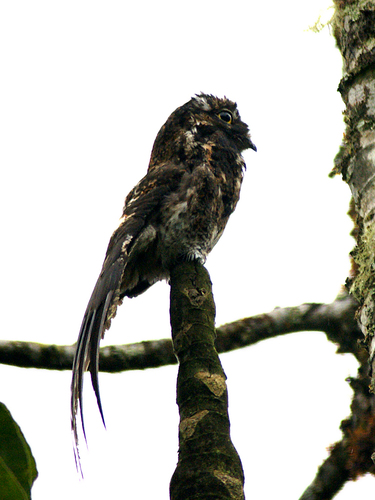
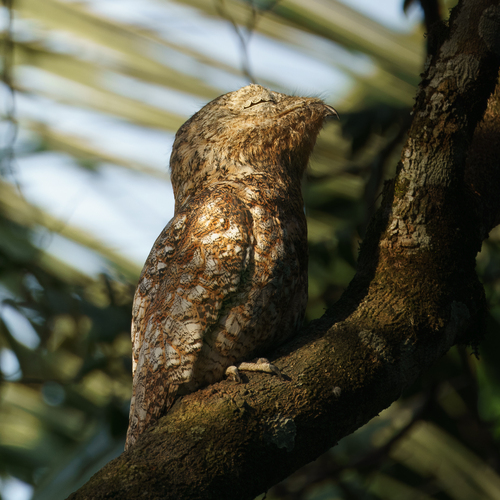
Common potoos, scientifically named Nyctibius griseus, are 34–38 cm (13–15 in) long, with mottled red-brown, white, black, and grey cryptic plumage.
Camouflage Adaptation
This disruptive coloration lets them camouflage against tree branches. Males and females look very similar, and cannot be told apart through visual observation.
Eye Appearance
Their eyes can either look like large black dots with a small yellow ring, or large yellow irises with small pupils, because the bird can voluntarily constrict its pupils.
Eyelid Slits
The common potoo has two or three slits in its eyelid that stay open at all times, letting it see even when its eyelids are closed.
Eyelid Movement
Its upper and lower eyelids can move independently and rotate over the eye to the desired position, so the bird can adjust its field of vision.
Mouth Structure
It has an unusually wide mouth, with a tooth on the upper mandible that is used for foraging.
Primary Song
Its song is haunting and melancholic: a repeating BO-OU, BO-ou, bo-ou sequence that gradually drops in both pitch and volume.
Seizure Call
When seized, the bird produces a squeaky sound similar to that of a crow.
Call Comparison
This call is very different from the much deeper, more dramatic call of the northern potoo.
Nominate Subspecies Range
The nominate subspecies of the common potoo is found in Trinidad and Tobago and every mainland South American country except Chile, though it has been recorded as a vagrant in Chile. In its South American range, it occurs from the Andes to the Atlantic Ocean.
N. g. panamensis Range
The subspecies N. g. panamensis ranges from eastern Nicaragua south through Costa Rica and Panama, and west of the Andes from northwestern Venezuela through Colombia and Ecuador into northwestern Peru.
Breeding and Habitat Type
The common potoo is a resident breeder that lives in open woodlands and savannah.
Elevation Limitations
It avoids cooler montane regions, and is rarely seen above 1,900 m (6,200 ft) above mean sea level even in the warmest parts of its range.
Arid Region Occurrence
It generally avoids arid regions, but was recorded in the dry Caribbean plain of Colombia in April 1999.
Uruguay-Brazil Border Populations
It has many populations living in gallery forest-type environments around the border between Uruguay and Brazil.
Southern Edge Range Rarity
A bit further south, where the ratio of woodland to grassland is somewhat lower, it is decidedly rare.
Argentina Population Status
Further due west, in Argentina's Entre Ríos Province which has abundant riparian forest, it is also not common.
Southern Population Movement
Birds at the southern end of the common potoo's range may migrate short distances northward during winter.