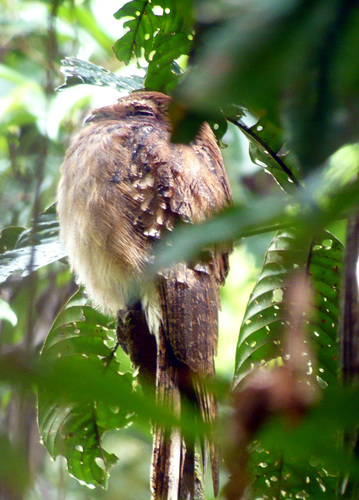
About Nyctibius aethereus (zu Wied-Neuwied, 1820)
Size and Weight
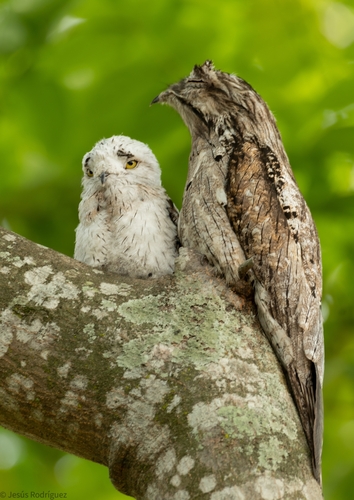
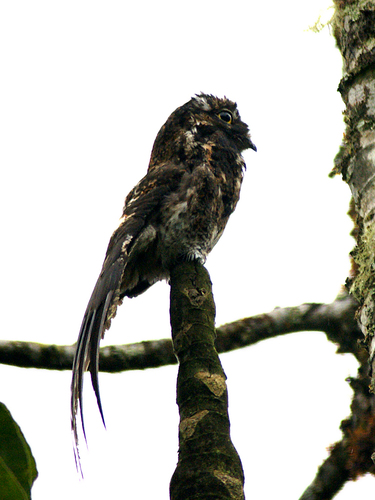
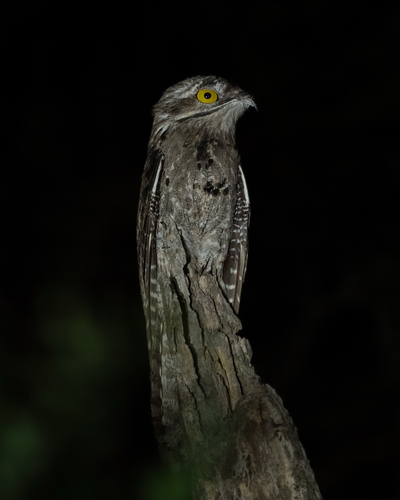
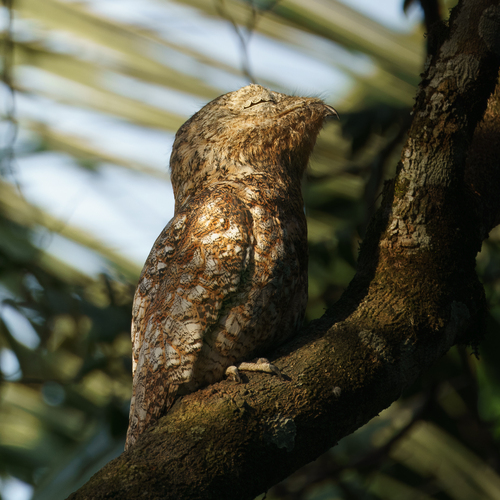
The long-tailed potoo (Nyctibius aethereus) measures 42 to 58 cm (17 to 23 in) in length and weighs 280 to 447 g (9.9 to 15.8 oz).
Nominate Subspecies Upperpart Coloration
The nominate subspecies has tawny brown upperparts. Its crown and nape feature buff spots, speckles, and blackish brown streaks. Its mantle, back, and rump are mottled with brown and buff, and also bear blackish brown streaks.
Tail Characteristics
It has a graduated tail that is overall brown, marked with tawny buff barring and brown streaks or vermiculation.
Facial and Wing Markings
Most of its face is tawny, and it has a buffish "moustache". Its wings are generally brown with broad pale tawny bars.
Underpart Coloration
The chin and throat are grayish buff. Its breast and flanks are brown, with buff speckles, blackish brown streaks, and bold buff and blackish brown spots. Its lower belly is buff with brown streaks and vermiculation.
Subspecies N. a. longicaudatus Traits
Subspecies N. a. longicaudatus is smaller than the nominate subspecies, and is often a more tawny brown overall, especially on the breast.
Subspecies N. a. chocoensis Traits
Subspecies N. a. chocoensis is smaller than N. a. longicaudatus but darker. Its black upperpart streaks are larger and bolder, and its brown base color tends toward chestnut.
Nominate Subspecies Distribution
The nominate subspecies of long-tailed potoo occurs in far northeastern Argentina, southeastern Paraguay, and southeastern Brazil, from approximately Minas Gerais and southern Bahia south to Paraná.
N. a. chocoensis Distribution
N. a. chocoensis is found only in Chocó Department, western Colombia.
N. a. longicaudatus Distribution
N. a. longicaudatus has by far the widest distribution of the three subspecies; it lives in Amazonia from Ecuador and Peru east through southern Colombia and Venezuela to the Guianas, in far northern Bolivia, and across much of western Brazil.
Forest Habitat Preferences
The long-tailed potoo lives in the interior of lowland tropical evergreen forests, where it is most commonly found from the understory to the subcanopy. These forests range from rather dry to very wet in humidity.
Nominate Subspecies Elevation Range
In the Atlantic Forest region, the nominate subspecies occurs up to 1,200 m (3,900 ft) in elevation.
Other Subspecies Elevation Ranges
The other two subspecies are found at lower elevations, reaching only 700 m (2,300 ft) in Ecuador and 750 m (2,460 ft) in Peru.