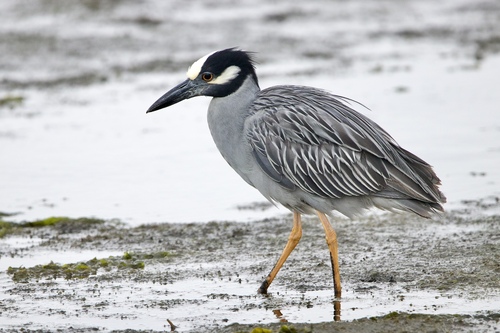
About Nyctanassa violacea (Linnaeus, 1758)
Taxonomy and Nomenclature
The yellow-crowned night heron, scientifically named Nyctanassa violacea, is one of just two night heron species that belong to the genus Nyctanassa.
Unlike the black-crowned night heron which has an extensive worldwide distribution, the yellow-crowned night heron is found only in the Americas.
In French it is called bihoreau violacé, and in some Spanish-speaking regions it is known as pedrete corona clara or yaboa común.
General Range Overview
This heron species is found exclusively across the Americas, and its range is closely tied to the availability of its main food source, crustaceans.
Yellow-crowned night herons spend the winter in locations with warm enough climates to support year-round crab activity.
Winter and Permanent Resident Range
These winter and year-round resident areas include tropical and subtropical regions, southern Florida, the Gulf Coast from Louisiana to Alabama, and the eastern Texas coast.
The species is also generally a permanent resident in Mexico, Central America, the Galápagos Islands, the Caribbean, and northern South America, reaching as far south as coastal Peru and Brazil.
Breeding Range Expansion
Between 1925 and 1960, the yellow-crowned night heron expanded its breeding range northward for reasons that remain unclear today.
During the breeding season, the species can be found in the inland southeast of the United States, in addition to its existing winter and year-round range.
Additional isolated breeding colonies have been recorded even further inland, extending all the way to the northern United States border.
General Habitat Requirements
Yellow-crowned night herons occupy habitats with shallow water.
Inland populations live in marshes, wooded swamps, and along lakeshores, while coastal populations occupy thickets, mangroves, and cliff-bordered coasts.
They can also live in areas that do not hold consistent water but flood regularly.
Habitat Salinity Tolerance
The species' habitat is closely linked to the habitat of the crustaceans that make up most of its diet, and it tolerates fresh, brackish, and saltwater.
Nesting Site Requirements
Nesting sites are another important habitat requirement.
Yellow-crowned night herons need bushes or trees to build their nests, though they will use rock ledges when vegetation is unavailable, such as on cliffs.
Human Coexistence
Unlike the black-crowned night heron, the yellow-crowned night heron does not avoid living near humans.
It can often be found in wooded residential neighborhoods, and will even nest on rooftops and driveways.
This close cohabitation does not always proceed peacefully, and can lead to conflicts with humans.