About Notelaea lloydii Guymer
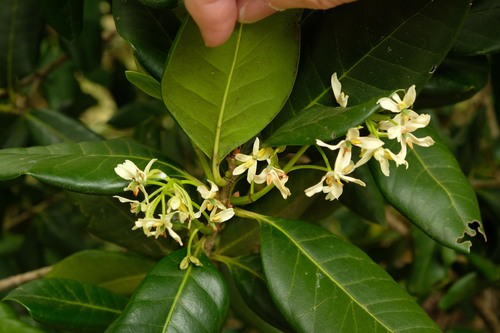
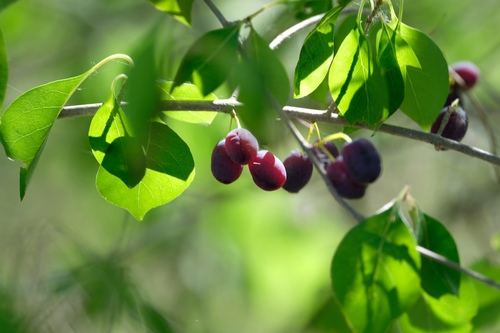
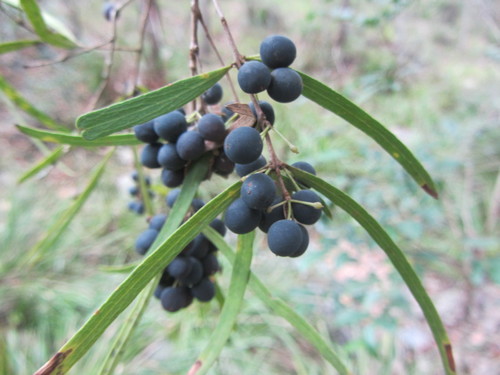
Notelaea lloydii, commonly known as Lloyd's olive, is a multi-branched shrub that usually reaches a height of 1 to 3 meters (3 feet 3 inches to 9 feet 10 inches). Its leaves are more or less hairless, leathery, and shaped either linearly or slightly like a sickle. They measure 70 to 140 millimeters (2.8 to 5.5 inches) long, 2.0 to 5.5 millimeters (0.079 to 0.217 inches) wide, and grow on a petiole 1 to 2 millimeters (0.039 to 0.079 inches) long. The leaf edges curve slightly downward, and leaf veins are clearly visible on the upper surface of the leaf. The flowers are pale yellow or cream-colored, arranged in clusters of 5 to 9 that grow 5 to 10 millimeters (0.20 to 0.39 inches) long from leaf axils. Sepals are 0.2 to 0.6 millimeters (0.0079 to 0.0236 inches) long. Petals are egg-shaped, with 4 egg-shaped lobes 0.9 to 2.2 millimeters (0.035 to 0.087 inches) long that join in pairs above the base of the stamens. The ovary is hairless, measuring 0.7 to 1 millimeter (0.028 to 0.039 inches) long, with a style 0.10 to 0.15 millimeters (0.0039 to 0.0059 inches) long and a pink, two-lobed stigma. Flowering takes place from June to early August. The fruit is a spherical to oval drupe 6 to 8 millimeters (0.24 to 0.31 inches) long and 5 to 8 millimeters (0.20 to 0.31 inches) in diameter. This species is only known from two populations located near Beaudesert and near Laidley. It typically grows in open eucalypt forest, most often near the edges of vine thickets.