About Fraxinus profunda (Bush) Bush
Species Nomenclature and Growth Form
Pumpkin ash, scientifically named Fraxinus profunda (Bush) Bush, is a medium-sized deciduous tree.
Size Dimensions
It typically reaches 12 to 30 meters (39 to 98 ft) in height, with a trunk up to 1 meter in diameter; exceptional individual trees can grow to 50 meters (160 feet) tall with a 4.7 meters (15 feet) diameter trunk.
Bark Characteristics
Key morphological traits of pumpkin ash are as follows: Mature trees have gray, thick bark that is fissured in a diamond pattern.
Bud Traits
Its buds are dark brown to blackish with a velvety texture.
Leaf Structure
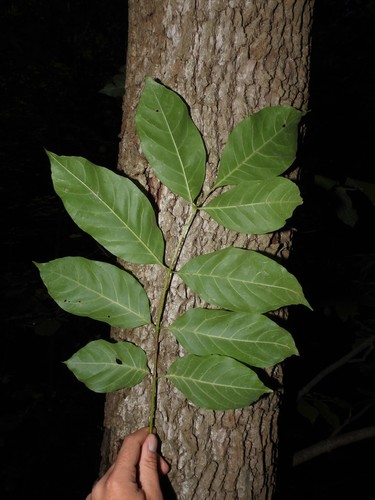
The leaves are 25 to 40 centimeters (9.8 to 15.7 inches) long, oppositely arranged, and pinnately compound with 7 to 9 leaflets.
Leaflet Dimensions and Margins
Each leaflet is 8 to 20 centimeters (3.1 to 7.9 inches) long and 5 to 8 centimeters (2.0 to 3.1 inches) broad, with smooth or obscurely serrated margins and short petiolules.
Leaflet Surface Features
The abaxial (lower) surfaces of leaflets are tomentose and do not have a dense covering of papillae, which is visible at greater than 40x magnification.
Flower Traits
Its flowers are wind-pollinated, purplish-green, lack a corolla, are borne in panicles, and bloom in spring shortly before leaves emerge.
Fruit Characteristics
The fruit is a samara 5 to 8 centimeters (2.0 to 3.1 inches) long, containing a single seed with an elongated apical wing 9 millimeters (0.35 inches) broad.
Sexual System
Like other species in the section Melioides, pumpkin ash is dioecious: male and female flowers grow on separate individual trees.
Trunk Base Trait
Pumpkin ash trees often develop bulbous swollen trunk bases, and this trait is sometimes noted as a diagnostic feature for the species.
Trunk Trait Caveats
However, not all pumpkin ash trees display this feature, and other ash species such as green ash can also develop swollen trunks when growing in very wet habitats.
Native Range
Pumpkin ash has a discontinuous native range in eastern North America.
Distribution Details
It occurs mainly in swamps and river bottoms of the Atlantic coastal plain, Mississippi valley, and lower Great Lakes basin, and is noticeably absent from intervening regions such as the Appalachian Mountains.
Regional Population Status
Widespread damage caused by the invasive emerald ash borer has left pumpkin ash near extirpation in North Carolina, South Carolina, and Florida, and it is considered critically endangered in Canada.
Sexual Maturity Timing
Pumpkin ash reaches sexual maturity and begins producing fruit at approximately ten years of age.
Seed Development Schedule
Seeds develop over the summer and are dropped in early fall.
Seed Dispersal Adaptations
The winged samaras are adapted for wind dispersal, but pumpkin ash seeds are uniquely adapted to water dispersal and can survive submersion for several months.
Seedling Growth Requirements
Seedlings grow best in moist soils within canopy openings and are sensitive to shade.
Juvenile Growth Rate
Young trees grow extremely quickly and can rapidly reach a height that allows them to compete with mature trees.
Habitat Preferences
Pumpkin ash grows primarily in swamps, floodplains, and other wet bottomland habitats.
Ecological Role as Larval Host
Along with other ash species, it serves as a food plant for the larvae of multiple Lepidoptera species.
Primary Threat
Pumpkin ash is threatened by the emerald ash borer, an invasive insect that has destroyed large numbers of ash trees across eastern North America.
IUCN Conservation Status
In 2017, the IUCN assessed pumpkin ash as Critically Endangered, due to observed massive population declines across most of its range.
Canadian Conservation Listing
In 2021, pumpkin ash was listed as endangered in Canada under the Species at Risk Act, 2002.
Resource Use Overview
Pumpkin ash provides resources for both humans and animals including deer and birds.
Avian Food Use
Birds such as wood ducks feed on the fruit of Fraxinus profunda.
Deer Food Use
Deer feed on the tree's twigs and leaves.
Human Lumber Use
Humans use the woody portions of the tree as lumber for building.
Tool Component Use
In addition to lumber, pumpkin ash wood is also used to make tool components such as tool stocks or handles.
Additional Commercial Uses
It is also used for lumber, naval store products, and nursery stock products.