About Nepeta cataria L.
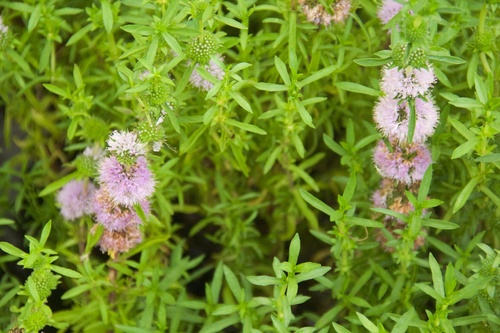
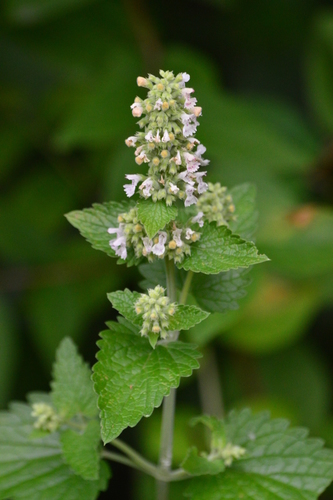
Nepeta cataria L. is a short-lived herbaceous perennial that regrows from a shallow taproot, and grows 30 to 100 cm (12 to 39 in) tall, usually producing several stems. Like most members of the mint family, each stem is square in cross-section, and has a somewhat gray color. Older plants tend to grow more branches, and especially healthy individuals develop a mound shape. The leaves have a canescent appearance, and appear white because they are covered in fine hairs; this hair coverage is particularly dense on the underside of the leaves. Leaves grow in opposite pairs attached to opposite sides of the stems. Leaf shapes range from cordate (heart-shaped), deltoid (triangular), to ovate (egg-shaped). They are attached via petioles (leaf stems), and measure 2 to 9 cm (0.8 to 3.5 in) long and 0.6 to 6 cm (0.2 to 2.4 in) wide. Leaf margins are coarsely crenate to serrate, ranging from wavy, rounded edges to forward-pointing asymmetrical saw-like teeth. Flowers are arranged in loose groups as an inflorescence: the lowest flowers are more widely spaced, while flowers toward the end are more tightly packed into a spike. These inflorescences grow at the tips of branches, and reach 2 to 8 cm (0.8 to 3.1 in) long, with inconspicuous bracts. A single plant can produce several thousand flowers, but fewer than 10% of these will be in full bloom at any given time. The individual flowers are somewhat small and inconspicuous, but very fragrant. They are bilaterally symmetrical, and measure 10 to 12 mm (0.39 to 0.47 in) long. Their petals are off-white to pink, and usually dotted with purple-pink spots. Flowers are bilabiate: the upper lip has two lobes, while the lower lip is much wider with a scalloped edge. The fruit is an egg-shaped nutlet that is nearly triquetrous, meaning it is three-sided with sharp edges and concave sides. It measures approximately 1.7 by 1 mm (0.067 by 0.039 in). Each nutlet can hold between one and four seeds. The nutlets are dark reddish-brown with two white spots near their base. According to Plants of the World Online, catnip is native to most of Eurasia. In Europe, it is confirmed native to southern regions around the Mediterranean and to eastern Europe, but sources disagree on whether it is native to northern European countries including the Baltic Countries, Germany, the Netherlands, and the United Kingdom. Around the Mediterranean, it is confirmed native to Portugal, Spain, France, Corsica, Italy, Switzerland, the former Yugoslavia, Albania, and Greece. In Eastern Europe, it is native to Bulgaria, Romania, Ukraine, Belarus, European Russia, and the Caucasus. It is generally agreed to be an introduced species in Scandinavia and Poland, and it may also grow in Ireland. In Asia, its range extends from Turkey into Syria, Lebanon, and Iraq, and continues eastward to Iran, Pakistan, and the western Himalayas, but does not extend further into India. It is native to all of Central Asia including Afghanistan, Kazakhstan, Kirghistan, Tajikistan, Turkmenistan, and Uzbekistan, and also extends to western Siberia. Its native status is disputed in China, the Russian Far East, Nepal, Korea, and Japan. In Africa, it may grow in Morocco, but this report is doubtful. It also occurs as an introduced species on the island of Java. In Australia, it has been reported in the states of South Australia, New South Wales, Victoria, Queensland, and Tasmania. It was introduced to New Zealand in 1870, and now grows on both the North and South Islands. In North America, it grows across Canada from the island of Newfoundland to British Columbia, but does not occur in Labrador or the three northern Canadian territories. In the United States, it is present in 48 states, and is only absent from Florida and Hawaii. In South America, it grows across many parts of Argentina as well as in Colombia. It grows in a wide variety of soil types, including clay, sand, and even shallow rocky soil. It requires good drainage to avoid waterlogging. The plant terpenoid nepetalactone is the main chemical component of Nepeta cataria's essential oil. Nepetalactone can be extracted from catnip via steam distillation. Nepeta cataria is cultivated as an ornamental garden plant. It is also grown for its ability to attract house cats and butterflies. The plant is drought-tolerant and deer-resistant, and can act as a repellent for certain insects, including aphids and squash bugs. Catnip grows best in full sunlight, and forms a loosely branching, low perennial. The cultivar Nepeta cataria 'Citriodora', also called lemon catmint, is known for the strong lemon scent of its leaves.