About Platycercus elegans (Gmelin, 1788)
Common Name and Size
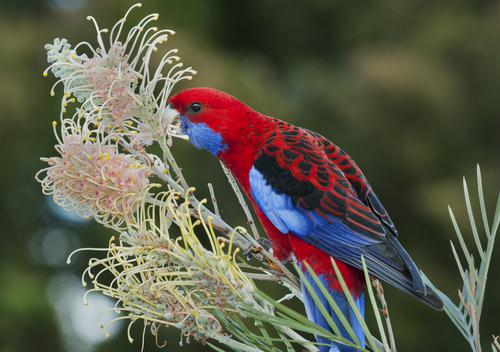
Platycercus elegans, commonly called the crimson rosella, is a medium-sized Australian parrot that measures 36 cm (14 in) in total length, with much of this length made up by its tail.
Subspecies Classification
There are seven recognized subspecies of this parrot, three of which have primarily crimson coloration.
Subspecies Color Variation
In the variety flaveolus, the red coloration is replaced by yellow, while the Adelaide rosella subspecies has a mix of red, orange, and yellow coloration.
Juvenile vs Adult Coloration (South-eastern Populations)
In south-eastern populations, adults and juveniles typically have strikingly different coloration; juvenile birds have mostly greenish-olive body plumage, which remains most prominent on the nape and breast.
Maturation Color Change
Juveniles are described as 'ripening' as they mature, changing their body coloration from green to red.
Shared Plumage Features Across Races
All races of Platycercus elegans have blue cheeks, black-scalloped wings with blue margins, a mostly blue tail, and predominantly red overall body coloration.
Tail Feather Use By Other Species
The blue tail feathers of the crimson rosella are one of the favorite decorations used by the satin bowerbird.
Bill and Iris Traits
This species has a pale grey bill and dark brown iris.
Sexual Dimorphism Extent
There is very little sexual dimorphism in crimson rosellas.
Sexual Dimorphism Specific Traits
The most noticeable difference between males and females is that males are up to 15% larger, and have a relatively larger and wider beak.
Native Australian Range
The native range of the crimson rosella extends from southeastern South Australia, through Tasmania, Victoria and coastal New South Wales, into southeastern Queensland.
Disjunct North Queensland Population
A separate, disconnected population lives in North Queensland.
New Zealand Introduction History (Otago Heads)
Around 1910, a small number of crimson rosellas were released off the Otago Heads, New Zealand, alongside eastern rosellas.
These two populations interbred, and by the 1950s no pure crimson rosellas remained in the area.
Persistence of Otago Heads Hybrid Population
This mixed population has persisted in Otago Heads ever since.
Wellington City Introduced Population
Crimson rosellas were also present as an introduced species in Wellington City from 1963 through the early 1990s.
Tararua Foothills Sighting Record
Two individual crimson rosellas were also recorded in the Tararua foothills in 1971.
New Zealand Wild Extinction Status
Crimson rosellas are now thought to be extinct in the wild in New Zealand.
Norfolk Island Introduction Origin
Crimson rosellas were brought to Norfolk Island as cage birds during the first penal settlement there.
Norfolk Island Establishment Timeline
After escaping into the wild, the species was reported on Norfolk Island before 1838, and had become numerous by 1900.
Norfolk Island Local Common Name
On Norfolk Island, they are often called 'red parrots' to distinguish them from the native Norfolk Island parakeet, which is called 'green parrots' there.
General Habitat Range
Crimson rosellas are common in coastal and mountain forests across all altitudes.
Preferred Forest Habitats
They primarily inhabit forests and woodlands, and prefer older, wetter forest habitats.
Natural Forest Type Occurrence
They can be found in tropical, subtropical, and temperate rainforests, both wet and dry sclerophyll forests, riparian forests, and open woodlands, ranging from sea level all the way up to the tree line.
Human-modified Habitat Use
They will also occupy human-modified areas such as farmlands, pastures, fire-breaks, parks, nature reserves, gardens, and golf courses.
Treeless Area Occurrence
They are rarely found in completely treeless areas.
Roosting Behavior
At night, they roost on high tree branches.