About Aratinga weddellii (Deville, 1851)
Nomenclature
The dusky-headed parakeet, with the scientific name Aratinga weddellii (Deville, 1851), is also called Weddell's conure or dusky-headed conure in aviculture.
General Appearance and Native Range
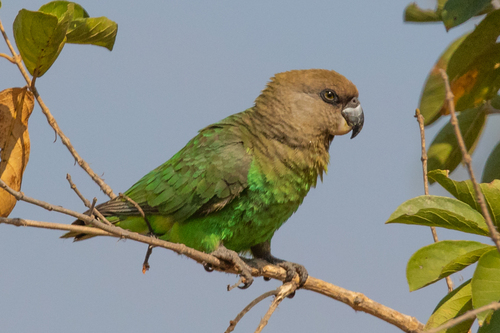
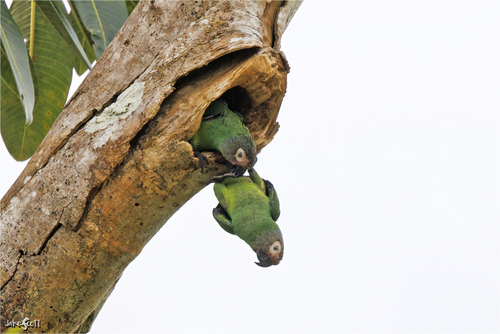
It is a small green Neotropical parrot with a dusty grey head, native to wooded habitats in the western Amazon basin of South America.
Natural Distribution
Its distribution ranges from southeastern Colombia south through eastern Ecuador, eastern Peru, and southwest Amazonian Brazil, to central Bolivia.
Feral Population
Recently, a feral colony has been sighted in coastal districts of Lima, Peru, where these birds likely originated from escaped pets that became established in the city.
Habitat Preference
This species prefers semiopen habitats such as várzea, forest edge, and forest remnants, and can also be found in coffee plantations.
Population Status
It is generally common, and its habitat preference makes it less vulnerable than many other Amazonian parrot species.
Conservation Classification
Because of this, BirdLife International and the IUCN classify it as Least Concern.
Plumage Mutations
This long-tailed parrot is overall green in color; rare lutino and blue mutations exist in captivity.
Head and Feather Coloration
It has a gray-brown head, a blue-tipped tail, and remiges that are dark gray from below and mainly blue from above.
Facial and Bill Features
Its bill is black, and it has a broad, bare white eye-ring that sometimes has a yellow tinge.
Size and Weight
It measures 25–28 cm (10–11 in) in length on average, and weighs around 100 grams, making it slightly smaller than the sun conure.
Common Colloquial Name
Many people refer to these conures as mini-macaws, because they have bare skin near their beaks and eyes, similar to macaws.
Social Behavior
The dusky-headed parakeet is a social species, usually found in pairs or small groups.
Flocking Behavior
It may even form mixed flocks with different species of conures, and can gather in flocks of up to 100 individuals when food is abundant.
Diet Components
Its diet consists of fruit, seeds, and flowers; it also searches decaying wood for insect larvae, and ingests mineral-rich soil from locations such as clay licks as a dietary supplement.
Clay Consumption Function
Eating clay is thought to provide extra minerals and neutralize toxins found in the species' diet.
Predators
Like many other neotropical parrots, its predators include a variety of birds of prey, monkeys, and in some cases, jaguars.
Nesting and Parental Care
Pairs of dusky-headed parakeets raise their offspring together, nesting in woodpecker holes in trees or arboreal termite nests.
Captivity Adaptability
They adapt well to captivity.
Captive Breeding
They are fairly easy to breed when provided with a durable nest box, and can lay up to three clutches of eggs per year.
Captive Temperament
Compared to other conure species, they are relatively quiet, but are still energetic and playful, like most conures.
Captive Lifespan
In captivity, their lifespans range from 25 to 50 years, with a typical lifespan of 35–40 years.