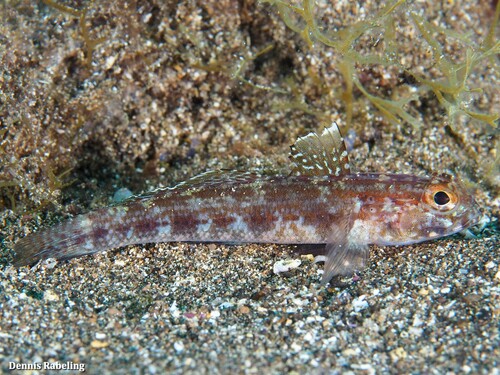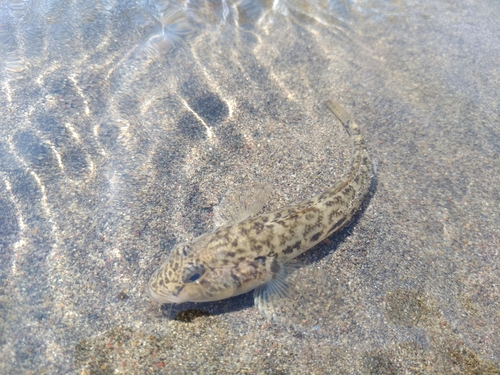
About Neogobius fluviatilis (Pallas, 1814)
Species Nomenclature
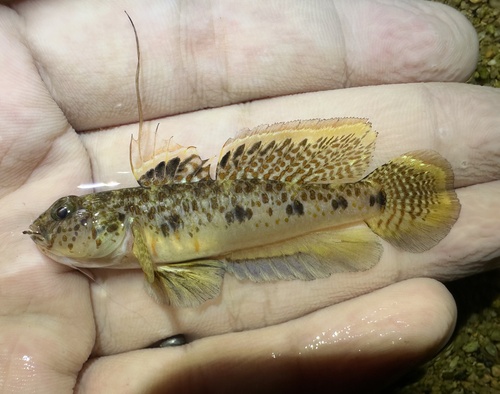
Neogobius fluviatilis, commonly called the monkey goby, has the following physical characteristics.
Scale Distribution
Cycloid scales cover its head, nape, back, one third of the gill covers, the bases of the pectoral fins, and the posterior half of the throat and belly.
Dorsal Fin Size
Its second dorsal fin is small relative to the posterior end of its body.
Head and Snout Morphology
The width of its head is equal to or slightly greater than its head height, and the head ends in an acuminated, or leaf-shaped, snout.
Jaw and Teeth Structure
The jaws of this species hold small, conical teeth, and the mandibles are positioned forward in the skull.
Abdominal Suckers
A line of suckers runs along the monkey goby’s abdomen, extending from the collar to the anus.
Body Coloration and Pattern
Its base color is brownish gray or yellowish gray, and it usually has a very pale brown pattern of merged dark spots.
Fin Markings
Rows of dark spots also appear on its dorsal and caudal fins.
Adult Length
The average adult monkey goby reaches 7–10 centimeters in length, though the species can grow up to 18–20 centimeters long.
Typical Weight
Individuals typically weigh around 50 grams.
Native Range General
The monkey goby’s natural range consists of fresh and brackish water basins connected to the Black Sea and the Sea of Marmara.
Sea of Marmara Basin Distribution
Within the Sea of Marmara basin, it is commonly found in Lake Manyas, Lake Sapanca, and the Kazoli River in the Bosporus Strait.
Black Sea Region Distribution
In the Black Sea and its surrounding areas, the monkey goby is common in all desalinated water, including the Danube river and its tributaries, the lagoons and estuaries of the north-western Black Sea, the Sea of Azov, and the rivers of the Caucasus.
Invasive Range General
The monkey goby has recently been recorded as an invasive species in several European countries.
First Hungarian Invasive Record
It was first documented as a non-native species in Lake Balaton, Hungary in 1970.
Danube River Invasion Spread
It was found in the Middle Danube in Hungary in 1984, and by 2001 it had spread to the Slovak-Hungarian section of the Danube River.
Baltic Sea Basin Invasion
It was first recorded as an invasive species in the Baltic Sea basin in 1997, and it has since become common in the Włocławek Reservoir and Zegrze Reservoir.
Western Europe Invasion Records
It has been present in the German section of the Rhine River since March 2009, and has also been found in the Waal River near Nijmegen, the Netherlands.
Greek Invasion Record
In August 2011, the monkey goby was recorded for the first time in Greece’s Evros River, which flows into the Aegean Sea.