About Naja sputatrix Boie, 1827
Taxonomy and Defensive Adaptation
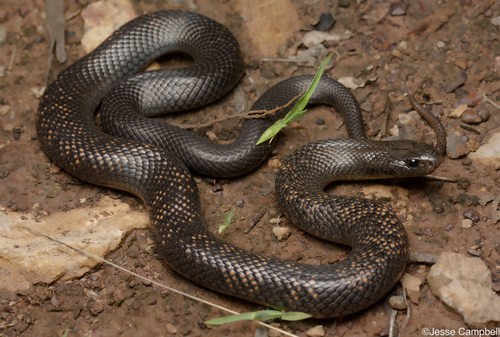
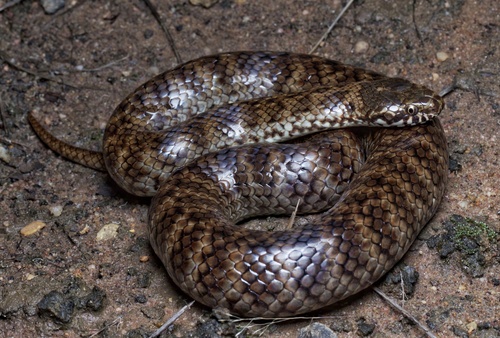
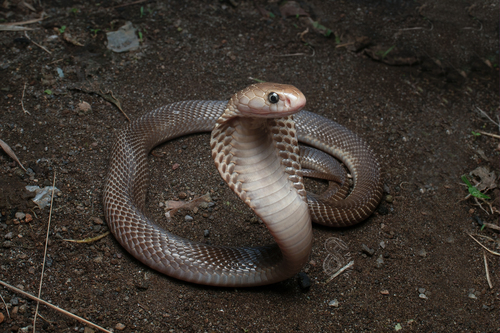
The Java spitting cobra (Naja sputatrix Boie, 1827) is a medium to large-sized snake with long cervical ribs that can expand to form a hood when the snake feels threatened. Its body is compressed dorsoventrally, and cylindrical toward the posterior end.
Size
Adults average 1.3 metres (4.3 ft) in length, and can reach a maximum length of around 1.85 metres (6.1 ft). It has an elliptical head that is slightly distinct from the neck, with a short rounded snout and large nostrils.
Head and Eye Features
Its eyes are moderate in size, with round pupils. Dorsal scales are smooth and very oblique, and usually have a dorsal scale count of 25–19.
Coloration Variation
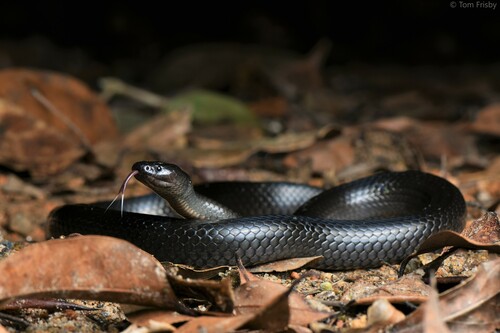
There are differences in colouration and pattern between Javan specimens and specimens from other islands where the species occurs. Most adult Javan individuals are uniform yellowish, brown, or blackish, while juveniles often have throat bands and lateral throat spots.
Hood Markings
Not all specimens have a distinct mark on their hood; when a mark is present, it is most often chevron-shaped.
Native Range
This cobra species is native to the Indonesian island of Java, and the Lesser Sunda Islands of Bali, Lombok, Sumbawa, Komodo, Flores, Lomblen, and Alor. It may possibly also live on other islands in the Lesser Sunda group.
Range Observations
One individual was found on Rinca Island on 26 December 2015. Confirmation is still needed to confirm whether the species is also present on Timor and Sulawesi.
Sulawesi Specimen Status
While a single specimen has been observed on Sulawesi, researchers think this specimen may have originated from Java, as it was indistinguishable from Javan specimens.
Western Java Population Surveys
Researcher De Hass studied this species in two districts of western Java: it was relatively uncommon in Nandjoeng Djaja, and was not recorded at all in Bandjarwangi, which sits at an altitude of 900 metres (3,000 ft). A 1998 study by FB Yuwono found the species was abundant across Java.
Altitude Records
Dunn (1927b) reported that specimens collected on Komodo were found from sea level up to 650 metres (2,130 ft), which is the highest recorded altitude this species has been found at.
Habitat Range
The Java spitting cobra occurs mostly in tropical forests and wet forests, but adapts well to a wide range of habitats across its island range, including more arid regions, dry woodlands, and cultivated hill country. On Komodo, it has been observed in habitats including dry savanna and deciduous monsoon forest.
Spitting Behavior
Some sources have reported that Komodo specimens of this species are reluctant to spit, but field observations contradict this claim.
Predation
This species is a common prey item for the Komodo dragon.
Defensive Behavior
Naja sputatrix is very defensive, and will readily spit venom when it feels threatened. It is a terrestrial, nocturnal snake.
Diet
It preys mainly on small mammals such as small rats and mice, but will also feed on frogs, other snakes, and lizards. In a 1998 study, herpetologists Shine and Boeadi measured and dissected 80 Javan specimens of this species, and found that most prey items taken were mammals.
Mating Period
Mating for this species takes place during the dry season, which runs from August to October. Females usually lay eggs at the end of the dry season in November, or at the very start of the wet season.
Clutch Size
Clutches can hold between 13 and 19 eggs, with an average clutch size of around 16 eggs. Javan females can produce and lay up to 36 eggs total, with an average production of 25 eggs.
Egg Incubation
According to researcher Kopstein, the incubation period for eggs is around 88 days. Like other elapids, hatchlings are fully independent immediately after birth.