About Hydrophis schistosus Daudin, 1803
Hydrophis schistosus Daudin, 1803 is a venomous sea snake species.
Scale Identification Features
This species can be identified by its specific scale characteristics: the rostral scale is longer than it is broad, and contacts four shields; the frontal scale is also longer than it is broad, and shorter than the parietal scales; nasal scales contact the two anterior labials, and are sometimes partially divided; there is one preocular scale, and one or two postocular scales; temporals number 1–3; there are seven or eight upper labials, with either the fourth, or the third and fourth labials extending to the eye, and the last upper labial is sometimes divided; anterior chin-shields are rather indistinct and separated.
Scale Arrangement
Scales bear a tubercle or keel, and are arranged in 50–70 rows; ventrals number 230–314, and are slightly enlarged.
Coloration
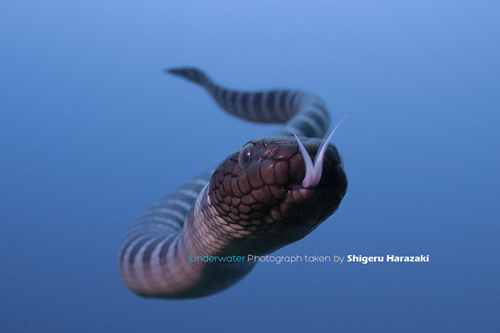
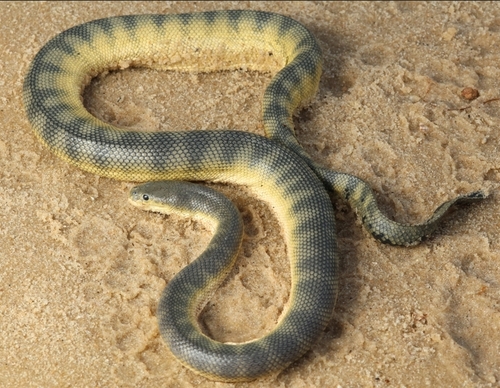
Adult individuals are usually uniformly dark grey on the upper body, with whitish sides and underparts. Young specimens are olive or grey with black transverse bands that are broadest across the middle of the body.
Size
The maximum recorded head-and-body length is 1110 mm, with a tail length of 190 mm.
Local Names
Local names for the species include Vala Kadiyan in Tamil and valakadyn in Malayalam; both names translate to "net biter".
Distribution Range
This species is distributed in the Arabian Sea and Persian Gulf (found in waters off Bahrain, Iran, Iraq, Kuwait, Oman, Qatar, Saudi Arabia and the United Arab Emirates), in waters south of the Seychelles and Madagascar, in the seas off South Asia (off Pakistan, India, including coasts from Gujarat to West Bengal and the Andaman & Nicobar Islands, Sri Lanka, and Bangladesh), and in Southeast Asian seas (off Myanmar, Thailand, and Vietnam).
Taxonomic Revision
Populations previously attributed to this species from Australia (Northern Territory and Queensland) and New Guinea are now provisionally identified as Enhydrina zweifeli, because DNA tests confirmed they are not related to this species.
Habitat
In terms of habitat and behavior, this species is generally found along the coast and on coastal islands of India, where it is among the most common of the 20 native species of sea snake.
Activity Pattern
It is active both during the day and at night.
Diving Abilities
It can dive to depths of up to 100 m, and can stay underwater for a maximum of five hours before needing to resurface.
Physiological Adaptations
Like other sea snakes, it has specialized salt glands to eliminate excess salt from the body.
Temperament
It is venomous and notably aggressive, with some herpetologists describing it as "cantankerous and savage".
Venom Toxicity
An estimated 1.5 milligrams of its venom is considered lethal to humans.
Diet
Its primary food source is fish.