About Acanthophis antarcticus (Shaw, 1802)
Scientific Classification & Body Form
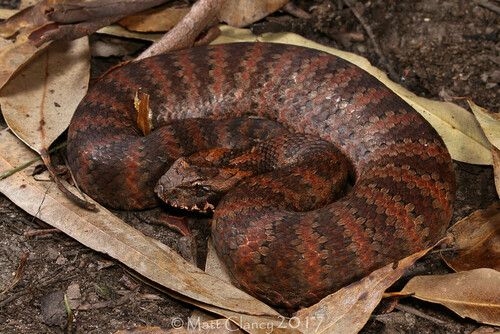
The common death adder, Acanthophis antarcticus (Shaw, 1802), has a broad, flattened triangular head and a thick body marked with red, brown, and black bands, with a belly that can be grey, cream, or pink. It reaches a maximum body length of 70 to 100 centimetres, which equals 2.3 to 3.3 feet.
Taxonomic Family Placement
Unlike the common or European adder (Vipera berus), the common death adder belongs to the elapid snake family Elapidae, rather than Viperidae, a family that does not occur in Australia.
Australian Distribution
The common death adder is distributed across most of eastern and coastal southern Australia, including Queensland, New South Wales, and South Australia. It is much less common in the Northern Territory, Western Australia, and western parts of South Australia, and is no longer found in Victoria.
Global Distribution
It is also native to Papua.
Habitat Types
This species lives in forests, woodlands, grasslands, and heaths along Australia's eastern coast.
Camouflage & Microhabitat
Its banded patterning makes the common death adder an expert at camouflage, and it hides under loose leaf litter and debris in woodland, shrubland, and grassland.
Reproductive Strategy
Unlike most snake species, common death adders give birth to live young rather than laying eggs.
Litter Characteristics
In late summer, a female produces a litter of 3 to 20 live offspring, though single litters of more than 30 young have been recorded.