About Myoporum montanum R.Br.
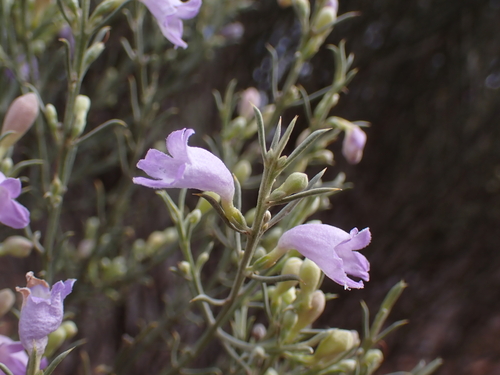
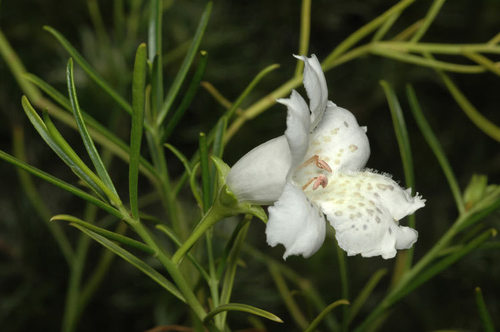
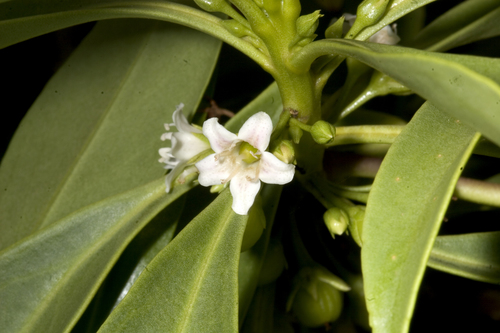
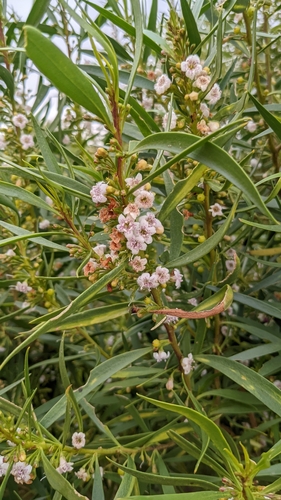
Myoporum montanum R.Br., commonly called waterbush, is a glabrous shrub or small tree that grows up to 8 metres (30 ft) tall. This species is hard to distinguish from Myoporum acuminatum, and their distribution ranges overlap; George Bentham originally classified M. montanum as a variety of Myoporum acuminatum. M. montanum can be told apart from M. acuminatum by its smaller, narrower leaves, sepals that lack the translucent margins found on M. acuminatum sepals, and pink or light purple fruit compared to the dark purple or blue fruit of M. acuminatum. Waterbush leaves vary in shape, but are most often thin, linear to elliptic, gradually tapering to a tip, with the mid-vein visible only on the lower surface. Leaves are typically 45–100 millimetres (2–4 in) long and 5–21 millimetres (0.2–0.8 in) wide, glabrous, the same colour on both sides, and have smooth edges. Sweet-scented flowers grow in clusters of 1 to 5 from leaf axils, on stalks 4.5–11 millimetres (0.2–0.4 in) long. There are 5 egg-shaped to triangular sepals with slightly papery margins that are only translucent near their base. Flowers usually have five (rarely six) white petals, which are occasionally light pink or purple, and may bear rows of purple spots. Petals form a tube 2–5 millimetres (0.08–0.2 in) long, with lobes around the same length as the tube. The total diameter of an open flower is around 6–8 millimetres (0.2–0.3 in). Flowering occurs mostly in winter and summer, and is followed by the development of smooth or slightly rough drupe fruits. Drupes are ovoid in shape, 5–8 millimetres (0.2–0.3 in) in diameter, and coloured light purple, red purple or brown. A remnant of the flower style protrudes from the tip of the fruit. Robert Chinnock recognised three distinct forms of this species: the Type form from the Blue Mountains, which has narrow, linear leaves and small flowers that are only faintly spotted, if at all; the Desert form from arid areas of Australia, which is a large shrub or small tree with thick, elliptic leaves and prominently purplish red-spotted flowers; and the Tropical form from northern Australia, New Guinea and Timor, which has thin leaves and very small, unspotted white flowers. Waterbush occurs in all mainland states of Australia, with scattered populations in New Guinea and Irian Jaya, and a single recorded occurrence from Timor. It is very common in eastern Queensland, New South Wales and eastern South Australia. It grows in a wide range of ecosystem types, from mangrove swamps to rainforest to the Simpson Desert, across a broad range of soil types. Outside of its common Australian range, occurrences across the rest of the continent, New Guinea and Timor are mostly restricted to coastal regions, watercourses and other locations with more reliable water access. The fruit of Myoporum montanum is a food source for many bird species, including emus, and was historically eaten by Aboriginal people. The food value of the fruits is rated as low, and some species in this genus are known to contain liver toxins. The flavour is described as "bitterly aromatic and salty sweet". In horticulture, waterbush is a hardy cultivated plant that tolerates drought. It makes a useful screen plant for drier sites, and is easily propagated from cuttings.