About Eremophila scoparia (R.Br.) F.Muell.
Growth Habit
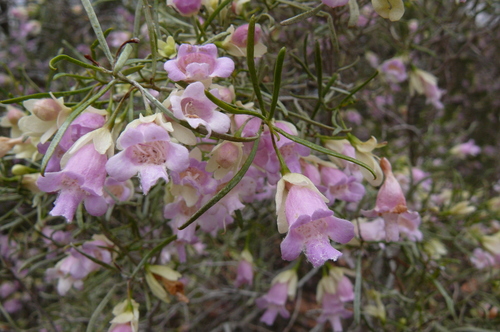
Eremophila scoparia is a broom-like shrub that grows to between 1 and 3 meters (3 and 10 feet) in height.
Foliage Surface Characteristics
Its branches and leaves are covered in yellowish or silvery-grey scaly hairs, though individual scales are indistinct, so the plant’s surface may appear glabrous.
Leaf Arrangement and Shape
Leaves are mostly arranged in opposite pairs, shaped linear to almost cylindrical, and S-shaped when viewed from the side.
Leaf Size and Tip Feature
Most leaves are 4–25 mm (0.2–1 in) long, 0.8–2.5 mm (0.03–0.1 in) wide, and have a hooked tip.
Flower Stalk Characteristics
Flowers grow singly or in pairs in leaf axils, on a stalk 2–6 mm (0.08–0.2 in) long that bears the same scaly covering as the leaves.
Sepal Traits
There are 5 linear sepals, 1.5–3.5 mm (0.06–0.1 in) long, covered in the same scaly covering on the outside, but hairy on the inner surface.
Petal Tube Structure
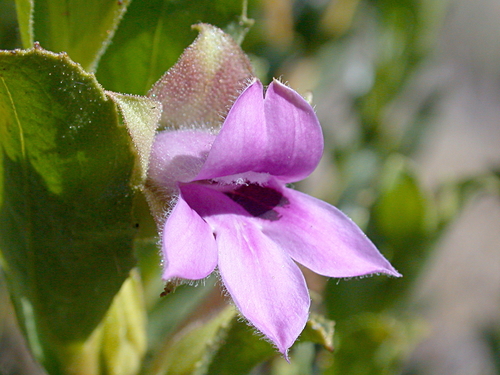
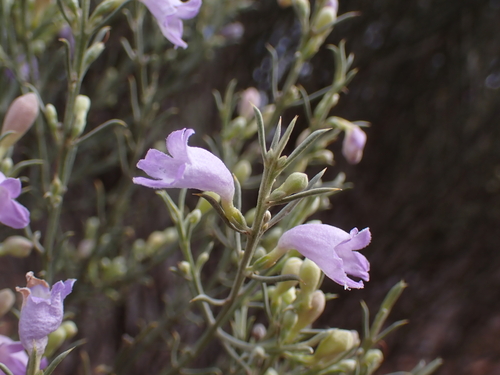
Petals are 8–25 mm (0.31–0.98 in) long, joined at the lower end to form a tube.
Petal Coloration
The outside of the petal tube is blue, lilac, pink or white, while the inside is white with yellow spots.
Outer Petal Surface Features
The outer surface of the petal tube and its lobes are covered in scaly hairs.
Inner Petal Surface Features
The inside of the lobes is glabrous except for branched hairs near their edges, and the inside of the tube is densely filled with long, soft hairs.
Stamen Position
The 4 stamens are fully enclosed within the petal tube.
Flowering Period
Flowering can occur throughout the year, but peaks between August and October.
Fruit Shape and Texture
The fruits are dry and woody, ranging in shape from oval to cone-shaped to almost spherical, and are slightly fleshy.
Fruit Size and Covering
They are 3.3–5 mm (0.1–0.2 in) long and have a scaly covering.
Common Name and Broad Distribution
This species, commonly called silver emu bush, is distributed across Western Australia, South Australia, Victoria and New South Wales.
Western Australia Distribution
In Western Australia, it occurs between Merredin and Echuca in the Avon Wheatbelt, Coolgardie, Great Victoria Desert, Hampton, Mallee, Murchison and Nullarbor biogeographic regions.
South Australia Distribution
In South Australia, it grows in the North-Western, Lake Eyre, Nullarbor, Gairdner-Torrens, Flinders Ranges, Eastern, Eyre Peninsula, Northern Lofty and Murray botanical regions.
Victoria and New South Wales Distribution
In Victoria it is found only in the north-western corner, and in New South Wales it occurs south from Wilcannia.
Habitat and Plant Communities
It can grow in a wide range of soils, is common in mulga, mallee and chenopod plant communities, and is often the dominant shrub in these areas.
Horticultural Value
In horticulture, this eremophila is valued for its broom-like shape and pale to deep lilac flowers.
Propagation Methods
It can be propagated from cuttings or by grafting onto Myoporum rootstock.
Cultivation Soil and Light Requirements
It grows best in well-drained soil in either full sun or part shade.
Tolerance and Pruning
It tolerates drought, even the harshest frost, and can be pruned to maintain its shape or rejuvenate older specimens.